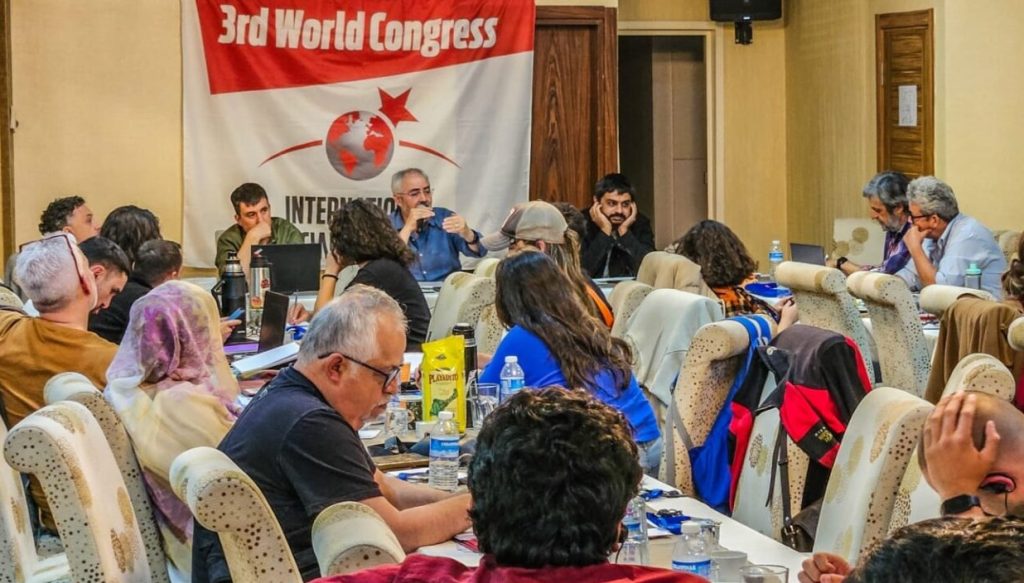
The International Socialist League (ISL) has announced the formation of an alliance with the League for the Fifth International (LFI) and the International Trotskyist Opposition (ITO). This decision follows the ISL’s third world congress held recently in Istanbul, where representatives from organizations across 38 countries participated. The alliance’s formation raises questions regarding its sustainability and the ideological foundations upon which it rests.
The backdrop of this merger is the ongoing conflict in Ukraine, which has become a significant dividing line within the international socialist movement. Various factions have adopted divergent stances on the war, with the ISL aligning itself with what it terms the “Ukrainian resistance.” This position has faced criticism for lacking a clear definition of what constitutes this resistance, particularly in the context of the pro-imperialist government led by President Volodymyr Zelenskyy.
The ISL, along with the ITO and LFI, issued a joint statement marking the second anniversary of the Ukraine conflict. This document, however, has been criticized for its contradictions and vague formulations. While it acknowledges that the Ukrainian working class has not developed an independent political stance, it simultaneously endorses the government’s military objectives, including the recapture of Crimea and the Donbas region. Such support raises concerns about the implications for self-determination in these contested areas.
The statement notably sidesteps a critical inquiry for socialists in Western nations: how to respond to their governments’ military support for Ukraine. Although the text criticizes NATO for insufficient aid, it leaves readers to interpret what this means for socialist action. As tensions escalate, clarity on these issues is essential for the left.
Historical Context of the ISL and Its Allies
The ISL is primarily composed of various national Trotskyist organizations, including the Socialist Workers Movement (MST) from Argentina, which has played a pivotal role in the league’s formation. The MST emerged in the early 1990s from the Movement for Socialism (MAS), and while it has undergone significant ideological shifts, it has consistently sought to build coalitions with other leftist groups.
The LFI, which traces its origins to a faction expelled from the International Socialists in the UK in 1975, has had a tumultuous history. Historically, it has claimed a principled anti-imperialist stance, particularly during the Falklands War and the Irish conflict. However, its recent alignment with the ISL indicates a departure from this trajectory, raising questions about its political integrity.
The ITO, led by the Workers Communist Party (PCL) in Italy, completes this coalition. Historically, the PCL has navigated various political landscapes, including alliances with reformist parties, but has now chosen to align itself with the ISL, further complicating the ideological landscape.
This alliance of Trotskyist groups raises fundamental questions about their unity and the principles guiding their collaboration. Critics argue that the merger is more of a convenience than a coherent ideological alignment. The past experiences of these groups suggest that any semblance of unity may be precarious, particularly when faced with external pressures such as the Ukraine conflict.
Challenges Ahead for the New Coalition
As the international socialist left grapples with the implications of the Ukraine war, the fragile unity among these factions faces significant challenges. The ISL’s commitment to support for the Ukrainian government, despite its pro-NATO implications, may alienate segments of the socialist movement that prioritize anti-imperialist principles.
Internal dissent is likely to emerge as the coalition attempts to navigate the complexities of their differing positions on the war. The potential for ideological fragmentation looms large, as the lack of a unified stance on critical issues may undermine the coalition’s effectiveness.
Moreover, the historical context of these organizations suggests a pattern of fragmentation following unsteady alliances. The ISL’s ability to maintain cohesion amidst these pressures will be a crucial test for the new alliance. As socialist groups continue to engage with the realities of contemporary global conflicts, the evolution of this coalition will be closely monitored.
The formation of this alliance represents a notable moment in the ongoing saga of the international socialist left. Whether it leads to a robust and effective movement or becomes yet another example of failed unity remains to be seen. The coming months will be pivotal in determining the future of this coalition and its impact on the broader socialist landscape.