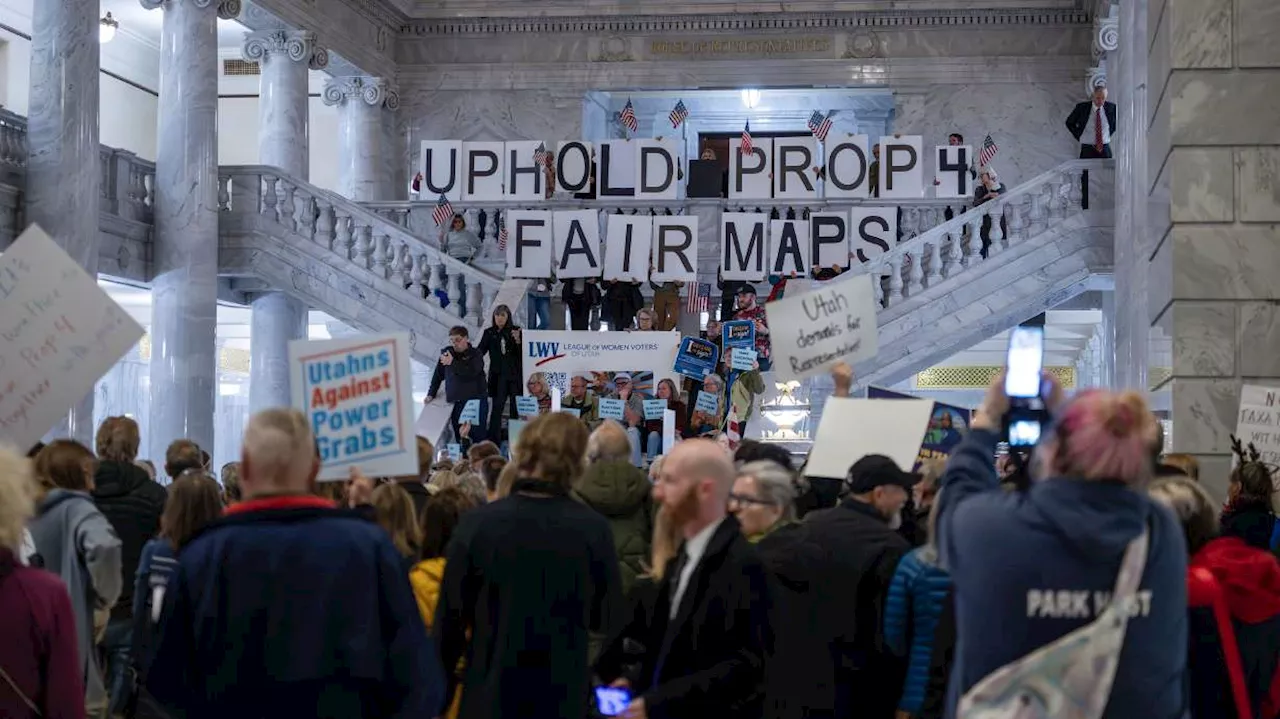
The contentious issue of who should draw congressional maps in Utah remains unresolved, as state lawmakers, judges, and citizens continue to debate the process. At the heart of the discussion is whether the Legislature holds the exclusive constitutional authority to establish voting district boundaries. This debate intensified after the Utah Supreme Court ruled that lawmakers exceeded their authority when they altered **Proposition 4**, a 2018 ballot initiative that aimed to create nonpartisan guidelines for map-drawing and established an independent commission to recommend new congressional districts.
The latest development came when **3rd District Judge Dianna Gibson** rejected a map created by the Legislature. Instead, she favored a proposal submitted by plaintiffs alleging that Republican lawmakers engaged in gerrymandering. The alternate map would delineate a district in northern Salt Lake County, which is expected to lean Democratic. Currently, all four congressional seats in Utah are occupied by Republicans.
In response to Judge Gibson’s ruling, the Legislature convened a special session on **March 12, 2024**, to adjust the filing deadline for congressional candidates to March 2025. This extension allows time for the pending appeal of Gibson’s decision to proceed through the court system.
Utah voters have expressed a desire for a more inclusive approach to the redistricting process. **House Speaker Mike Schultz**, a Republican from Hooper, shared a poll on social media indicating that a significant majority of residents prefer their elected officials to lead the redistricting process rather than judges. The poll, conducted by the conservative **Sutherland Institute**, revealed that only **8%** of respondents supported the idea of judges selecting maps.
While Schultz highlighted these findings, the polling data presents a more complex picture. Respondents were given seven options for who should decide congressional district boundaries, including judicial appointees, local volunteers, and elected officials. Notably, the last three categories combined accounted for **71%** of responses, while none of the other options garnered more than **10%** support.
Leah Murray, director of the **Walker Institute of Politics** at **Weber State University**, emphasized that the poll’s format allowed for honest responses without triggering partisan biases. Although the specific question did not address the Legislature or **Proposition 4** directly, it provided insight into public sentiment regarding the redistricting process.
As the debate unfolds, Utah’s political landscape will continue to evolve, with the outcome of ongoing legal challenges likely to play a crucial role in determining how future congressional maps will be drawn. Lawmakers and citizens alike are closely watching the developments, as the implications of redistricting extend far beyond the drawing of lines on a map, affecting representation and political power throughout the state.