Educators in the West Contra Costa Unified School District are preparing for a potential strike as negotiations with district officials have reached an impasse. Over the past eight months, members of the United Teachers of Richmond have voiced their demands for improved pay and working conditions. The union is advocating for a 10% salary increase over two years, full employer-paid health care, and enhancements to class sizes and special education services. In response, the district has proposed a 2% raise and 85% employer-paid health care.
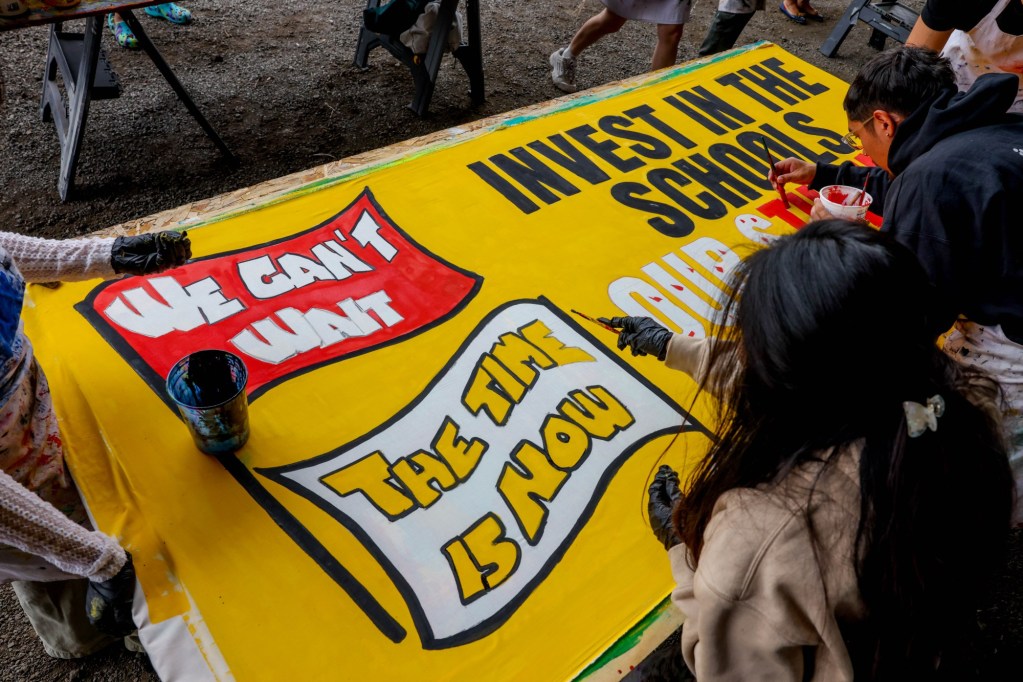
During a recent gathering, educators painted banners and printed posters, rallying around their cause. “The more aligned we are, the more the community is here with us, the faster our strike will be, the sooner it will end,” stated Sandrine Demathieu, a teacher at Nystrom Elementary School. Her colleague, Masa Peterson, emphasized the importance of their roles in shaping students’ futures, reflecting on the sacrifices they have made in a profession often overshadowed by more financially rewarding careers.
A significant portion of the union’s members, 98%, voted to authorize a strike if negotiations do not yield satisfactory results, following the expiration of their contract on June 30. Peterson articulated the long-term impact of quality education, stating, “Me teaching a student how to read impacts the rest of their life.”
The district’s fiscal position has raised concerns. In a statement on November 20, Trustee Demetrio Gonzalez-Hoy acknowledged the educators’ goals but highlighted the district’s financial difficulties, attributing them to “inadequate and inequitable state funding,” as well as cuts made during the Trump administration. He pointed to the district’s spending on outside contracts, which has surged from $59 million five years ago to $117 million today, as a contributing factor to its challenges.
“While I support our teachers, we must work together to find solutions,” Gonzalez-Hoy emphasized, urging community members to engage in discussions and hold district leadership accountable for fiscal decisions.
According to a report from Private Equity Stakeholder Action, the spending on external contracts has not translated into better services for students. The report noted a decrease in one-on-one hours for special needs students despite increased expenditures. Marcus Walton, spokesperson for the Contra Costa County Office of Education, expressed concern over the district’s ability to maintain fiscal stability, especially in light of staffing challenges that hinder the provision of essential services.
At a Board of Education meeting on November 19, Superintendent Cheryl Cotton acknowledged the need to address contract spending. “We must support our school sites and educators,” she stated, recognizing the complexities involved in finding solutions. Cotton’s remarks followed a state panel hearing involving union representatives, which is expected to produce a nonbinding report with recommendations for both parties.
As negotiations continue, the district remains committed to finding a resolution that avoids a strike. Spokesperson Raechelle Forrest noted, “We are committed to continuing these discussions into next week and through the break — whatever it takes — to try to reach a fair resolution.”
A tentative agreement has been reached between the district and the Teamsters Local Union 856, which represents approximately 1,500 district employees. If ratified, this agreement would provide a 3% raise, with 2% retroactive to July 1, 2025, and the remaining 1% starting January 1, 2026. Members will be voting on these terms on December 1 and 2.
The outlook remains uncertain for educators represented by the United Teachers of Richmond, with President Francisco Ortiz indicating that a strike could commence as early as December 3. Families may face disruptions as students could be relocated to different campuses or placed in large groups during potential strike action. Some parents at a union-led town hall have expressed intentions to keep their children home to support the educators.
In response to the anticipated impact on students, the union is working on partnerships with local community organizations to secure support services during a strike and has compiled a list of food banks for families who rely on school meals.
The situation in West Contra Costa reflects broader challenges facing educational institutions, as educators seek to secure both fair compensation and quality services for their students amid complex fiscal realities.