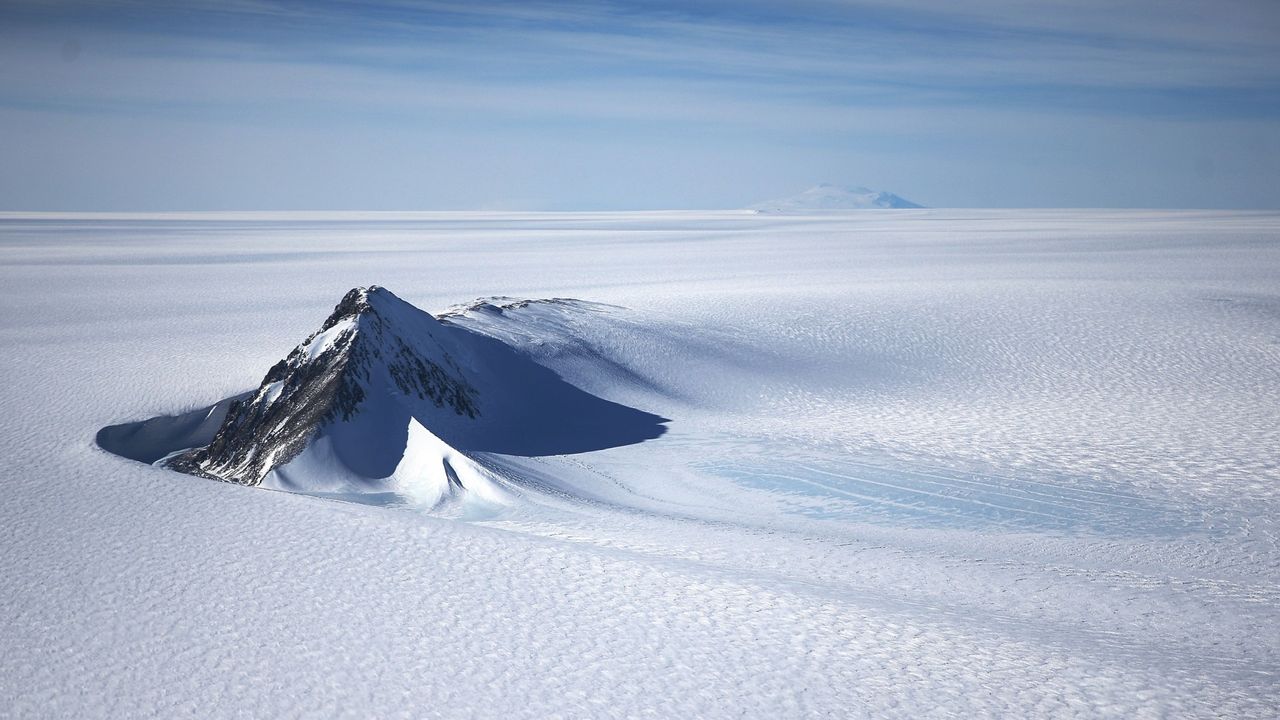
A significant discovery beneath Antarctica, known as the Antarctic Geoid Low, is providing scientists with unprecedented insights into the deep interior of the Earth. This gravity anomaly, characterized by a gentle dip in the planet’s gravitational field, reflects the distribution of mass deep within the Earth and reveals processes that have been active for approximately 70 million years. A team from the University of Florida recently published findings that illustrate how this feature is not merely a fleeting phenomenon, but a long-lasting imprint of geological activity occurring thousands of miles beneath the surface.
The term “gravity hole” may evoke alarming imagery, but its implications for human life are negligible. For instance, an individual weighing 198 pounds (or 90 kilograms) would experience a weight difference of only about 5 to 6 grams in this area. However, the scientific significance of the Antarctic Geoid Low is profound, as it reveals the internal arrangements of materials within the Earth and how these distributions have evolved over time.
Understanding the Gravity Anomaly
The Antarctic Geoid Low is formed due to variations in the Earth’s interior. Hot, buoyant mantle rocks rise while colder, denser slabs of ancient seafloor sink. These slow movements redistribute mass within the Earth, subtly altering its gravitational field. Regions where gravity is slightly weaker, such as Antarctica, lead to the ocean’s gravity-defined “level surface” being positioned closer to the planet’s center. The Antarctic Geoid Low stands as one of the deepest long-wavelength valleys on Earth.
The researchers employed seismic images of the current mantle, generated from earthquake waves, and used advanced computational models to simulate the flow of rocks over millions of years. This process allows scientists to reconstruct the mantle’s past, even though direct observation is limited to its present state. In their analysis, the research team noted that the gravity low demonstrates a remarkable persistence over the last 70 million years, evolving in tandem with major changes in the flow of rocks beneath Antarctica.
According to study co-author Alessandro Forte, Ph.D., a professor of geophysics at the University of Florida, the consistency of the gravity low over such an extensive geological timescale is striking. “The gravity low is not a random, short-lived feature,” Forte stated. The findings suggest that around 34 million years ago, when Antarctica transitioned into a permanently ice-covered continent, there may have been a correlation between this transition and the intensification of the gravity anomaly.
Implications for Climate and Geophysical Research
The study indicates that long-wavelength changes in Earth’s gravity field could influence regional sea level measurements, potentially impacting ice-sheet dynamics. Currently, the gravity-defined sea surface in the Antarctic geoid low is situated about 394 feet (or 120 meters) below the global average. Over geological timescales, shifts in this gravitational landscape may alter how sea levels are measured relative to land.
While the research does not establish a direct link between gravity changes and ice sheet development, it highlights an internal Earth process that occurred at a pivotal moment. Forte noted that the study illustrates how deep Earth dynamics can reshape the gravity field, leading to further research on potential climate influences. “Whether that translated into a measurable influence on climate or ice is a separate question that requires additional coupled modeling and evidence,” Forte explained.
The findings, published in the journal Scientific Reports on December 19, 2025, represent a culmination of nearly a decade of collaborative research, spearheaded by first author Petar Glišović and involving seismologists from the University of Texas at Austin. This extensive study underscores the unique ability of Earth scientists to cross-reference gravity measurements with seismic data, allowing for a comprehensive understanding of both current and historical geological processes.
Research of this nature extends beyond Earth. The principles of long-wavelength gravity anomalies apply to other planetary bodies, providing clues about their internal dynamics. Observations on planets like Mars and Venus reveal gravity variations that suggest ancient geological activity. Thus, while Earth offers a unique perspective through its intersection of gravity measurements and geological records, the implications of such studies resonate throughout the field of planetary science.
The Antarctic Geoid Low serves not only as a key feature in understanding Earth’s geological history but also as an essential component in the ongoing exploration of our planet’s complex interior dynamics. As researchers continue to investigate these anomalies, they will undoubtedly uncover further insights that challenge and refine our understanding of the Earth and its processes.