
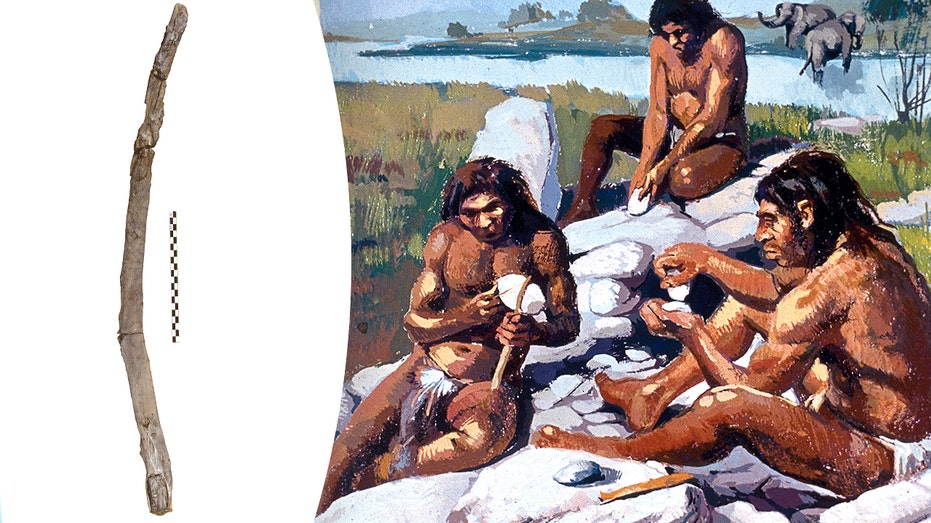
Archaeologists have made a remarkable discovery in Greece’s Megalopolis basin, unearthing what may be the oldest handheld wooden tools ever found. Dating back approximately 430,000 years, these ancient artifacts were discovered in a region that once comprised wetlands and lakes, providing a unique environment for preservation. This finding, detailed in a study published in the Proceedings of the National Academy of Sciences in late January, challenges existing timelines regarding early human tool use.
The tools consist of a stick measuring around 2.5 feet in length, likely utilized for digging in muddy terrain, and a smaller handheld piece of wood, which researchers believe may have been used to shape stone tools. The significance of these discoveries lies in their potential to provide insights into the tool-making capabilities of early human ancestors, including Neanderthals.
According to Annemieke Milks, an archaeologist at the University of Reading and lead author of the study, the well-preserved state of these wooden tools underscores the importance of systematic exploration of early wood remains. The tools were protected by sediment in the bog, allowing them to survive in a manner that is rare for wooden artifacts, which typically deteriorate over time.
Despite the excitement surrounding the discovery, there remains uncertainty about the tools’ specific functions. Jarod Hutson, an archaeologist affiliated with the Smithsonian National Museum of Natural History, expressed caution regarding the interpretation of the artifacts. He remarked to the Associated Press that “it’s difficult to get excited about these because they don’t strike you immediately as wooden tools” and emphasized that the exact purposes of the tools are still unclear.
The findings in Greece contribute to a growing body of evidence that surprises the archaeological community. Recent discoveries have included cave art estimated to be around 68,000 years old on a tropical island in Indonesia and the identification of the oldest-known poisoned arrowheads, which date back approximately 60,000 years. Each of these discoveries continues to reshape our understanding of early human life and activities.
As researchers delve deeper into these ancient tools, the implications for our knowledge of prehistoric societies become increasingly significant. The evolving narrative of human evolution and technological development is enriched by such findings, highlighting the complexities of our ancestors’ lives long before the existence of modern humans. The ongoing research may eventually clarify the roles these tools played in the daily lives of ancient peoples, offering a glimpse into a world that has long been shrouded in mystery.


