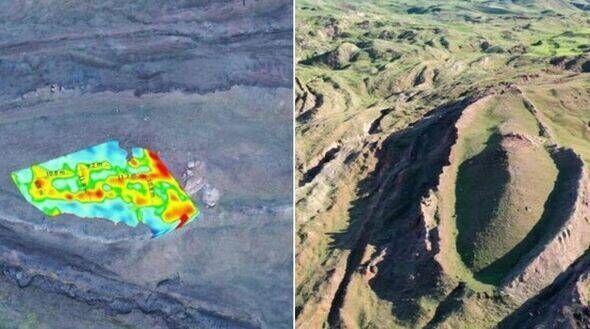
Archaeologists in Turkey have utilized advanced radar technology to uncover potential remnants of Noah’s Ark, a discovery that could reshape our understanding of this biblical narrative. Using Ground Penetrating Radar (GPR), researchers from the team Noah’s Ark Scans have identified what they believe to be a “chemical imprint” and “pieces of wood” within the Durupinar Formation, located near Mount Ararat. This site is historically significant, as it is associated with the resting place of Noah’s Ark following the catastrophic flood described in ancient texts over 4,300 years ago.
The American research team, led by independent researcher Andrew Jones, has observed angular structures and a hollow space beneath the mountain. The GPR analysis revealed a corridor approximately 4 meters wide, potentially indicating a design consistent with the biblical description of the ark featuring three decks. According to Genesis 6:16, “Make a roof for the ark, and finish it to a cubit above, and set the door of the ark in its side. Make it with lower, second, and third decks.”
In an interview with The Christian Broadcasting Network (CBN), Jones expressed his cautious optimism: “We’re not expecting something that’s fully preserved. What’s left is the chemical imprint, pieces of wood, and the shape of a hall.” The formation itself, discovered in March 1948 after heavy rains and seismic activity washed away the surrounding mud, has sparked debate among scholars. While some argue it is merely a natural rock structure, others, including Jones and his team, believe it may be a significant archaeological find.
Details of the Discovery
The Durupinar Formation, situated just 29 kilometers south of Mount Ararat, has only gained attention in the modern era. This area has long been linked to the story of Noah, with biblical texts stating that the ark settled on the “mountains of Ararat” after a 150-day deluge. The researchers’ scans have revealed three distinct layers beneath the surface, aligning with the biblical account of the ark having multiple floors.
Jones highlighted the discovery of angular structures that extend approximately 6 meters below the surface, suggesting the presence of compartments that would be expected in a man-made vessel. “This is not what you’d expect to see if the site were simply a solid block of rock or the result of random mudflow debris,” Jones remarked. “But it is exactly what you’d expect to find if this were a man-made boat, consistent with the biblical specifications of Noah’s Ark.”
In addition to the radar findings, soil analysis conducted by the team uncovered intriguing differences in vegetation. Jones noted that the grass within the ark-shaped formation displayed a distinct coloration compared to the surrounding area, indicating a possible man-made origin. Fellow researcher William Crabtree observed that a passageway appears to extend from the formation’s tip toward its center, wide enough for a person to walk through.
Next Steps for Research
The team plans to expand their soil testing beyond the initial 22 samples they have collected, aiming to conduct additional GPR surveys and core drilling probes throughout the site. “We want to compare what’s inside the formation to what’s outside,” Jones explained. “That could give us a much clearer picture of whether this is truly something man-made.”
Soil science plays a critical role in their investigation, as Crabtree noted that the organic matter found within the formation is double that of the adjacent soil. “The potassium concentrations inside are also roughly 40 percent elevated,” he added. Such findings could suggest that if this formation is indeed the remains of a wooden vessel, the decaying wood would contribute to these elevated levels.
As the research progresses, the implications of these findings could not only contribute to discussions surrounding the historical validity of biblical accounts but may also captivate the broader public imagination about humanity’s ancient past. The ongoing investigations at the Durupinar Formation continue to draw interest from both the scientific community and those intrigued by the possibility of uncovering one of history’s most enduring stories.