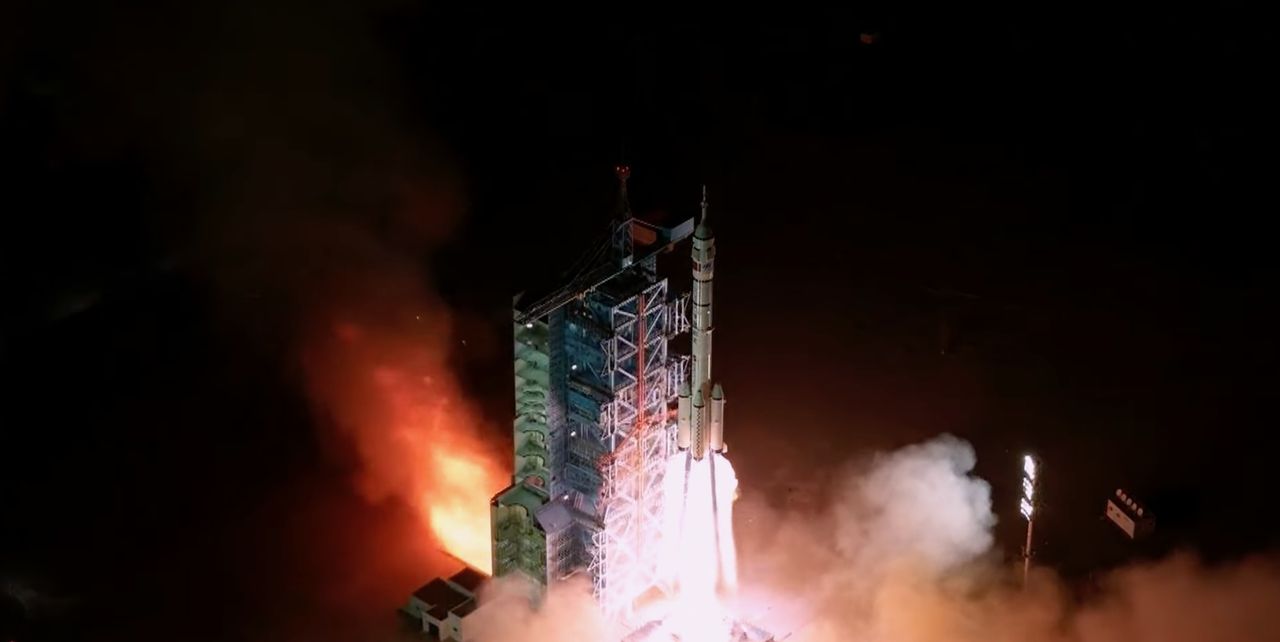
Three astronauts aboard China’s Tiangong space station are currently without a safe return option following the departure of their intended return vehicle. The astronauts, members of the Shenzhou 21 mission, arrived at Tiangong on October 31, 2023, for a planned six-month stay. However, their ride home was utilized on November 13, 2023, when the Shenzhou 20 spacecraft transported a different crew back to Earth after being deemed unsafe due to damage from a space debris strike.
As the situation stands, the Shenzhou 21 crew, which includes commander Zhang Lu and astronauts Zhang Hongzhang and Wu Fei, is living aboard the Tiangong space station without a reliable evacuation option. The Shenzhou 20 is currently the only crew-capable vehicle docked at the station, but reports indicate it has developed cracks in one of its windows, rendering it unfit for crew return.
Emergency Plans and Backup Options
Fortunately, the astronauts’ predicament may be temporary. The China Manned Space Agency maintains a policy of keeping a Long March 2F rocket and a Shenzhou spacecraft in a state of near readiness during crewed missions. According to Andrew Jones from SpaceNews, if an emergency arises, a backup spacecraft can be launched to Tiangong within approximately 8.5 days. This time frame likely started counting down immediately after the Shenzhou 20’s departure.
While the specific timeline for the next launch has not been disclosed, Chinese space officials have indicated that a Shenzhou 22 spacecraft will be launched to Tiangong, presumably without a crew onboard, to ensure the safety of the astronauts currently in orbit. The officials did not provide further details, only stating that the launch would take place “at an appropriate time in the future.”
Context and Historical Comparisons
The current situation echoes a past incident involving NASA astronauts Butch Wilmore and Suni Williams, who experienced complications during their mission to the International Space Station (ISS) in June 2024. Their spacecraft, Boeing’s Starliner, faced technical difficulties, leading NASA to decide on an uncrewed return. Wilmore and Williams continued their mission for nearly nine months before returning home safely via a SpaceX Crew Dragon capsule.
While both missions share the theme of unexpected challenges, the Shenzhou 21 astronauts face a more precarious situation. During the ISS mission, there were always alternative lifeboats available for Wilmore and Williams. In contrast, the only viable option currently docked at Tiangong is the compromised Shenzhou 20.
The Shenzhou 21 mission marks the tenth crewed operation to Tiangong, a space station that is approximately 20% the mass of the ISS. The crew members, including Zhang Lu, who previously flew on Shenzhou 15 in 2022, are tasked with conducting various experiments during their stay. The mission also features two newcomers to spaceflight, Zhang Hongzhang and Wu Fei, the latter of whom is noted as the youngest member of China’s astronaut corps.
As the world watches, the actions taken by the China Manned Space Agency in the coming days will be crucial in ensuring the safety of the Shenzhou 21 crew. The agency’s commitment to rapid response in emergencies reflects the high stakes involved in human space exploration.