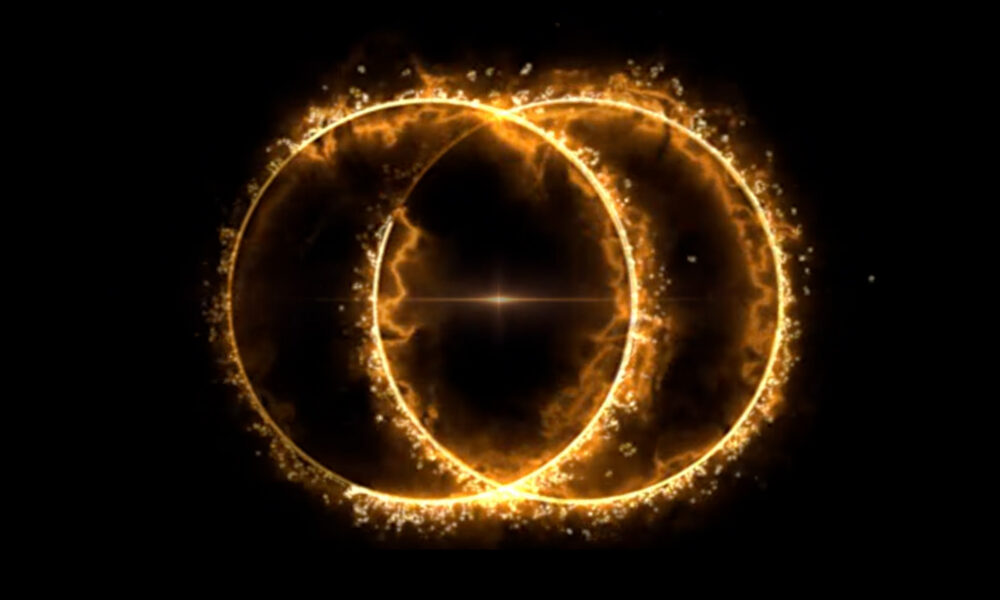
Astronomers have unveiled a stunning double-ring structure, located approximately 7.5 billion light years from Earth, that challenges existing understandings of cosmic phenomena. This enormous formation, known as an Odd Radio Circle (ORC), is hundreds of thousands of light years across and emits a striking glow in radio wavelengths. The findings were detailed in a study published in the Monthly Notices of the Royal Astronomical Society.
The recent discovery is particularly significant as it marks only the second instance of an ORC comprising two rings since these intriguing structures were first identified six years ago. ORCs are believed to consist of magnetized plasma, typically observable only through radio light, and can be significantly larger than the Milky Way. Despite their impressive scale, the origins of these cosmic rings remain largely elusive.
Ananda Hota, the study’s lead author and an assistant professor at the University of Mumbai, expressed excitement about the potential implications of these formations. “ORCs are among the most bizarre and beautiful cosmic structures we’ve ever seen — and they may hold vital clues about how galaxies and black holes co-evolve, hand-in-hand,” Hota stated.
Insights from the Discovery
The newly discovered ORC, named after its galaxy RAD J131346.9+500320, resides within a galaxy cluster, a dense region containing multiple galaxies bound by gravity. This proximity suggests that interactions between surrounding plasma and the energetic jets produced by supermassive black holes may play a crucial role in the formation of such structures.
In this scenario, the energetic jets from a black hole at the center of a galaxy could create magnetized clouds of plasma, which might then be energized by a significant explosion near the galactic core. This process could cause the clouds to glow anew, forming the characteristic radio rings.
Pratik Dabhade, a coauthor of the study and assistant professor in the astrophysics division at the National Centre For Nuclear Research in Warsaw, Poland, emphasized the importance of this research. “These discoveries show that ORCs and radio rings are not isolated curiosities — they are part of a broader family of exotic plasma structures shaped by black hole jets, winds, and their environments,” he explained.
Unveiling a Hidden Cosmic Landscape
The study of ORCs is part of a larger exploration into what astronomers are calling a “low-surface brightness universe.” This term refers to a range of cosmic objects that have remained largely hidden from traditional observational methods but are now being revealed by advanced radio telescopes.
In addition to ORCs, researchers have uncovered other fascinating phenomena in this realm. These include a perfectly round supernova remnant and Wolf-Rayet stars, which burn intensely for only a brief period in cosmic terms.
As astronomers continue to probe these mysteries, the discoveries promise to enhance our understanding of the universe and the complex interactions that govern its evolution. The findings surrounding RAD J131346.9+500320 may ultimately provide crucial insights into the dynamics of galaxies and the supermassive black holes at their centers, shedding light on the intricate tapestry of cosmic evolution.