
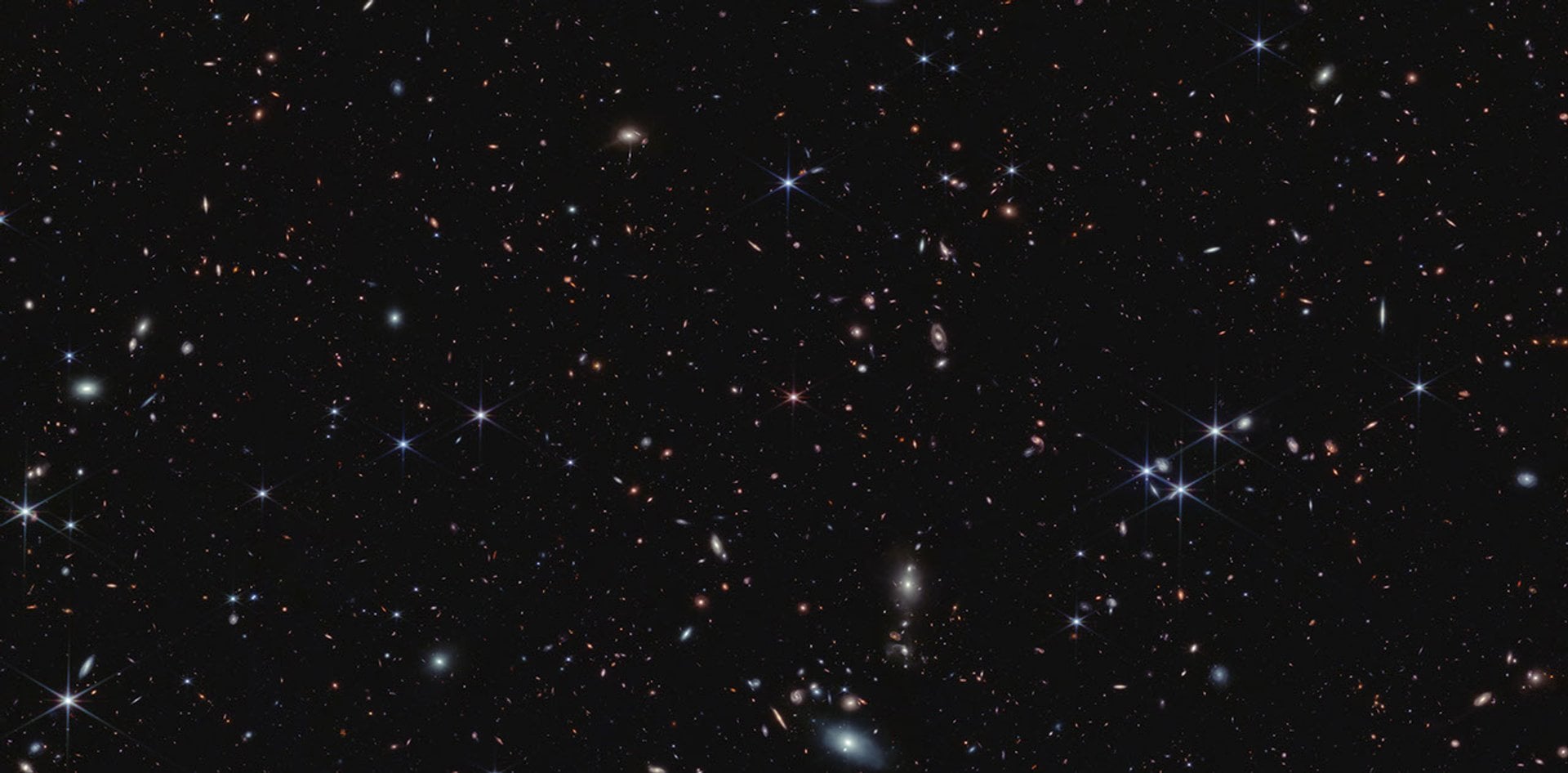
The discovery of potential “monster stars” in the early Universe marks a significant advancement in astrophysics. An international team of astronomers has uncovered compelling evidence suggesting that massive stars, ranging from 1,000 to 10,000 solar masses, existed shortly after the Big Bang. This finding could reshape our understanding of how supermassive black holes (SMBHs) formed less than a billion years after the Universe began.
Utilizing the advanced capabilities of the James Webb Space Telescope (JWST), the researchers focused on a galaxy known as GS 3073. This galaxy was previously identified in 2022 by a team led by Muhammad A. Latif and Daniel Whalen from the Institute for Astronomy (IfA) at the University of Edinburgh. Their analysis revealed an extraordinarily high nitrogen-to-oxygen ratio of 0.46. This ratio cannot be explained by any known types of stars or stellar explosions, prompting the researchers to propose that the first stars, termed Population III stars, formed from turbulent flows of cold gas just a few hundred million years after the Big Bang.
Insights from the Research Team
The research team, which includes Devesh Nandal, a Postdoctoral Fellow from the University of Virginia and the Institute for Theory and Computation (ITC) at the Harvard & Smithsonian Center for Astrophysics, modeled the processes of these massive stars. They aimed to understand how stars of this size would evolve and the chemicals they would produce. Their findings suggest that these monster stars could directly collapse into massive black holes, serving as the seeds for the SMBHs observed today.
Nandal commented on the significance of their findings, noting that the chemical signatures observed in GS 3073 align with the predictions of their models. They established that helium fusion in the cores of these stars produces carbon, which subsequently combines with hydrogen to form nitrogen. This nitrogen is then distributed throughout the star and eventually released into the surrounding space.
Implications for Cosmology
The implications of this research extend beyond just the understanding of individual stars. The existence of these monster stars could help explain the presence of multiple quasars detected by the JWST, which existed less than one billion years after the Big Bang. Quasars are fueled by SMBHs that accelerate gas and dust to near light speed, resulting in intense energy emissions that can outshine entire galaxies.
The team suggests that their model specifically accounts for the unique nitrogen signature found in GS 3073. Notably, this signature does not occur in stars outside the 1,000 to 10,000 solar mass range. If confirmed, this discovery would resolve two significant questions arising from previous observations by the JWST, offering fresh insights into the “Cosmic Dark Ages”—the period between 380,000 and 1 billion years after the Universe’s inception.
The researchers anticipate that future surveys will uncover more galaxies exhibiting similar nitrogen excesses, facilitating further exploration into the existence of these ancient monster stars. Whalen expressed optimism about the potential for new discoveries, paving the way for a deeper understanding of the Universe’s early history.
This groundbreaking research not only enhances our knowledge of stellar evolution but also challenges existing cosmological models. As astronomers continue to explore the profound mysteries of the Universe, findings like these pave the way for a more comprehensive understanding of the cosmos and its formation.


