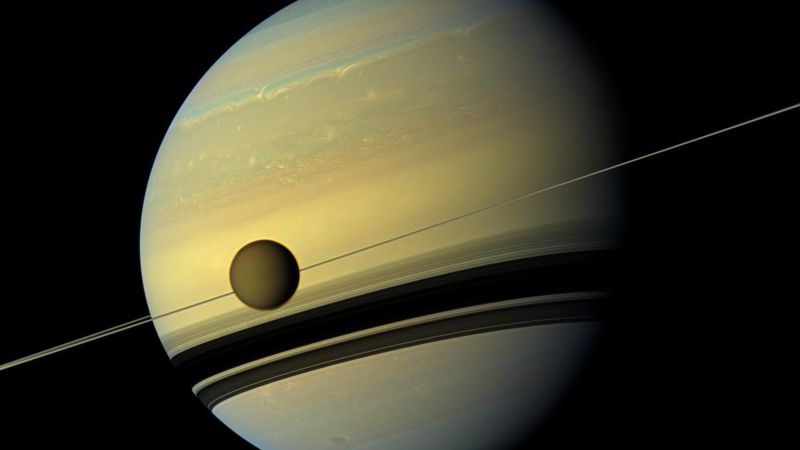
Saturn’s largest moon, Titan, has long intrigued astronomers, and new research suggests its origin may be linked to a cosmic collision that also explains the formation of Saturn’s iconic rings. A study published on the open-access repository ArXiv and accepted for publication in The Planetary Science Journal proposes that Titan was formed from a collision with another moon approximately 500 million years ago. This event may have not only shaped Titan but also contributed to the creation of Saturn’s rings.
Titan, shrouded in a dense haze, is approximately half the size of Earth and larger than Mercury. Its significant mass influences Saturn’s tilt and wobble, with Titan currently drifting away from Saturn at a rate of 11 centimeters (4.3 inches) per year. This unique movement, along with many other characteristics of Saturn’s 274 moons, is part of an ongoing investigation by scientists. The data for this research largely stemmed from the Cassini spacecraft, which studied Saturn from 2004 to 2017.
The lead author of the study, Matija Ćuk, a research scientist at the SETI Institute, explained that this research integrates existing theories about Titan’s formation, Cassini’s data, and sophisticated computer simulations. Ćuk posits that a lost moon, dubbed “proto-Hyperion,” collided with Titan, merging to become part of it. This collision could also have contributed to the creation of Hyperion, Saturn’s largest non-spherical moon, which is significantly smaller than Titan, at about 5% of its diameter.
The study suggests that the merger of Titan and the lost moon could explain Saturn’s tilt. Saturn rotates at an angle of 26.7 degrees relative to its orbital plane, a phenomenon previously thought to be influenced by gravitational interactions with Neptune. “The orbit of Neptune has a bit of a wobble in space,” Ćuk noted, clarifying how the gravitational dynamics operate. However, Cassini’s findings indicated a misalignment between Saturn’s spin and Neptune’s orbit, suggesting an additional factor at play.
In 2022, there was speculation about a moon named “Chrysalis,” which might have contributed to Saturn’s tilt before being lost to gravitational forces. Ćuk’s study refines this notion, emphasizing that the event was likely a collision rather than simply a disintegration of a moon. “I call it proto-Hyperion, but it was 1,000 times larger — like a smaller version of Titan,” he said, indicating the complexity of Saturn’s moon system.
The collision’s aftermath is believed to have led to Saturn’s rings forming hundreds of millions of years later. As Titan’s orbit expanded, it may have disturbed some of Saturn’s inner moons, resulting in collisions that produced the rings. Supporting this theory, a recent paper indicated that Titan’s surface could be as young as 300 million years old, based on the scarcity of impact craters.
To validate this intriguing hypothesis, researchers are looking forward to data from NASA’s Dragonfly, a nuclear-powered rotorcraft set to launch in 2028 and reach Titan by late 2034. This mission aims to analyze Titan’s surface and collect samples that may provide further insights into its geological history.
The evolution of Saturn’s moons and the origin of its rings continue to captivate scientists. Linda Spilker, a senior research and planetary scientist at NASA’s Jet Propulsion Laboratory, remarked on the study’s implications, noting that it presents compelling evidence that Hyperion and Saturn’s rings formed long after Saturn itself.
Moreover, William B. Hubbard, a professor emeritus of planetary sciences at the University of Arizona, emphasized that the new research presents a more plausible explanation for the dynamics of the Saturn system. “A variant of this process, involving the still-existing satellite Hyperion, is more probable,” he stated, reinforcing the study’s significance.
The intricate relationships and historical events surrounding Saturn and its moons highlight the ongoing complexities of planetary science. As researchers continue to piece together the history of this fascinating system, the findings from Cassini and upcoming missions like Dragonfly promise to shed light on the mysteries of Titan and its celestial companions.