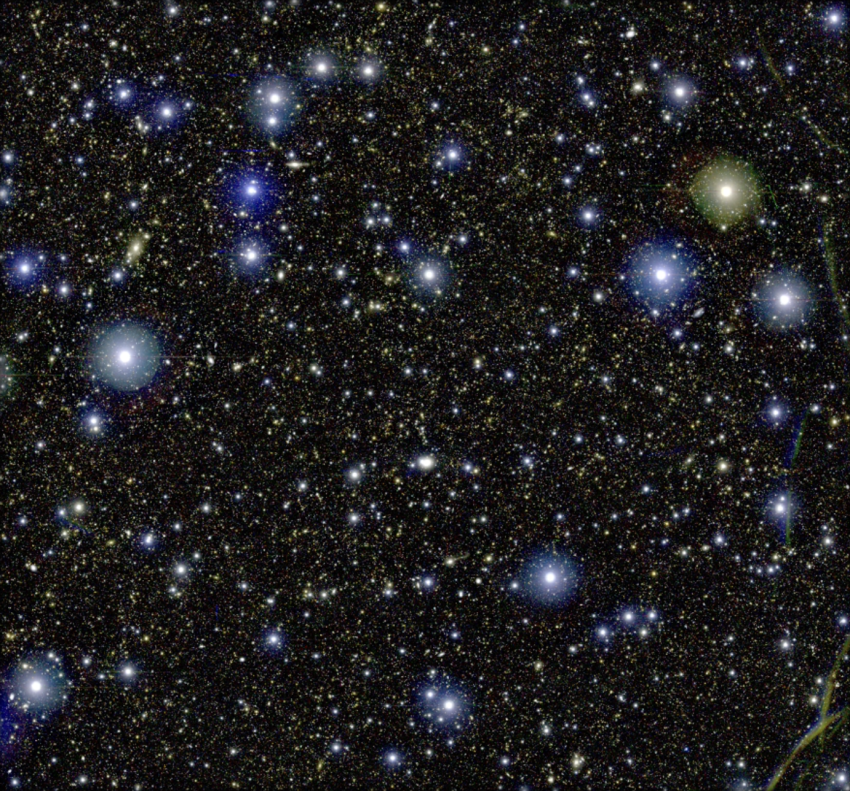
A team of astronomers has identified a rare quasar in the early Universe that hosts a supermassive black hole growing at an extraordinary rate. This discovery, made by researchers from Waseda University and Tohoku University, indicates that the black hole is consuming matter approximately 13 times faster than conventional theories suggest is possible.
Observations made using the Subaru Telescope reveal that while this black hole is ingesting material at an accelerated pace, it simultaneously emits intense X-rays and produces a powerful radio jet. Such a combination of characteristics was not predicted by existing models, suggesting that scientists may be observing the black hole during a brief phase of unstable growth.
Understanding Rapid Black Hole Growth
Supermassive black holes, typically ranging from millions to billions of times the mass of the Sun, are believed to reside at the centers of most galaxies. They grow by attracting surrounding gas, which forms a rotating accretion disk. This process energizes a compact region of hot plasma, known as a corona, which is a primary source of X-ray emissions. Additionally, some black holes produce narrow jets that are visible in radio wavelengths when actively feeding, earning them the designation of quasars.
The significant question that arises from this discovery is how these massive entities developed so rapidly in the Universe’s early history. One proposed explanation is through a process called super-Eddington accretion. Under normal conditions, radiation produced by infalling material pushes outward, creating a limit to how quickly a black hole can grow, termed the Eddington limit. Certain extreme conditions may allow some black holes to temporarily exceed this limit, resulting in rapid increases in mass.
To explore this phenomenon, the researchers utilized the near-infrared spectrograph (MOIRCS) at the Subaru Telescope. By analyzing the motion of gas near the quasar and examining the Mg II (2800 Å) emission line, they were able to estimate the mass of the black hole, which existed about 12 billion years ago. Their findings indicate the black hole is accreting matter at approximately 13 times the Eddington limit, based on X-ray measurements.
Challenges to Existing Theories
What distinguishes this quasar is its behavior across various wavelengths of light. Many theoretical models predict that during periods of super-Eddington growth, alterations in the inner structure of the accretion flow would diminish X-ray emissions and suppress jet activity. Contrary to these predictions, the quasar remains bright in X-rays while also being significantly radio-loud.
The researchers suggest that this unusual combination indicates the black hole is undergoing rapid growth while maintaining an energized corona and an active jet. This observation may represent a brief transitional phase, possibly following a sudden influx of gas. In such a scenario, an abrupt increase in available material could propel the black hole into a super-Eddington state. For a limited time, both the X-ray-emitting corona and the radio jet remain highly active before the system gradually reverts to a more typical growth mode.
If accurate, this interpretation allows scientists to study black hole growth in real-time during the early Universe, contributing to understanding how supermassive black holes formed so swiftly.
The strong radio signals emitted by the jet suggest it carries enough energy to influence its surroundings. Such jets can heat or disrupt gas within their host galaxies, potentially affecting star formation and shaping the evolution of galaxies and their central black holes. The relationship between super-Eddington growth and jet-driven feedback remains poorly understood, making this quasar a critical reference point for testing new theories.
Lead author Sakiko Obuchi from Waseda University expressed optimism about the discovery, stating, “This discovery may bring us closer to understanding how supermassive black holes formed so quickly in the early Universe. We want to investigate what powers the unusually strong X-ray and radio emissions, and whether similar objects have been hiding in survey data.”
The findings were published in the Astrophysical Journal on January 21, 2026, under the title “Discovery of an X-ray Luminous Radio-Loud Quasar at z = 3.4: A Possible Transitional Super-Eddington Phase.” The research received support from multiple grants, including the Grants-in-Aid for Scientific Research, the JST FOREST Program, and a research grant from the Inamori Foundation.
The Subaru Telescope is operated by the National Astronomical Observatory of Japan and the National Institutes of Natural Sciences, with additional support from the MEXT Project to Promote Large Scientific Frontiers. The research team acknowledges and respects the cultural and historical significance of Maunakea in Hawai`i, where these observations were conducted.