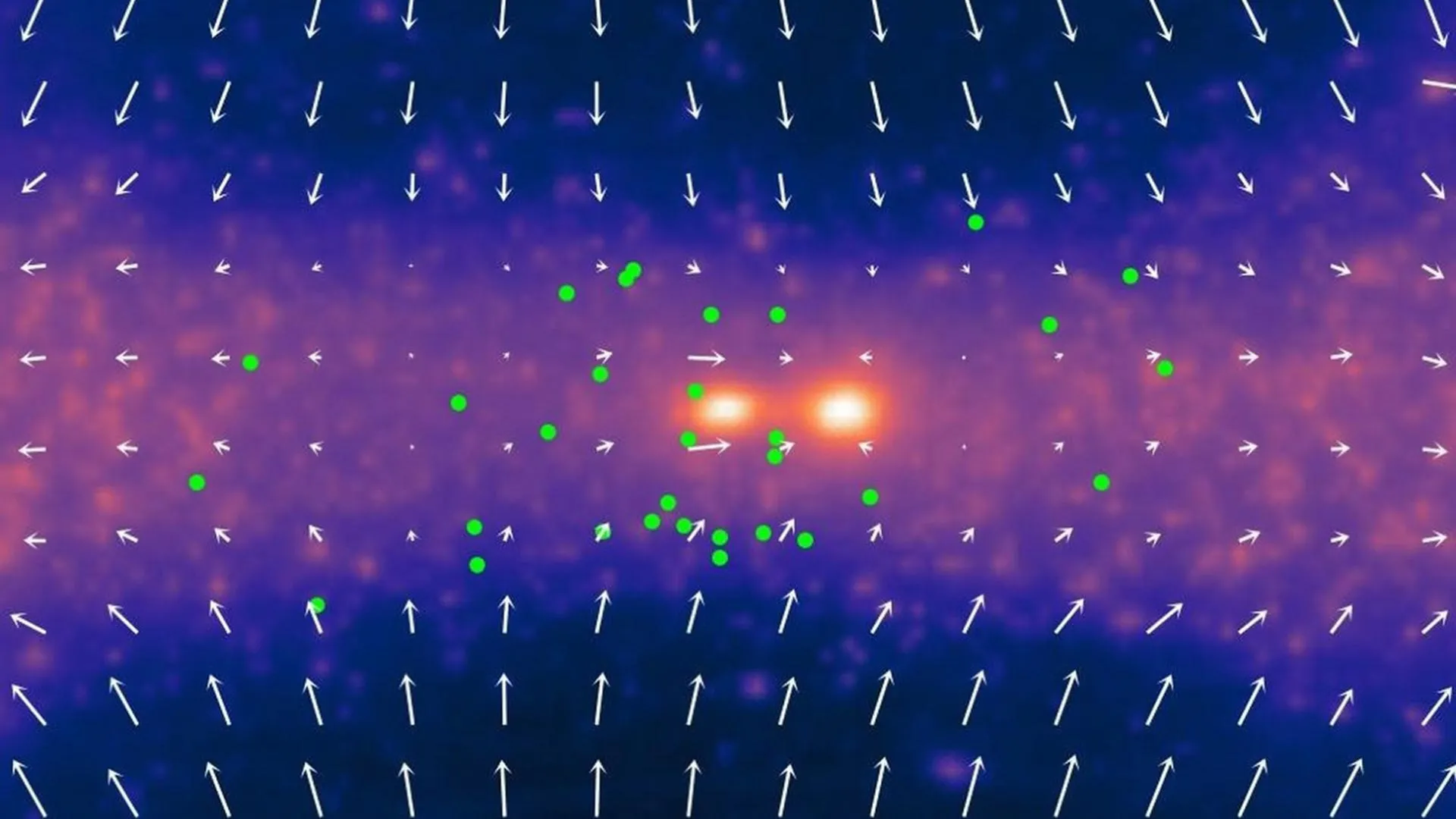
A significant astronomical discovery has emerged, revealing that the Milky Way resides within a vast, flat sheet of matter. This finding, published on March 6, 2026, by a team from the University of Groningen, provides clarity on why many nearby galaxies are moving away from the Milky Way instead of being drawn in by its gravitational pull.
For decades, researchers have grappled with the observation that most galaxies in proximity to the Milky Way are receding, a phenomenon first noted by astronomer Edwin Hubble nearly a century ago. Hubble’s work laid the groundwork for modern cosmology, demonstrating that the universe is expanding, a conclusion derived from his observations of distant galaxies.
Despite this expansive trend, the Andromeda Galaxy remains a notable exception, approaching the Milky Way at approximately 100 kilometers per second. This raises questions about the gravitational dynamics at play among galaxies within the Local Group, which comprises the Milky Way, Andromeda, and several smaller galaxies.
A Cosmic Structure Explained
The breakthrough came from simulations conducted by a research team led by PhD graduate Ewoud Wempe at the Kapteyn Institute. Their advanced computer modeling revealed that the mass surrounding the Local Group is organized in a broad, flattened structure extending over tens of millions of light-years. This structure is primarily composed of dark matter, which, along with ordinary matter, creates a balance that allows neighboring galaxies to drift outward instead of being drawn in.
The simulations produced by the researchers not only replicated the positions of galaxies in the region but also accurately mirrored their velocities, confirming the model’s validity. This “virtual twin” of the cosmic neighborhood aligns closely with observable data, suggesting that the arrangement of matter in this flattened sheet counteracts the gravitational influence of the Local Group.
The team’s simulations started with conditions from the early universe, leveraging measurements of the cosmic microwave background to estimate matter distribution shortly after the Big Bang. This iterative modeling led to a contemporary system that aligns with the current dynamics of the Local Group, including the Milky Way and Andromeda.
Addressing Longstanding Mysteries
According to Ewoud Wempe, this study marks a critical advancement in understanding dark matter distribution and its influence on galaxy motion. “We are exploring all possible local configurations of the early universe that ultimately could lead to the Local Group,” he noted. This model not only aligns with established cosmological theories but also offers fresh insights into the local dynamics of the universe.
Astronomer Amina Helmi expressed enthusiasm for the findings, highlighting their potential to resolve a mystery that has perplexed scientists for decades. “I am excited to see that, based purely on the motions of galaxies, we can determine a mass distribution that corresponds to the positions of galaxies within and just outside the Local Group,” she stated.
This discovery sheds light on the complex gravitational interactions within our cosmic neighborhood, offering a clearer understanding of the universe’s structure and the forces shaping it. As astronomers continue to unravel the mysteries of dark matter and cosmic formation, this research contributes significantly to our comprehension of the universe’s vast and intricate web.