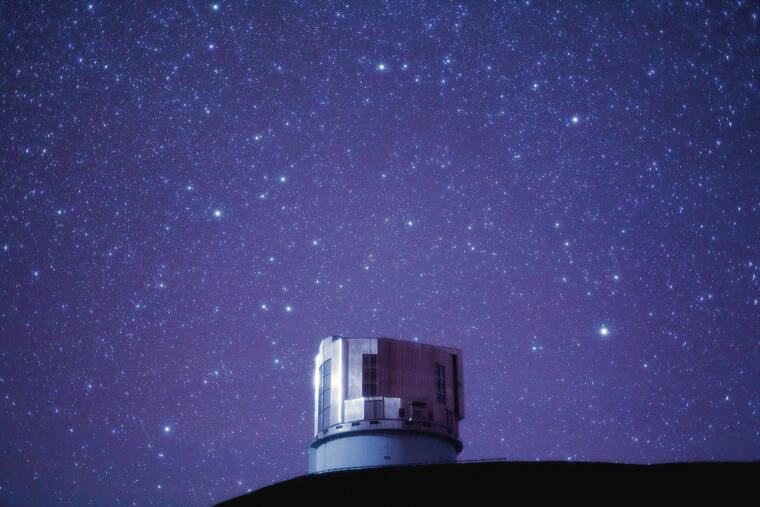
Astronomers from the Subaru Telescope and the W.M. Keck Observatory on Mauna Kea have made significant discoveries, identifying a massive planet and a brown dwarf that orbit distant stars. These findings are part of the newly launched Observing Accelerators with SCExAO Imaging Survey (OASIS) program, which aims to enhance our understanding of how giant planets and substellar objects form and evolve.
The first notable discovery, identified as HIP 71618 B, is a brown dwarf with a mass equivalent to 60 Jupiter masses. Located 169 light-years away in the constellation Bootes, this brown dwarf is often referred to as a “failed star” because it never accumulates enough mass to sustain nuclear fusion. Unlike stars, brown dwarfs emit less light and are cooler, making them more challenging to observe. The combined efforts of the Keck/NIRC2 and Subaru/SCExAO instruments, utilized within days of each other, successfully identified this companion. Subsequent observations over the following year confirmed its orbital path.
The second discovery, known as HIP 54515 b, is an 18-Jupiter-mass planet orbiting a star 271 light-years away in the constellation Leo. This planet orbits at a distance comparable to that of Neptune around the Sun, appearing exceptionally close to its host star from Earth. This proximity is analogous to viewing a football from over 200 miles away. The Subaru Telescope’s SCExAO system provided the high-resolution images necessary to detect this faint giant planet alongside its bright star.
Future Implications and Observational Opportunities
The implications of these discoveries are substantial. According to Thayne Currie, a professor at the University of Texas at San Antonio and principal investigator of the OASIS program, “These discoveries may help advance our abilities to image another Earth with future space-based observatories such as NASA’s Roman Space Telescope.” He emphasized the importance of Mauna Kea’s observing conditions and advanced instrumentation in achieving these results.
In addition to these discoveries, the astronomical community looks forward to upcoming celestial events. The Quadrantids meteor shower, known for its brilliant meteors, will peak on the night of January 3 into the early morning of January 4, 2024. Originating from the asteroid 2003 EH1, this shower can produce up to 40 meteors per hour at its peak. Favorable viewing conditions are anticipated for observers in Hawaii, particularly after midnight when the radiant rises higher in the sky.
Stargazing Highlights in January
For stargazers, January offers a rich tapestry of celestial phenomena. The star family known as Kekaomakali‘i, or the “Bailer of Makali‘i,” will dominate the night sky. Rising prominently in the eastern sky after sunset, this starline is crucial for traditional Hawaiian navigation. It includes notable stars such as Hokulei (Capella), Na Mahoe (Gemini), Kapuahi (Aldebaran), A‘a (Sirius), and Ke Ali‘i Kona i ka lewa (Canopus). Within this constellation, the Makali‘i (Pleiades) cluster signals the ongoing makahiki season, a period of rest and reflection in Hawaiian culture.
In the western sky, Jupiter (Ka‘awela) will be visible shortly after sunset, while Hokuloa (Venus) will shine brightly in the southwestern part of the night sky. Observers using binoculars or telescopes can appreciate the beauty of these planets, making them rewarding targets for stargazing.
For early risers, Jupiter will remain a prominent feature in the pre-dawn western sky throughout January. Observers can also look toward Hokupa‘a in the north to spot the Big Dipper and its neighboring stars, including Hokule‘a (Arcturus), which plays a vital role in Hawaiian navigation.
As the astronomical community continues to explore the universe, these discoveries and upcoming events highlight the importance of celestial observation and its cultural significance, particularly in Hawaiian heritage.
For more information about the OASIS program, visit the Keck Observatory and Subaru Telescope websites.