China’s Chang’e-6 mission has delivered significant insights into lunar geology by returning soil samples from the far side of the Moon. On June 25, 2024, the mission successfully retrieved 1,935.3 grams of lunar soil from the South Pole–Aitken Basin, a site known for being the Moon’s largest, deepest, and oldest impact structure. This groundbreaking achievement allows scientists to investigate the unique composition and geological history of the far side, an area previously unexplored in such detail.
Previous sample-return missions, such as Apollo, Luna, and Chang’e-5, contributed around 383 kilograms of lunar material, primarily from the near side. These missions have significantly advanced our understanding of lunar evolution and regolith properties. However, the lack of far-side samples limited the scope of research until now.
Scientific Findings on Lunar Soil Behavior
According to Hu Hao, chief designer of the Chang’e-6 mission, the returned samples displayed characteristics distinct from those gathered by Chang’e-5. The soil appeared “slightly more viscous and somewhat clumpier,” prompting further investigation into its properties. A research team led by Prof. Qi Shengwen from the Institute of Geology and Geophysics of the Chinese Academy of Sciences (IGGCAS) conducted a series of experiments to quantify these observations, focusing on the angle of repose, a parameter crucial for understanding the flowability of granular materials.
The findings, published in Nature Astronomy, revealed that the soil from Chang’e-6 has a significantly higher angle of repose compared to near-side samples. This indicates a flow behavior typical of cohesive soils, which may have important implications for lunar construction and exploration.
Further analysis ruled out magnetic and cementation effects, as the samples contained only trace amounts of magnetic minerals and no clay minerals. Instead, the elevated angle of repose results from three interparticle forces: friction, van der Waals forces, and electrostatic forces.
Unique Particle Characteristics
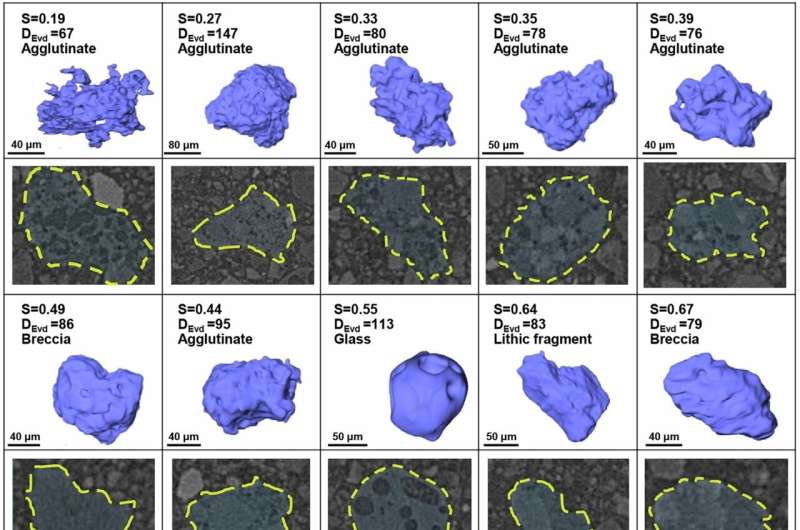
The research identified a critical size threshold of approximately 100 micrometers, below which fine non-clay mineral particles begin to exhibit cohesive behavior. The D 60 metric, which indicates the particle diameter at which 60% of the sample is finer, was found to be only 48.4 micrometers for the Chang’e-6 samples. This indicates that the lunar soil is not only finer but also more irregular in shape compared to near-side soils, which typically have higher particle sphericity.
“This is unusual,” noted Prof. Qi. “Finer particles are typically more spherical. Despite being fine-grained, Chang’e-6 soil displays more complex particle morphologies.” The higher feldspar content, approximately 32.6%, in the samples, along with more intense space weathering on the far side, may contribute to these unique characteristics.
The study provides a systematic explanation of the cohesive behavior of lunar soil, enhancing our understanding of far-side regolith from a granular mechanics perspective. These insights may pave the way for future lunar exploration and the potential construction of habitats on the Moon.
For more information, the full research can be found in the article by Shengwen Qi et al., titled “Strongly cohesive lunar soil identified at the Chang’e-6 landing site,” published in Nature Astronomy (2025).