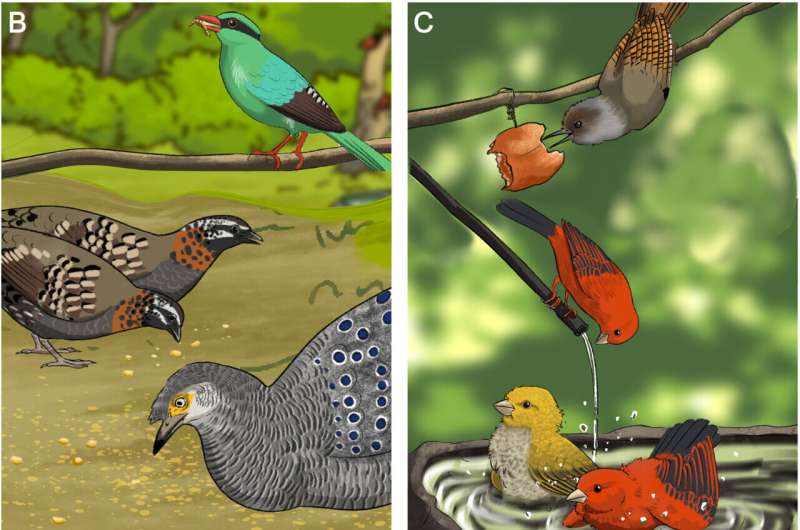
A recent study published in Avian Research reveals that the Hide-in-Bird Pond (HIBP) model is transforming bird-friendly tourism in China. This community-driven initiative allows local populations to create artificial ponds and feeding stations, attracting various bird species for non-invasive observation and photography. The model not only supports avian diversity but also provides an alternative income source for rural communities.
Researchers from the Kunming Institute of Zoology at the Chinese Academy of Sciences conducted the first national-scale assessment of this grassroots avitourism framework. Through semi-structured interviews with 98 operators and spatial analysis, the study identified 251 HIBP sites across 24 provinces, with nearly 40% located in Yunnan Province. Collectively, these sites have documented 524 bird species, which accounts for approximately 36% of China’s total avifauna. Notably, 148 of these species are either nationally protected or globally threatened.
The spatial distribution of HIBP sites is particularly significant. Approximately 72% of these sites are found within 5 km of protected areas, and 87% are situated in economically disadvantaged regions. This correlation suggests that HIBP could effectively reconcile ecological conservation with sustainable rural development by offering communities an alternative to resource-dependent livelihoods.
Nevertheless, the study highlights potential risks associated with the current absence of standardized management protocols and effective regulatory oversight. The researchers caution that without appropriate governance frameworks, the growing popularity of the HIBP model may lead to unintended ecological and management consequences.
To mitigate these risks, the study advocates for science-based guidelines, registration systems, and adaptive management strategies. Implementing these measures is essential for maintaining ecological integrity and ensuring the long-term sustainability of the HIBP initiative.
The findings contribute valuable insights into how community-driven ecotourism can support international biodiversity goals, such as those outlined in the Kunming-Montreal Global Biodiversity Framework. By promoting rural revitalization in regions characterized by high biodiversity, the HIBP model represents a promising pathway for harmonizing conservation efforts with economic opportunities.
More information on this study can be found in the publication by Lin He et al., titled “Hide-in-Bird Pond: A new pathway to synergize biodiversity conservation and sustainable development in China,” available in Avian Research (2026). The study’s DOI is 10.1016/j.avrs.2025.100323.