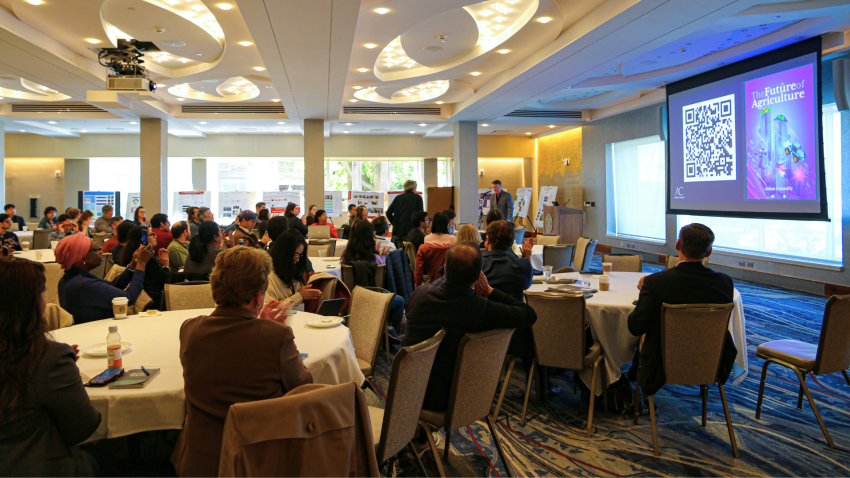
The annual workshop hosted by the Cornell Institute for Digital Agriculture (CIDA) on October 21, 2023, at the Statler Hotel in Ithaca, New York, showcased groundbreaking advancements in artificial intelligence (AI) applied to agriculture. The event drew faculty, students, and industry partners from various disciplines, including the College of Agriculture and Life Sciences (CALS) and the College of Veterinary Medicine. Participants engaged in project updates, networking opportunities, and a keynote address highlighting how AI is transforming food systems.
Dr. Renata Ivanek, co-director of CIDA and professor of epidemiology at Cornell’s College of Veterinary Medicine, emphasized the summit’s aim to foster collaboration among specialists in veterinary medicine, computer science, law, and ethics. “The goal of the summit is to bring together experts…and initiate development of an ecosystem of benchmarks designed to foster AI-driven innovation,” said Ivanek. She noted the importance of creating an environment where agriculture, animal health, and technology can interact cohesively.
CIDA’s mission revolves around uniting researchers, industry players, farmers, and students to develop sustainable food systems. The summit featured insights into the latest advancements in AI, sustainable agriculture, and climate-resilient farming. Keynote speaker Aidan Connolly discussed the potential of AI to revolutionize farming practices. He envisaged a future where “AI [is] running and even designing farms,” integrating historical agricultural practices with modern technology to enhance food security.
Innovative Programs at the Forefront of AI in Agriculture
The event highlighted several Cornell initiatives aimed at advancing AI and digital agriculture. The Cornell Agricultural Systems Testbed (CAST) and the forthcoming AI4AG program were presented as pivotal projects. These initiatives focus on merging data from field and livestock systems to create AI tools that are “farm-ready.” Dr. Julio Giordano, co-director of CIDA and professor of animal science, explained, “The AI4AG initiative is about connecting people and data – building the infrastructure that allows agricultural systems to benefit from the latest advances in machine learning.”
Other notable projects discussed included the Center for Research on Programmable Plant Systems (CROPPS), which enables plants to communicate their nutritional needs through programmable sensors, and NASA ACRES, which employs remote sensing and hyperspectral imaging to enhance soil and crop modeling. The NSF-funded AI LEAF institute aims to develop decision-support tools for climate-smart farming, while the Grow-NY initiative continues to support ag-tech startups leveraging AI for precision management and sustainability.
The CIDA Research Innovation Fund also played a significant role in the summit, featuring presentations on innovative research projects at the intersection of agriculture and technology. Professor Jeff Tester from Cornell Engineering shared insights on sustainable approaches to valorizing agricultural and food waste, while Research Professor Ed Mabaya discussed strategies to enhance digital agriculture in Africa.
Fostering Collaboration for Future Innovations
Throughout the event, CIDA leaders underscored the importance of cross-disciplinary collaboration. Dr. Fengqi You, co-director of CIDA and Roxanne E. and Michael J. Zak Professor in Energy Systems Engineering, stated, “Through the Research Innovation Fund, we’re supporting bold ideas that cross traditional boundaries.” This initiative aims to encourage researchers to pursue new avenues of research and secure additional funding.
The summit concluded with an Industry Thought Summit, featuring discussions led by Connolly and David Erickson, S.C. Thomas Sze Director of the Sibley School of Mechanical and Aerospace Engineering. The talks focused on the significance of partnerships between academia and industry, followed by a moderated discussion that facilitated attendee engagement.
“What makes CIDA unique is its ecosystem; we’re not working in isolation,” said Dr. Hakim Weatherspoon, co-director of CIDA and professor of computer science. “By bringing together Cornell centers and industry leaders through events like this, we’re accelerating innovation that has both local and global impact.”
For further information about CIDA and its initiatives, visit digitalagriculture.cornell.edu.