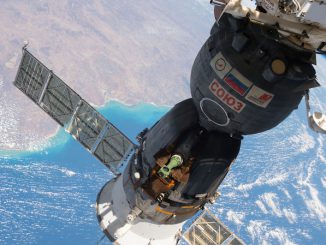
The Crew 12 astronauts successfully docked with the International Space Station (ISS) on February 11, 2024, restoring the station’s crew to its full capacity of seven members. The SpaceX Crew Dragon capsule arrived at the ISS at 3:15 PM EST, 34 hours after launching from the Kennedy Space Center aboard a Falcon 9 rocket.
Upon entering the station, the Crew 12 team, which includes Jessica Meir, Andrey Fedyaev, Jack Hathaway, and Sophie Adenot, was warmly welcomed by the existing crew, led by station commander Sergey Kud-Sverchkov. The arrival of this new team comes one month after the early return of four astronauts due to a medical issue, which left the ISS temporarily under-staffed.
Welcome Ceremony and New Missions Ahead
During a brief welcoming ceremony, Kud-Sverchkov expressed his relief and excitement, stating, “Welcome to Crew 12. We are happy they all arrived safe and sound.” Meir, making her second long-duration stay aboard the ISS, reflected on the diverse backgrounds of the crew, highlighting the collaborative spirit of international space exploration: “We have so many countries represented, so many backgrounds, so many disciplines.”
The new crew members opened the hatch of the Crew Dragon two hours after docking, marking the beginning of their mission. Meir’s team is taking over from Crew 11, which included Zena Cardman, Mike Fincke, Kimiya Yui, and Oleg Platonov. Their early departure left the station with only three occupants—Kud-Sverchkov, Sergey Mikaev, and Chris Williams. While the ISS can be operated with a minimal crew, a full team is essential for conducting extensive research and maintenance tasks.
Challenges and Achievements in Space Travel
Adenot, a seasoned French air force helicopter test pilot, described the launch experience as exhilarating, stating, “SpaceX gave the crew quite a ride, very fun!” She and Hathaway emphasized the awe of viewing Earth from space, remarking on the beauty of seeing “no lines, no borders.”
With Crew 12’s arrival, research activities in the U.S. segment of the ISS can resume at full capacity. This is crucial for ongoing experiments and missions, including planned spacewalks that require the presence of two astronauts. Mission control had initially aimed to accelerate Crew 12’s launch to February 11, to reduce the time Williams would be the sole operator in the U.S. segment, but scheduling conflicts and weather conditions delayed the launch.
Following their arrival, the crew notified mission control of the need for a private medical conference, adhering to strict medical privacy guidelines. NASA does not disclose specific health issues among astronauts, but it is known that many experience initial discomfort as they adapt to weightlessness.
The successful docking of Crew 12 not only enhances the operational capabilities of the ISS but also reinforces the importance of international collaboration in space exploration.