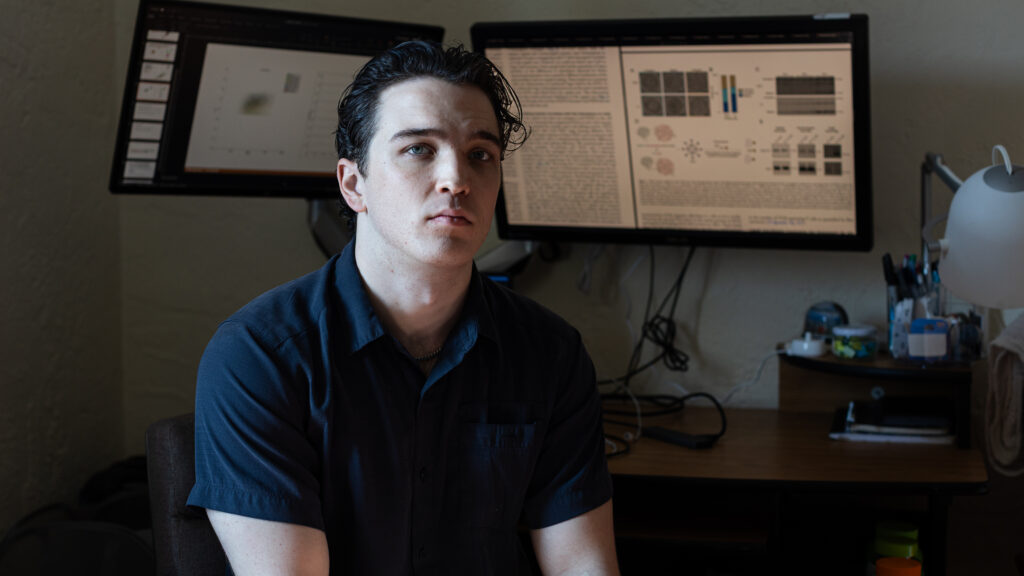
First-year Ph.D. students in biomedical fields are confronting significant challenges as funding becomes increasingly tenuous. The National Institutes of Health has reduced its project funding, leaving many aspiring researchers in uncertainty. This shift affects students like Alex Sathler, who, despite securing a prestigious National Science Foundation fellowship valued at $37,000 annually, has been unable to find a suitable lab for his dissertation research.
Sathler, who is enrolled in a joint program at the University of California, Berkeley and UC San Francisco, faced rejection from two labs that he approached for collaboration. Both lab heads indicated they could not take on additional students due to financial constraints. This situation is not unique to Sathler; many of his peers report similar experiences. “Everyone in my program deserves to be in their dream lab,” he noted, expressing concern that the lack of funding is limiting opportunities for students to align with their research interests.
The current funding landscape has intensified competition for spots in well-funded labs. The National Institutes of Health is projected to decrease funding again in 2026, exacerbating the challenges faced by new graduate students. As a result, professors are hesitant to commit to taking on new students, often retracting previous offers. This shift has resulted in students questioning their prospects in a highly competitive academic environment, where funding remains scarce.
Chevelle Newsome, president of the Council of Graduate Schools, emphasized the pervasive nature of these challenges. “The strain that you’re hearing is real. It’s not an isolated case. It’s actually across the board,” she stated, highlighting the systemic issues affecting graduate students nationwide. Some Ph.D. programs have preemptively reduced incoming class sizes by a third or more due to anticipated funding cuts, though overall enrollment in biomedical graduate programs saw a slight increase last fall.
During the first year, life science Ph.D. students typically engage in rotations, which allow them to explore various labs before committing to one. Hannah Barsouk, a biochemistry student at Stanford University, shared that numerous labs have expressed uncertainty about their ability to accept new students. Having contacted 30 to 40 labs, she has created a list to track her interactions and the funding status of each lab. Barsouk described the situation as creating a “cloud of general anxiety” over her initial year.
In response to funding concerns, some institutions have altered their admission processes. Georgia Tech and Emory University recently switched to a direct-admission system for their joint bioengineering program, requiring applicants to secure a lab before gaining admission. This model, while more common in Europe, places significant pressure on students to navigate potential lab environments based only on discussions rather than direct experiences.
At Stanford, funding for bioscience graduate students has been reduced from four years to two, with plans to further decrease it to one year for incoming students. This change compels faculty to be more selective about which students they will support. Joe Wu, director of the Stanford Cardiovascular Institute, noted, “Unless the student’s outstanding, then you’re not going to commit.”
The funding climate has also affected commitments from faculty members. One biology student, who spoke on condition of anonymity, reported that after receiving a near-guarantee of space in a lab, the professor later stated she needed to secure her own funding to join. This shift left her feeling misled and uncertain about her future.
For students like Sathler, navigating graduate school has become increasingly complex. He has encountered labs that acknowledge his NSF fellowship as beneficial, yet still claim it does not fully cover salary expenses, further compounding the difficulties in securing a position.
While students have until the start of their second year to finalize their lab placements, the uncertainty surrounding funding persists. There is a glimmer of hope, as congressional appropriations committees have recently endorsed a slight budget increase for the NIH, although a Senate vote on the matter is still pending.
As conditions change, some students are exploring alternative graduate programs, which highlights the extent of disillusionment within the academic community. The biology student mentioned earlier, after realizing her chances of joining her desired lab were low, applied to other programs despite being already enrolled. Unfortunately, her attempts were unsuccessful, leaving her in a precarious position.
Despite the challenges, students remain committed to their academic pursuits. However, many now grapple with doubts about their long-term goals. One student reflected on her aspirations of leading her own lab, expressing concern that current funding dynamics could hinder her ability to achieve that dream. “I still very much want to be a professor, and I just don’t know if that’s ever going to be possible because of the way NIH and the NSF are being dismantled,” she said.
The ongoing situation reflects broader issues within the biomedical research community, raising critical questions about the future of academic careers in light of diminishing funding opportunities. The implications for the next generation of scientists are significant, as they navigate a landscape marked by uncertainty and competition.