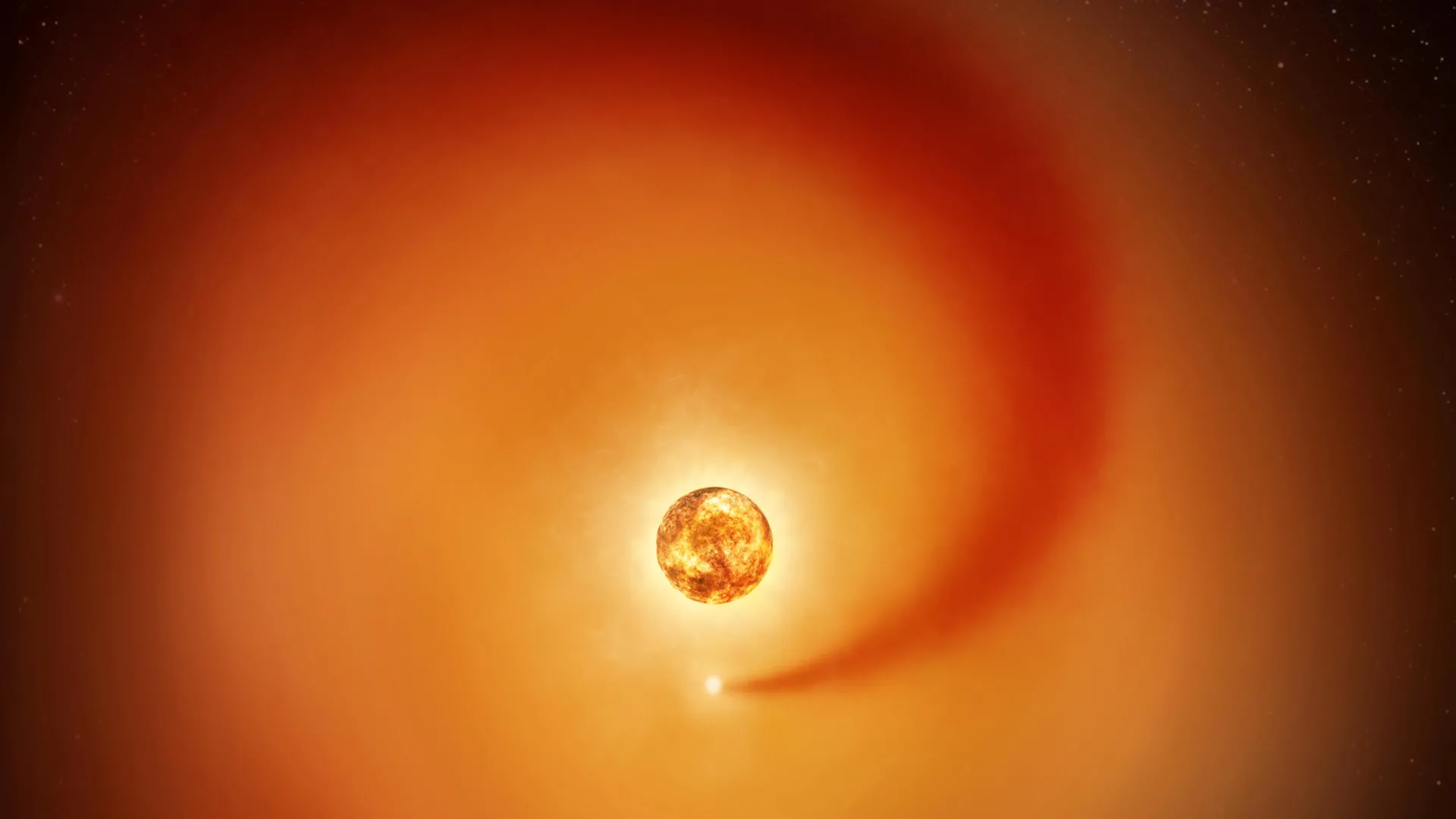
NASA astronomers have identified a hidden companion star orbiting the red supergiant Betelgeuse, revealing the source of its unusual brightness fluctuations. This groundbreaking discovery, announced on January 10, 2026, during the 247th meeting of the American Astronomical Society in Phoenix, stems from nearly eight years of observations made using the Hubble Space Telescope and other ground-based facilities.
The companion star, named Siwarha, is shaping the environment around Betelgeuse by creating a dense stream of gas as it moves through the giant star’s outer layers. This phenomenon has provided insights into the long-observed variability in Betelgeuse’s brightness and atmospheric behavior, offering a clearer understanding of the life cycles of massive stars.
Uncovering the Nature of Betelgeuse
Researchers at the Center for Astrophysics | Harvard & Smithsonian (CfA) led the study, which confirmed the presence of Siwarha and its impact on Betelgeuse. By analyzing subtle changes in the star’s light over the years, scientists were able to trace the effects of this companion star, which had been theorized but never conclusively proven until now.
The data revealed that as Siwarha disturbs the surrounding gas, it produces a visible trail of denser material. This discovery addresses one of the longstanding mysteries surrounding Betelgeuse, which lies approximately 650 light-years from Earth in the Orion constellation. Betelgeuse is notable for its immense size, capable of containing more than 400 million Suns, making it a prime candidate for studying the evolution of giant stars.
Patterns of Behavior and Future Observations
Combining data from Hubble with observations from the Fred Lawrence Whipple Observatory and the Roque de Los Muchachos Observatory, researchers detected repeating patterns in Betelgeuse’s behavior. These patterns provided strong evidence of Siwarha’s influence, particularly in the star’s spectrum and the motion of gas in its outer atmosphere.
The companion star’s wake appears every 2,100 days, aligning with earlier theoretical predictions. Andrea Dupree, an astronomer at the CfA and lead author of the study, likened the phenomenon to “a boat moving through water,” where the companion creates a ripple effect in Betelgeuse’s atmosphere.
Astronomers have monitored Betelgeuse for decades, noting significant changes in its brightness, especially a dramatic dimming event in 2020 described as a stellar “sneeze.” The study identified two major cycles in the star’s variability: a shorter 400-day period linked to internal pulsations and a longer cycle of about 2,100 days attributed to the influence of Siwarha.
The discovery of the companion star’s wake provides compelling evidence that Betelgeuse’s unpredictable behavior stems from external forces, rather than solely internal dynamics. “Finding the wake from its companion means we can now understand how stars like this evolve, shed material, and eventually explode as supernovae,” Dupree stated.
Looking ahead, astronomers plan further observations when Siwarha becomes visible again in 2027. This discovery not only enhances our understanding of Betelgeuse but may also shed light on similar mysteries involving other massive stars.
The Hubble Space Telescope continues to be an invaluable asset in astronomical research, having operated for over 30 years. It is a collaborative effort between NASA and the European Space Agency, with mission operations overseen by NASA’s Goddard Space Flight Center and scientific operations managed by the Space Telescope Science Institute.
This remarkable discovery not only confirms the existence of a companion star but also opens new avenues for exploring the complex dynamics of one of the most studied stars in the universe.