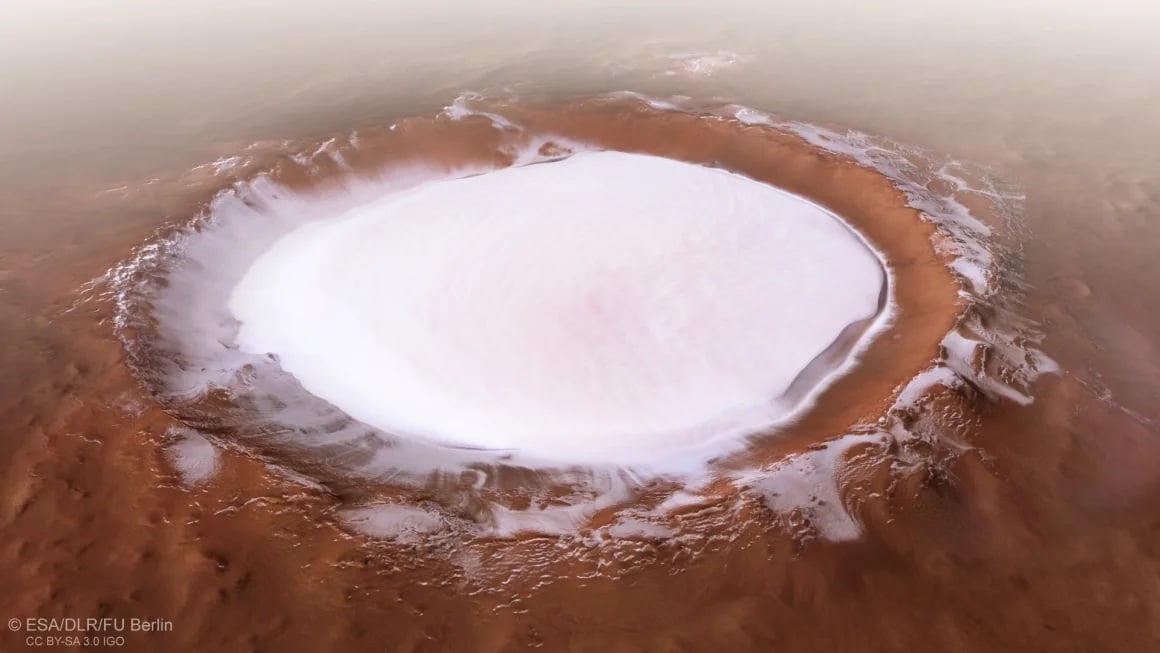
Research led by a team of Japanese scientists has uncovered significant insights into Mars’ climatic history through the study of ice deposits within its craters. The findings indicate that these deposits serve as a record of the planet’s past, revealing that Mars experienced multiple ice ages over millions of years. This research provides critical information about how much water once existed on Mars and the processes that led to the planet’s current arid state.
These discoveries highlight features on the Martian surface that suggest a warmer and wetter past, characterized by rivers, lakes, and even an ancient ocean covering parts of the northern hemisphere. The craters analyzed by the research team are located between 20°N and 45°N latitude and contain various indicators of past glaciation, including ridges and maze-like formations.
Research Methodology and Findings
The study, published in the journal Geology on March 28, 2025, was spearheaded by Trishit Ruj, an associate professor at the Institute for Planetary Materials at Okayama University. Collaborating institutions included the Kochi Institute for Core Sample Research, the International Research School of Planetary Sciences, Kochi University, Brown University, the University of Tokyo, and the JAXA Institute of Space and Astronautical Science (ISAS).
Using high-resolution images from NASA’s Mars Reconnaissance Orbiter, the team focused on craters exhibiting signs of glaciation. They observed that the ice deposits consistently accumulated in the shadowed southwestern walls of these craters, supporting the notion that Mars underwent significant climatic fluctuations driven by changes in its axial tilt, or obliquity.
Dr. Ruj emphasized that the axial tilt of Mars is similar to Earth’s, approximately 25 degrees compared to Earth’s 23.4 degrees. This similarity implies that shifts in climate, based on axial tilt, were responsible for the planet’s gradual transition from a water-rich environment to its current icy conditions.
The research indicates that during the Amazonian period, which spans approximately 640 to 98 million years ago, Mars underwent a series of glacial cycles, with the volume of ice decreasing over time. This gradual loss of water highlights the broader transformation of Mars into a cold, arid landscape.
Implications for Future Exploration
The insights gained from this research are not only pivotal for understanding Martian history but also have practical implications for future crewed missions to Mars. The ability to locate and utilize local sources of water ice will be essential for sustaining human life on the planet. Water is vital for food production, oxygen generation, and fuel production, making in-situ resource utilization (ISRU) a necessity for long-term missions.
Dr. Hasegawa from Kochi University noted that the study of ice deposits on Mars serves as a unique opportunity to understand climate processes over extensive timescales. The techniques developed for analyzing Martian ice could also be applied to monitor glaciers and permafrost on Earth, which face similar challenges due to climate change.
The connection between Martian research and Earth’s environmental issues underscores the significance of this study. As global temperatures rise, leading to diminishing freshwater supplies, the methodologies used in this research can provide valuable insights for managing Earth’s changing climate.
Overall, the examination of ice deposits within Mars’ craters not only sheds light on the planet’s past but may also guide humanity’s future as we strive to explore and potentially inhabit another world.