
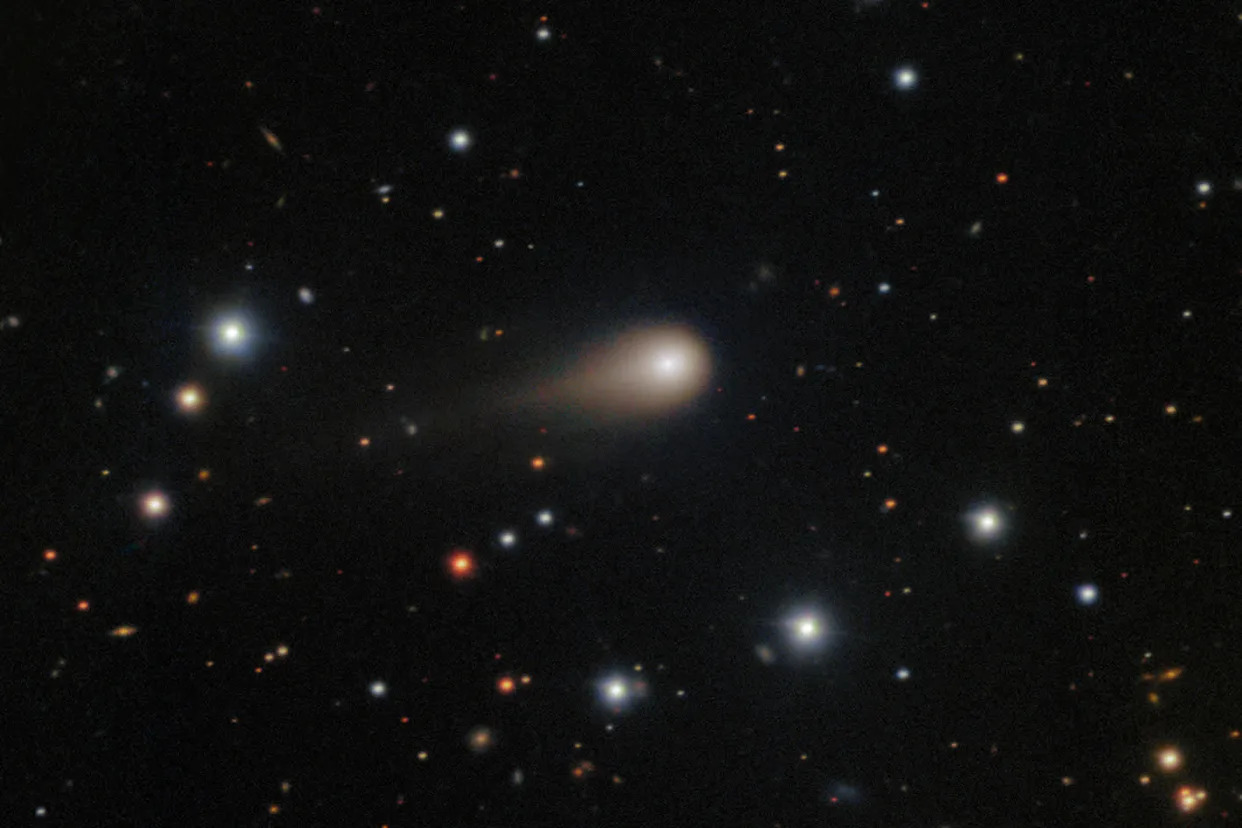
An interstellar comet, designated as 3I/ATLAS, is set to make its closest approach to the sun this week, drawing significant attention from astronomers worldwide. This celestial body, which could be older than our solar system, is not expected to pose any threat to Earth, remaining a safe distance of at least 170 million miles away.
Discovered on July 1, 2025, by the NASA-funded Asteroid Terrestrial-impact Last Alert System (ATLAS) survey telescope in Rio Hurtado, Chile, 3I/ATLAS is notable for being the third recognized interstellar object to pass through our solar system. Astronomers later traced its existence back to earlier observations in telescope archives from June 14 of this year.
Characteristics and Composition of Comet 3I/ATLAS
The comet’s nucleus measures between 1,444 feet and 3.5 miles across, according to data from the Hubble Telescope. Its classification as a comet arises from its icy composition and the presence of a bright cloud of gas and dust surrounding it, known as a coma. As it approaches the sun, the comet’s ice and dust begin to vaporize, creating a distinctive fuzzy appearance or tail.
Astronomers propose that 3I/ATLAS likely formed billions of years ago, possibly predating our solar system. The comet’s name reflects its classification: “3I” indicates it is the third interstellar object discovered, while “ATLAS” acknowledges the survey responsible for its discovery.
The comet’s hyperbolic trajectory confirms its interstellar origins. Unlike objects that orbit the sun, 3I/ATLAS travels at a remarkable speed of approximately 137,000 miles per hour, making it too fast to be captured by the sun’s gravitational pull.
Scientific Insights and Future Observations
Despite its distance from Earth, the scientific value of 3I/ATLAS is immense. Interstellar objects like this comet serve as cosmic time capsules, potentially containing chemical and physical information from other star systems formed billions of years ago. Recent observations have revealed the presence of atomic nickel vapor emanating from the comet, detected at a great distance from the sun, where temperatures are extremely low—about four times Earth’s distance from the sun.
Astronomers are intrigued by this finding, as it is unusual for solid metals like nickel to vaporize under such cold conditions. They speculate that the nickel might be interacting with carbon monoxide or other organic compounds, which can facilitate the release of nickel atoms at significantly lower temperatures.
Comet 3I/ATLAS will reach its closest point to the sun on October 30, 2025, just inside the orbit of Mars. It will reappear on the other side of the sun by early December, although visibility will require powerful telescopes. The ongoing study of 3I/ATLAS not only enriches our understanding of interstellar objects but also enhances our knowledge of the broader cosmos and the origins of our solar system.


