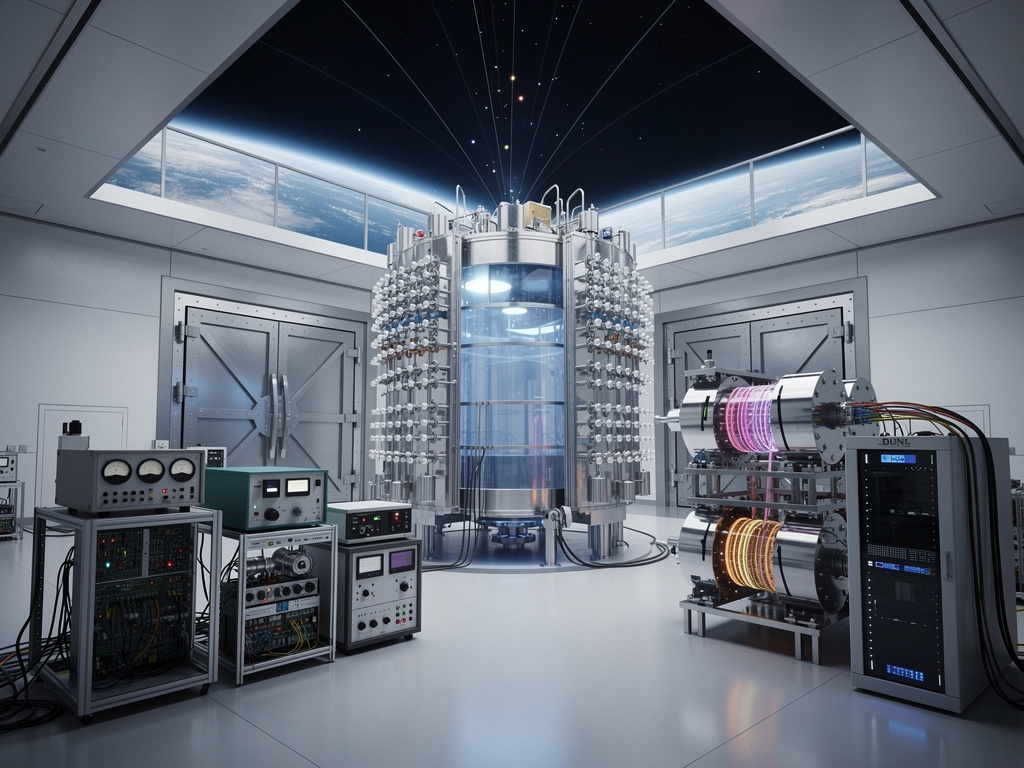
In New Mexico’s high desert, the Los Alamos National Laboratory (LANL) continues to be a leader in nuclear research, a legacy that began with the Manhattan Project. The lab is now at the forefront of advancements in neutrino physics and nuclear stewardship. A significant report from 1993, titled “Recent Developments in Neutrino Physics”, has resurfaced, igniting discussions among scientists and policymakers about the fundamental nature of these elusive particles.
The report, identified as LA-UR-93-1350-25, details early 1990s developments in neutrino studies, which are crucial for understanding the universe. Authored by LANL researchers for the U.S. Department of Energy, the document highlights experimental data from accelerator facilities and discusses the implications of neutrino oscillation—an anomaly suggesting that neutrinos change types as they travel, challenging established theories in particle physics. This foundational work laid the groundwork for future Nobel Prize-winning research, confirming Los Alamos’s pivotal role in merging theoretical concepts with practical experimentation.
Modern Advances in Neutrino Physics
Today, research at Los Alamos has evolved significantly, reflecting a growing interdisciplinary approach that incorporates cosmology and quantum mechanics. Recent initiatives at the Los Alamos Neutron Science Center utilize high-intensity proton accelerators to explore neutron interactions, relevant for both scientific inquiry and national security. These contemporary efforts build on insights from the earlier neutrino report, adapting methodologies to fit modern computational frameworks and collaborative international projects.
The 1993 report discussed insights from experiments conducted at the Los Alamos Meson Physics Facility, where beams of neutrinos were generated to test their interaction rates. These studies indicated the possibility of neutrino mass, a finding that has since been validated by experiments at international facilities, such as Japan’s Super-Kamiokande. In 2023, LANL contributed to a comprehensive study on neutrino-nucleus scattering, which is essential for exploring dark matter candidates, showcasing the lab’s commitment to advancing our understanding of the universe.
The ongoing Deep Underground Neutrino Experiment (DUNE), a collaboration with the Fermi National Accelerator Laboratory, exemplifies the lab’s continued dedication to neutrino research. This ambitious project aims to send neutrino beams from Illinois to South Dakota, measuring oscillations over extensive distances to uncover the properties of neutrinos with unprecedented precision. Experts at the lab note that simulations informed by past reports, including LA-UR-93-1350-25, have been vital in developing DUNE’s sophisticated detection systems.
National Security and Ethical Considerations
While Los Alamos is recognized for its scientific contributions, its research has long been intertwined with national defense efforts. The lab’s evolution post-World War II, documented in various sources, includes significant developments such as the hydrogen bomb and the maintenance of the U.S. nuclear arsenal. Recent reports indicate that LANL has increased its production of plutonium pits, a critical component for modernizing nuclear warheads, in response to Pentagon requirements outlined in an October 2025 article from the New York Times.
This militarized focus raises ethical questions, especially when considering historical documents like the 1993 neutrino report, which, although academic in nature, informed classified simulations for nuclear weapon design. Insiders reveal that models of neutrino interactions are used to predict fission processes in warheads, ensuring reliability without the need for live testing, a practice restricted by international treaties.
Operational challenges are not uncommon; a recent contamination incident reported by the Santa Fe New Mexican involved three workers exposed to low levels of radioactive material during maintenance, prompting safety reviews by the Defense Nuclear Facilities Safety Board. These occurrences underscore the dual nature of the lab’s mission: advancing scientific knowledge while addressing the inherent risks of working with fissile materials.
As Los Alamos navigates global tensions, aging infrastructure presents additional challenges. Facilities established decades ago are struggling to meet the demands of contemporary research, leading to contamination risks and work disruptions. In a December 2025 address covered by the Albuquerque Journal, officials announced investments in new supercomputers designed to simulate nuclear reactions at scales unattainable in the 1990s. These technological advancements build upon insights from neutrino physics, enabling virtual testing of weapon components.
Innovations in Nuclear Forensics and Future Directions
The laboratory is also at the forefront of innovations in nuclear forensics, developing technologies to detect illicit nuclear materials. Recent tests of a mass spectrometer capable of identifying nuclear contraband in under 30 minutes illustrate the lab’s role in enhancing global security. This technology builds on the particle detection techniques discussed in the 1993 report, now refined with artificial intelligence.
Collaborations with institutions such as the Idaho National Laboratory highlight LANL’s commitment to advancing modular nuclear systems. Enthusiasm in the industry is growing around these “extra-modular” reactors, which utilize sodium coolant for increased efficiency, potentially transforming energy production. Despite such advancements, critics caution that they may escalate arms races, as discussed in a November 2025 essay in Foreign Affairs.
The interplay between fundamental research and practical applications remains a hallmark of Los Alamos. The insights from the 1993 neutrino report continue to inform current projects, including those focused on fusion energy and clean power sources. The lab’s scientific influence extends beyond the United States, contributing to treaty monitoring efforts, such as the Comprehensive Nuclear-Test-Ban Treaty, where neutrino detection methods could signify underground explosions.
Looking to the future, Los Alamos is poised to address major challenges, from quantum computing applications in particle simulations to climate modeling influenced by nuclear processes. The health physics division is refining radiation safety protocols, crucial in light of recent incidents. Partnerships with private sectors developing small modular reactors signal a shift towards democratizing nuclear technology, while discussions about potential Department of Energy contracts for plutonium conversion reflect market optimism for advanced fuels.
In conclusion, documents like LA-UR-93-1350-25 serve as historical anchors that remind us of how past inquiries fuel future breakthroughs. As the world grapples with energy crises and security threats, Los Alamos’s ongoing legacy offers a blend of scientific pursuit and global responsibility, continuing to shape the trajectory of nuclear research and national security. Through collaboration and innovation, the lab stands ready to navigate the complexities of the modern era.