
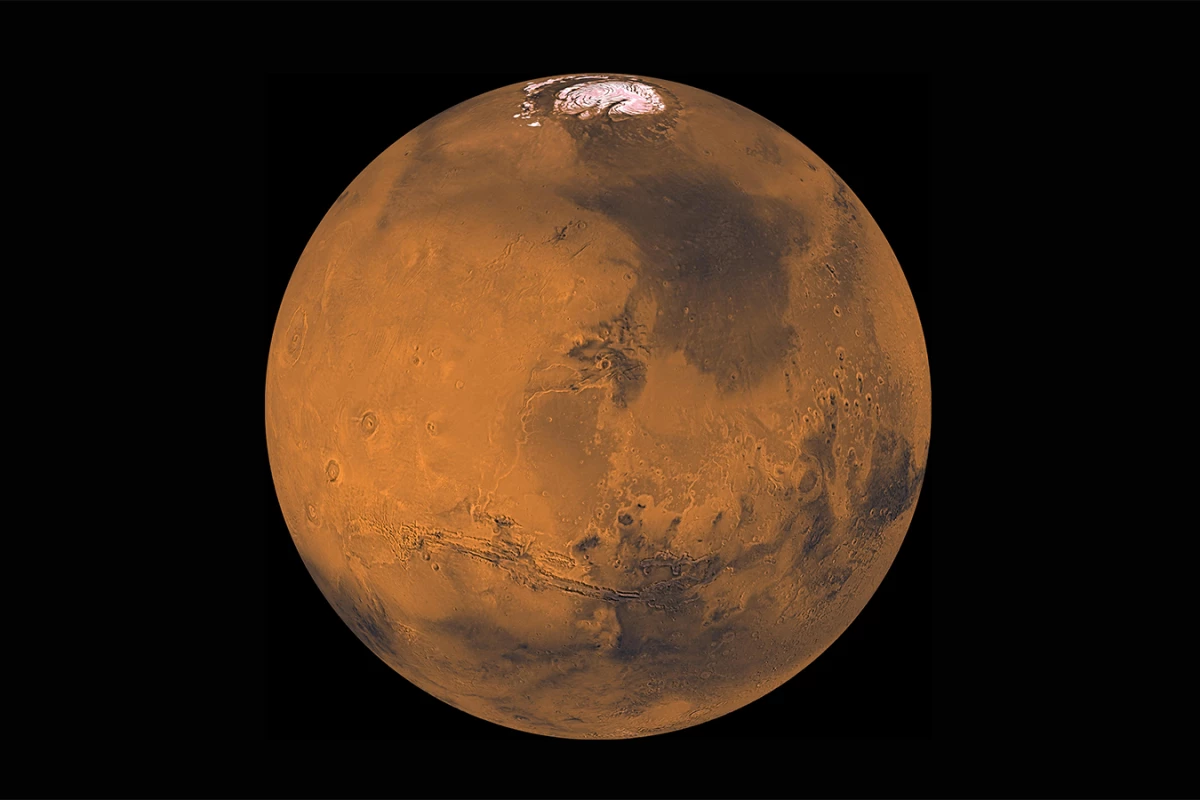
Human exploration of Mars is set to face new challenges as research reveals that time will pass differently on the Red Planet compared to Earth. According to a study conducted by scientists at the National Institute of Standards and Technology (NIST), astronauts on Mars will experience time running approximately 477 microseconds faster per day than on Earth. This discrepancy arises from the effects of gravity and motion as described by Albert Einstein’s Theory of Relativity.
Understanding how time functions in space is crucial for the success of future missions and potential human settlements on Mars. The findings, published in The Astronomical Journal, delve into the complexities of time dilation—a phenomenon that affects not just astronauts but also the technology used for navigation and communication.
Understanding Time Dilation on Mars
Time dilation occurs due to variations in speed and gravitational forces. For example, when GPS satellites orbit the Earth at about 17,500 mph (28,000 km/h), they experience time differently than clocks on the ground. In low Earth orbit, these satellites gain approximately 45 microseconds daily due to reduced gravitational pull, but they also lose about 7 microseconds due to their speed. This results in a net gain of 38 microseconds per day that must be corrected to maintain accurate positioning data.
On Mars, the situation becomes more intricate. The calculations for time dilation take into account multiple gravitational influences, including those of the Earth, Moon, Sun, and Mars itself. The research team, led by Neil Ashby and Bijunath Patla, discovered that the Martian orbit is more elliptical than that of the Moon, causing the speed of Mars around the Sun to vary throughout its year. This variation complicates the calculations, resulting in a more complex time dilation effect.
Implications for Future Missions
The implications of this research extend beyond theoretical physics. As humanity plans more ambitious missions to Mars, addressing these time discrepancies will be vital for reliable communication and navigation. Without corrections, data transmissions could be significantly off, leading to errors in position calculations that could amount to 89 miles (143 km) or more each day.
“It’s good to know for the first time what is happening on Mars time-wise,” said Neil Ashby. “Nobody knew that before. It improves our knowledge of the theory itself, the theory of how clocks tick and relativity.”
As space agencies prepare for the possibility of human colonies on Mars, the research highlights the need for a dynamic system to adjust for these time differences. The goal is to establish a reliable “internet of the Solar System” that can manage the complexities of time and communication across vast distances.
With Mars missions becoming more frequent, understanding the nuances of time dilation is essential. The study not only clarifies the scientific principles involved but also paves the way for practical solutions that will enhance the safety and effectiveness of future space exploration.


