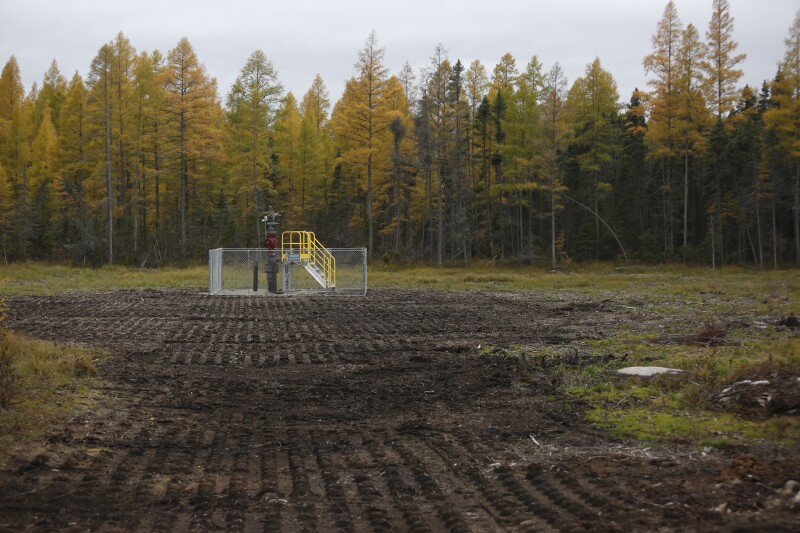
Mining companies are intensifying their search for hydrogen in Northeastern Minnesota, following the confirmation of helium reserves in the region. Two years after the initial discovery, Pulsar Helium has drilled three additional wells at its site between Babbitt and Isabella, bringing the total to five. The company aims to better assess the size of its helium reservoir, which is already among the highest concentrations globally.
Pulsar recently revealed that some of the helium extracted from its original well includes helium-3, a rare isotope valuable for applications in nuclear fusion and advanced computing. “A cylinder the size of my forearm here would be 30 million bucks,” noted Cliff Cain, CEO of Edelgas Group, which advises Pulsar on rare gases. Helium’s rarity on Earth, primarily sourced as a byproduct of decaying tritium from nuclear warheads, contributes to its high value. Some experts even consider sourcing helium from the moon, but Northeastern Minnesota remains an accessible option.
Hydrogen Exploration Gains Momentum
The geological features of the region, which include subsurface cracks and fissures, are believed to have trapped helium in pockets beneath the surface. These same characteristics are attracting attention from companies interested in exploring for hydrogen, often found alongside helium. Last month, Pulsar finalized the acquisition of a hydrogen exploration company, gaining access to over 59,000 acres in St. Louis and Itasca counties.
Thomas Abraham-James, president and CEO of Pulsar, mentioned that he is aware of other companies eyeing gas exploration in the area. He views their interest in helium not as competition, but as validation of the region’s potential. “It’s further validation of what we’ve done and the potential of this area,” he stated.
The search for hydrogen, often referred to as “natural hydrogen” or “geologic hydrogen,” is largely driven by the desire for a fuel that produces only water vapor when burned. Currently, most hydrogen is derived from fossil fuels, while other methods, such as electrolysis of water, require substantial energy. The possibility of naturally occurring hydrogen in Northeastern Minnesota has garnered interest from multiple companies.
The U.S. Geological Survey has identified areas along the Midcontinent Rift, which runs through Minnesota, as promising for hydrogen formation due to specific geological conditions. Quebec Innovative Materials Corp. recently announced its plans to explore for hydrogen in two townships within St. Louis County, while Koloma, backed by Bill Gates’ Breakthrough Energy Ventures, is preparing for exploratory drilling in the region.
Geological Factors and Future Prospects
Kristen Delano, Koloma’s head of government affairs, explained that the USGS data serves as a foundational reference for hydrogen exploration. The company is also utilizing artificial intelligence to analyze geological surveys and determine optimal drilling locations. “We also have expert geologists and data that shows us in the Iron Range, you have the right type of iron-rich rock,” Delano noted.
The confirmation of helium in Minnesota and the potential for hydrogen have prompted state officials to develop regulations for the emerging industry. The Minnesota Department of Natural Resources has stated that rulemaking for gas production permitting and leasing of state lands must be completed by May 2026.
The geological history of Northeastern Minnesota contributes to its potential as a hydrogen source. The Midcontinent Rift, formed 1.1 billion years ago, left behind deposits of copper, nickel, and other metals. Iron-rich olivine, found in the Duluth Complex, reacts with water to produce hydrogen. Latisha Brengman, an associate professor of earth and environmental sciences at the University of Minnesota Duluth, explained that these geological processes provide the right conditions for hydrogen production.
Hydrogen can also form through a process called radiolysis, where radiation from old granite decomposes water into hydrogen over extended periods. Although reactions creating hydrogen are believed to occur regularly, only one known reservoir exists in Mali, which has been utilized to power a nearby village. Experts suggest that additional natural hydrogen sources are yet to be discovered, with techniques combining both natural and engineered processes being explored.
As companies pursue hydrogen as a carbon-free energy source, the implications for various industries could be significant. Delano emphasized that regionally sourced hydrogen could revolutionize sectors such as iron mining and steelmaking. “Natural hydrogen’s best use is being put to use for other energy needs and cleaning up those really hard-to-abate sectors,” she stated.
Despite the promise of hydrogen, challenges remain in its storage and transport due to its lightweight and tendency to leak. Research published in Frontiers in Energy Research indicates that while hydrogen itself is not a greenhouse gas, its leakage can indirectly contribute to warming through its interactions with methane and tropospheric ozone.
Koloma anticipates being “very, very active” in 2026, with plans for seismic studies to assess subsurface conditions using specialized equipment. If the data aligns with their expectations, the company aims to establish a strong presence in Minnesota’s hydrogen exploration landscape. As Brengman prepares to collaborate with the U.S. Department of Energy’s National Laboratory of the Rockies to predict hydrogen production locations, she highlights the Midwest’s geological advantages. “The Midwest has a lot of great potential because it’s a very old terrain, and so there’s lots of old-water rock interaction to map out,” she said.