Four astronauts are gearing up for a monumental mission that will mark the first human journey beyond Earth’s gravity well to the Moon in over fifty years. Scheduled for launch in February 2026, NASA’s Artemis 2 mission aims to send these astronauts aboard the Orion spacecraft, which is mounted on the powerful Space Launch System (SLS) rocket. While the mission will not involve landing on the lunar surface—that goal is reserved for the subsequent Artemis 3 mission, slated for 2027—the crew will undertake a daring flight around the Moon, potentially reaching the furthest point from Earth ever achieved by humans.
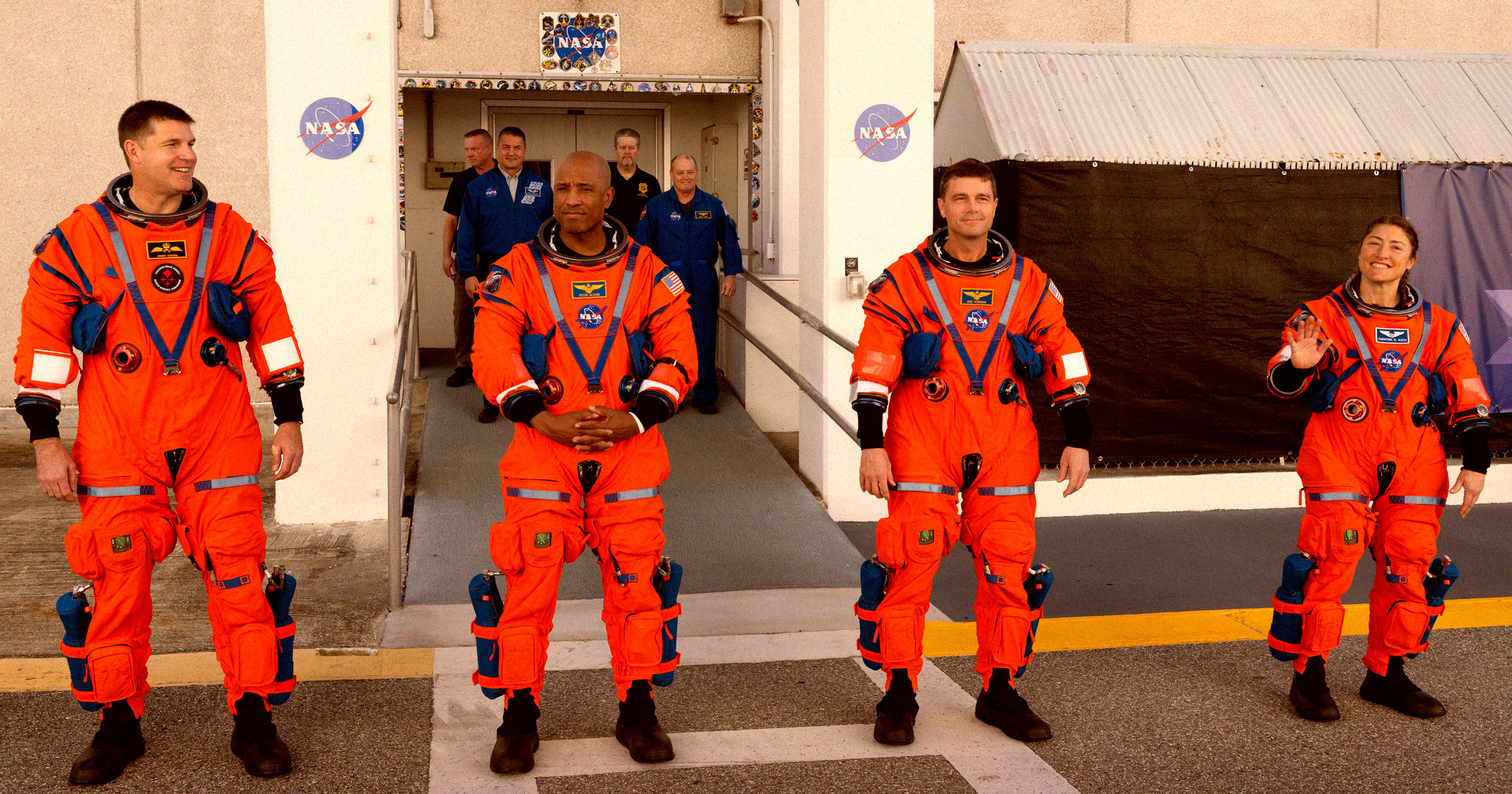
NASA’s preparations for Artemis 2 have gained momentum recently, with significant steps taken over the weekend. During a dress rehearsal, Canadian astronaut Jeremy Hansen and American astronauts Victor Glover, Reid Wiseman, and Christina Koch donned their bright orange Orion Crew Survival System suits, designed over several years for the mission. This rehearsal simulated launch day activities, including suit donning and boarding the spacecraft, even though the SLS rocket is yet to be positioned on the launch pad at the Kennedy Space Center.
The rehearsal took place in the Vehicle Assembly Building at NASA’s Kennedy Space Center. Engineers are currently finalizing preparations for the spacecraft, the SLS rocket, and ground systems. Although the dress rehearsal was initially scheduled for November 19, complications regarding the Orion’s hatch delayed the test. A spokesperson for NASA explained, “This demonstration was paused when a blemish was found on the crew module thermal barrier, preventing hatch closure until it could be addressed.” Despite these challenges, NASA remains optimistic, stating that Artemis 2 is on track for a launch no later than April 2026, with potential opportunities for an earlier launch as soon as February.
As the countdown to launch day continues, this rehearsal served as a vital verification of the timeline for both the crew and the supporting teams on the ground. Preparations are also being made for potential emergencies that could arise at the launch pad. The complexity of these tasks is immense, but the potential rewards are equally significant.
The last human presence near the Moon was during NASA’s Apollo 17 mission, which launched just over fifty-three years ago. As excitement builds, the upcoming Artemis 2 mission represents a significant step toward returning humans to the Moon and furthering exploration of the solar system.