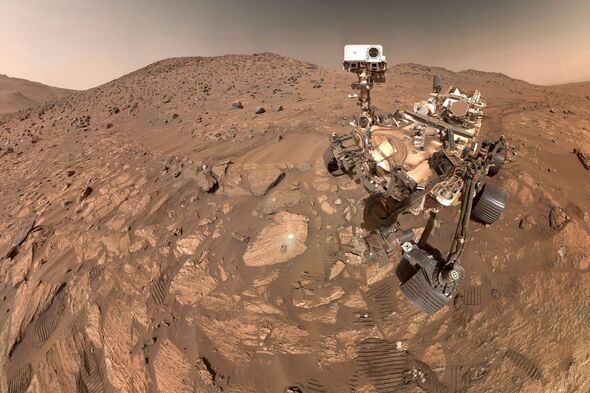
NASA’s Perseverance rover has made a significant discovery by recording crackling sounds on Mars, believed to originate from lightning. The findings, detailed by a French-led team, indicate that these sounds were detected while the rover monitored wind conditions on the planet. This marks the first time that what is presumed to be lightning has been captured on Mars, despite scientists previously suspecting its existence.
The rover’s microphone picked up these intriguing noises during a two-year observation period, identifying what researchers refer to as “mini lightning” on 55 separate occasions. Most of these events coincided with dust storms and dust devils, particularly on the windiest Martian sols. The electrical discharges occurred within approximately 6 feet (2 meters) of the microphone, which is positioned atop the rover’s tall mast.
Breakthrough Discovery in Martian Weather Phenomena
The crackling sounds, likely a result of electrical discharges, were clearly audible above the intense wind gusts and swirling dust particles. Described as reminiscent of static electricity on Earth, these discharges add a new dimension to our understanding of Martian weather.
Lead author Baptiste Chide from the Institute for Research in Astrophysics and Planetology in Toulouse expressed excitement over the discovery. He stated, “It opens a completely new field of investigation for Mars science. It’s like finding a missing piece of the puzzle.” Chide and his colleagues have spent the last five years searching for evidence of electrical activity and lightning on Mars.
While the findings are promising, Daniel Mitchard from Cardiff University cautioned that the results stem from a single instrument designed primarily to record laser interactions with Martian rocks. Mitchard, who was not involved in the study, noted, “It really is a chance discovery to hear something else going on nearby, and everything points to this being Martian lightning.” He added that there may still be debate within the scientific community regarding the interpretation of this data.
Insights into Martian Electrical Activity
The researchers analyzed a total of 28 hours of recordings that captured the perceived “mini lightning.” The electrical discharges from dust devils were brief, lasting only a few seconds, while those associated with dust storms could be heard for up to 30 minutes. Chide likened the phenomenon to a thunderstorm on Earth, albeit with limited visibility and subtle electric zaps.
According to Chide, Mars’ atmosphere is more susceptible to electrical discharges compared to Earth. Despite the compelling evidence, Mitchard reassured that it is “extremely unlikely” for the first human to walk on Mars to be struck by lightning while planting a flag on the surface. He did, however, note that the “small and frequent static-like discharges could prove problematic for sensitive equipment.”
This groundbreaking discovery not only enhances our understanding of the Martian environment but also opens up new avenues for future research as scientists continue to explore the planet’s complex atmospheric phenomena.