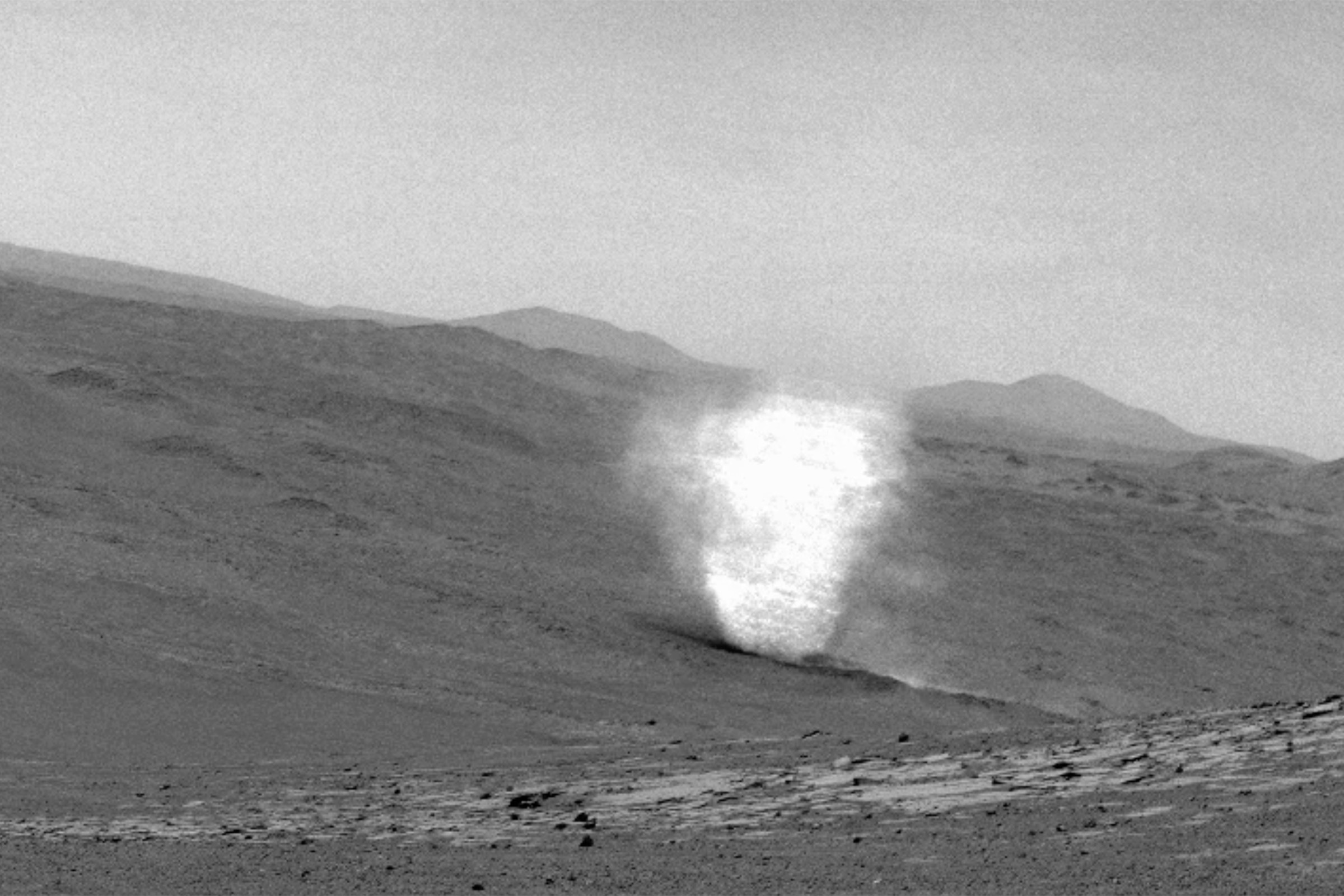
NASA’s Perseverance rover has made a groundbreaking discovery on Mars by capturing evidence of lightning discharges occurring within Martian dust devils. This phenomenon, previously suspected but never observed, has been confirmed in a study published in the journal Nature. The findings suggest that electrical discharges are generated in the thin atmosphere of Mars, particularly during the activity of dust devils.
Dust devils on Mars are similar to those on Earth, formed by rapidly rising columns of warm air that create whirlwinds. These whirlwinds, caused by temperature differences between the ground and cooler air above, trap dust particles that generate static electricity through a process known as the triboelectric effect. This effect can be seen on Earth, where shuffling across a carpet may create a spark when touching a metal object. Lead author Baptiste Chide, a planetary scientist from L’Institut de Recherche en Astrophysique et Planétologie, noted in a NASA statement that the thin atmosphere on Mars makes such electrical phenomena more likely due to lower charge requirements for generating sparks.
The absence of detected lightning on Mars had long puzzled scientists, especially given its presence on other planets like Saturn and Jupiter, which are not as closely monitored as Mars. The Perseverance rover has been equipped with a microphone on its SuperCam instrument, initially designed to analyze the sounds of Martian rocks when struck by a laser. Remarkably, this microphone recorded a total of 55 electrical disturbances since the rover’s mission began in 2021, with sixteen of these discharges occurring when a dust devil passed directly over the rover.
The lack of increased electrical activity during Mars’ frequent dust storms indicates that the source of the discharges is indeed the dust devils. This discovery is enhanced by the fortuitous frequency with which these whirlwinds have passed by the rover, allowing scientists to validate their hypothesis.
The implications of this finding are significant. Lightning has the potential to trigger unique chemical reactions and influence the chemical balance on Mars’ surface, which could affect the formation of complex compounds and possibly even organic molecules. As researchers continue to analyze these electrical phenomena, the discovery adds another layer to our understanding of the Red Planet and its atmospheric dynamics.
As scientists explore these exciting developments, the findings may pave the way for deeper investigations into the potential for life on Mars and the broader implications for planetary science.