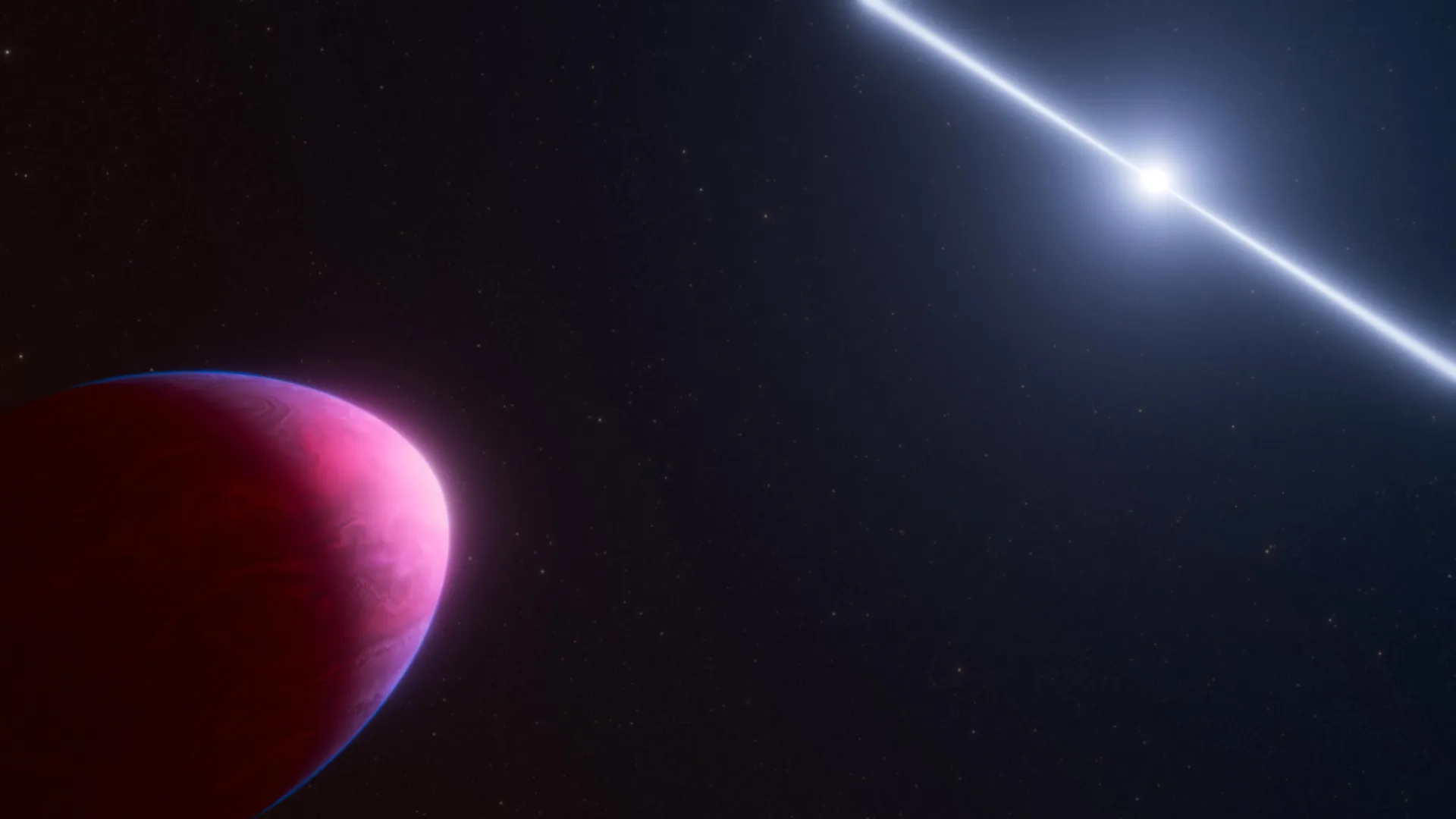
NASA’s James Webb Space Telescope has identified a peculiar exoplanet that challenges existing theories of planetary formation. Officially named PSR J2322-2650b, this newly discovered world orbits a neutron star and exhibits an unusual carbon-rich atmosphere, leading scientists to speculate about its potential diamond core. Its extreme gravitational forces shape the planet into a lemon-like form, and it completes an orbit in just 7.8 hours, raising fundamental questions about how such a planet could exist.
Unique Atmospheric Composition
The characteristics of PSR J2322-2650b defy conventional classification, existing in a gray area between planets and stars. With a mass similar to Jupiter, the planet’s atmosphere is dominated by helium and carbon compounds, rather than the more familiar gases like water and methane that are typically found on exoplanets. Researchers have detected dark, soot-like clouds surrounding the planet, and under the immense pressure within, carbon may crystallize into diamonds.
“This is a new type of planet atmosphere that nobody has ever seen before,” said Michael Zhang, an astrophysicist at the University of Chicago and principal investigator of the study, which has been accepted for publication in The Astrophysical Journal Letters. He added, “The planet orbits a star that’s completely bizarre — the mass of the Sun, but the size of a city.”
A Rare Observational Opportunity
The planet’s unique position allows researchers to study it in detail. Maya Beleznay, a graduate student at Stanford University, noted, “This system is unique because we are able to view the planet illuminated by its host star, but not see the host star at all.” This rare opportunity enables scientists to gather a pristine spectrum, facilitating a more detailed investigation than is typically possible with other exoplanets.
Upon analyzing the planet’s atmospheric signature, scientists discovered unexpected molecular compositions. Instead of the common molecules found on exoplanets, they identified molecular carbon forms, specifically C3 and C2. Zhang remarked, “It’s very hard to imagine how you get this extremely carbon-enriched composition. It seems to rule out every known formation mechanism.”
The planet’s proximity to its neutron star is staggering, orbiting at just 1 million miles away, compared to Earth’s distance of approximately 100 million miles from the Sun. This close orbit subjects PSR J2322-2650b to intense gravitational forces, stretching its shape and causing it to spin rapidly.
Exploring the Enigma
The system may belong to a rare category known as a black widow, where a fast-spinning pulsar is paired with a lower-mass companion. As the pulsar consumes material from its partner, its spin rate increases, creating a powerful stellar wind. Zhang emphasized the complexity of PSR J2322-2650b, stating, “Did this thing form like a normal planet? No, because the composition is entirely different.”
Experts like Roger Romani from Stanford University have proposed theories about the planet’s atmosphere. “As the companion cools down, the mixture of carbon and oxygen in the interior starts to crystallize,” Romani explained. This process might lead to pure carbon crystals floating to the top, mixing with helium. “But then something has to happen to keep the oxygen and nitrogen away. And that’s where there’s controversy.”
The discovery of PSR J2322-2650b was made possible due to the advanced capabilities of the James Webb Space Telescope, particularly its infrared sensitivity. Zhang highlighted, “On Earth, lots of things are hot, and that heat really interferes with the observations.” Webb’s ability to observe from a million miles away allows for clearer data collection, which is critical for understanding such distant celestial bodies.
This extraordinary finding not only expands our knowledge of planetary formation but also opens new avenues for exploration in the field of astrophysics. As researchers continue to investigate the nature of PSR J2322-2650b, the scientific community remains eager to unravel the mysteries surrounding this unprecedented exoplanet.