Pancreatic ductal adenocarcinoma (PDAC) is one of the most challenging cancers to treat, marked by its aggressive progression and a lack of effective prognostic tools. Traditional staging systems, such as the TNM classification, primarily focus on anatomical factors, which may not provide a complete picture for patient prognosis. In response to these limitations, researchers at the Tianjin Medical University Cancer Institute & Hospital have developed the Tianjin Grading System, which integrates anatomical, biological, and patient-specific factors to enhance prognostic accuracy.
The new grading system was introduced in a study published in Cancer Biology & Medicine in 2025. It aims to refine patient risk stratification and incorporates critical elements such as lymph node metastasis and serum levels of the tumor marker CA19-9. By combining these diverse factors, the Tianjin Grading System offers a more comprehensive approach to managing PDAC, ultimately aiding in clinical decision-making.
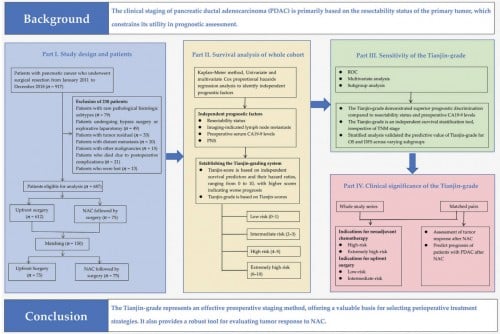
Research conducted on a cohort of 687 PDAC patients who underwent surgical resection revealed that this new grading system significantly outperformed traditional methods. By analyzing various prognostic factors—such as tumor resectability, imaging-detected lymph node metastasis, serum CA19-9 levels, and the Prognostic Nutritional Score (PNS)—the researchers identified independent prognostic factors that influence overall survival (OS) and disease-free survival (DFS).
Enhanced Prognostic Accuracy through Multi-Dimensional Assessment
The patients involved in the study were classified into four distinct risk groups: low-risk (0-1), intermediate-risk (2-3), high-risk (4-5), and extremely high-risk (6-10). Each group displayed significantly different survival outcomes. Notably, individuals categorized as high- and extremely high-risk exhibited considerable benefits from neoadjuvant chemotherapy (NAC), underscoring the importance of tailored treatment strategies.
Dr. Jihui Hao, a lead researcher on the project, emphasized the significance of this advancement, stating, “The Tianjin Grading System offers a more accurate way of predicting outcomes for PDAC patients by integrating not just anatomical factors but also biological and patient-specific conditions. This system helps us better understand which patients will benefit most from aggressive treatments like neoadjuvant chemotherapy, paving the way for more personalized, effective care strategies.”
The Tianjin Grading System is designed to streamline clinical decision-making regarding the treatment of PDAC. It aids in determining whether patients should undergo immediate surgery or receive NAC based on their risk profile. This comprehensive assessment also allows healthcare providers to tailor treatment plans, ultimately improving survival rates for high-risk patients while preventing overtreatment in low-risk cases.
Practical Applications in Diverse Clinical Settings
One of the remarkable aspects of the Tianjin Grading System is its accessibility. The system employs standard imaging and laboratory tests, making it a practical tool for clinical environments, including those with limited resources. By establishing a new standard in personalized pancreatic cancer care, the system has the potential to improve outcomes for patients globally.
The research was supported by the Tianjin Natural Science Foundation under Grant No. 24JCYBJC00580. This collaborative effort highlights the ongoing commitment to enhancing cancer treatment methodologies and emphasizes the necessity for deeper research into integrative approaches in the management of complex diseases like pancreatic cancer.
In summary, the Tianjin Grading System represents a significant advancement in the prognosis and treatment of PDAC. By merging anatomical and biological data into a single comprehensive grading framework, it stands to improve clinical outcomes and patient care in the face of one of the most formidable cancers.