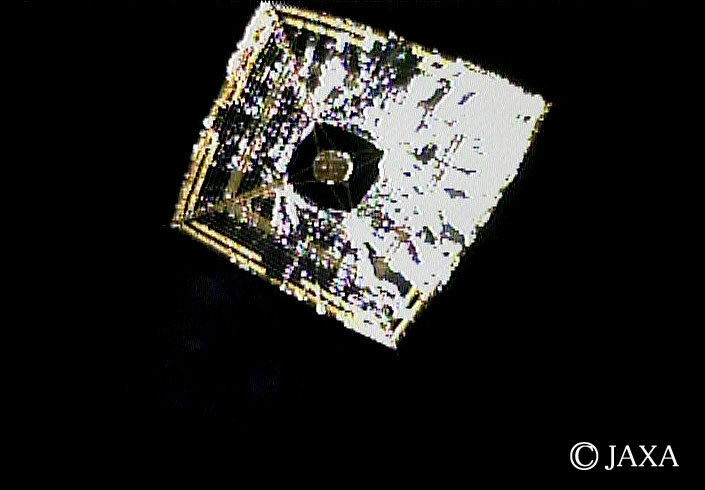
Advancements in solar sailing technology could soon enhance the way spacecraft maneuver in space. Researchers from the University of Pennsylvania, led by Gulzhan Aldan and Igor Bargatin, have developed a novel technique for turning solar sails using a method inspired by the Japanese art of kirigami. Their findings, published in a pre-print paper on arXiv, propose a system that allows solar sails to adjust their angle in response to sunlight without relying on traditional propellant-based systems.
The challenge of maneuverability has long been associated with solar sails, which typically require complex mechanisms to change direction. Traditional methods include reaction wheels, which, while effective, are heavy and require propellant. More recent innovations, such as tip vanes and Reflectivity Control Devices (RCDs), present their own limitations, including mechanical complexity and power consumption. In contrast, the kirigami approach involves strategic cuts in the sail material, allowing it to buckle and create a three-dimensional surface that can reflect light at various angles.
The innovation lies in the design of the sail’s grid-like structure, featuring axial and diagonal cuts in the aluminized polyimide film. When tension is applied, these cuts enable the material to deform, creating surfaces that act as thousands of miniature mirrors. Each segment can be angled to optimize the reflection of sunlight, resulting in thrust in the opposite direction due to the principle of conservation of momentum.
While some electrical power is necessary to activate the servo motors that induce the buckling, this system is more efficient than previous methods. Unlike RCDs used in the IKAROS mission in 2010, which consume energy continuously, the kirigami technique only draws power during operation.
To validate their model, Aldan and Bargatin conducted simulations using COMSOL, a standard physics simulation software. They performed ray tracing experiments to gauge the forces exerted on the sail at various angles. Their findings indicated a small but sufficient force of 1 nN per Watt of sunlight, enough to effectively turn a small solar sail and its payload over time.
In addition to simulations, the team executed a physical experiment. They prepared a sample of the kirigami film and placed it in a test chamber illuminated by a laser. As they stretched the film, they observed the laser’s movement on the chamber wall, confirming their predictions about the angle of incidence across different strain levels.
This innovative technique has the potential to significantly reduce the energy and propellant costs associated with maneuvering solar sails, paving the way for more efficient space exploration. While there are other technologies competing in this field, the practical implementation of kirigami sails may take time, with limited experimental missions currently available for testing.
As the research progresses, the future of solar sailing looks promising, with the potential for stunning visual effects in space as these technologically advanced sails come into play. Further exploration and testing are necessary to fully harness this technique, but the implications for solar sailing and space travel are considerable.
Learn more about the research from Aldan and Bargatin in their paper titled “Low-Power Solar Sail Control using In-Plane Forces from Tunable Buckling of Kirigami Films.”