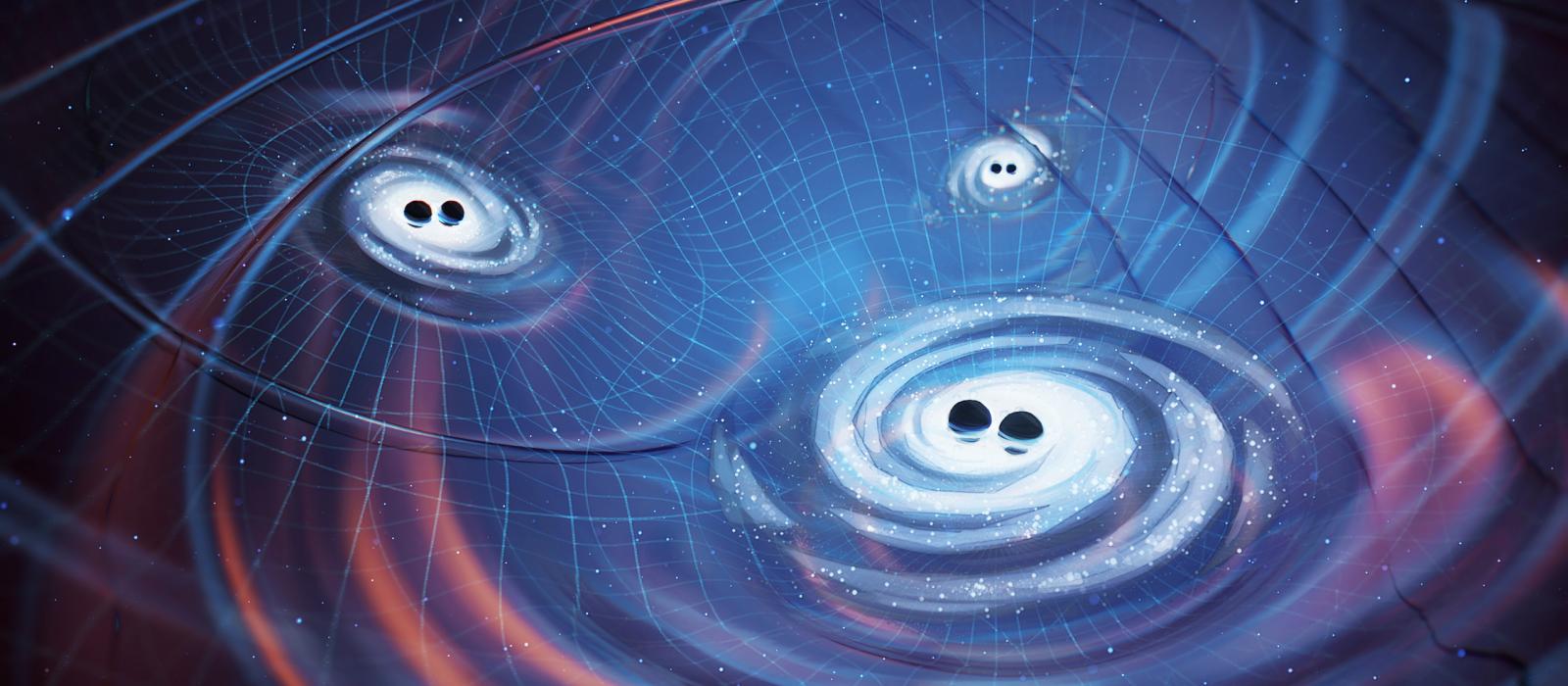
The discovery of gravitational waves (GWs) has opened new avenues in astrophysics, and recent research from the University of Amsterdam (UvA) proposes a novel method to explore the elusive substance known as dark matter. This groundbreaking study, published in the journal Physical Review Letters, suggests that GWs generated from merging black holes could provide crucial insights into the nature of dark matter, which is believed to constitute approximately 65% of the universe’s mass.
Researchers from UvA’s Institute of Physics and the Gravitation & Astroparticle Physics Amsterdam (GRAPPA) led the study, which was directed by Rodrigo Vicente, Theophanes K. Karydas, and Gianfranco Bertone. This innovative work builds on Einstein’s Theory of General Relativity, which predicted GWs when massive objects, such as black holes and neutron stars, collide and create ripples in spacetime.
The study focuses specifically on Extreme Mass-Ratio Inspirals (EMRIs), a phenomenon where black hole binaries or other compact celestial objects spiral inward to form larger black holes. By employing a more comprehensive modeling approach, the researchers examined how dark matter influences these events through its gravitational effects. Their framework diverges from previous studies that relied on simplified Newtonian descriptions, instead utilizing a fully relativistic model that accounts for various environmental conditions surrounding black holes.
Through this advanced methodology, the researchers identified how dense concentrations of dark matter might create distinct “spikes” or “mounds” around massive black holes. These features, they argue, would leave a recognizable imprint on the GWs detected by future observatories.
In anticipation of these advancements, the European Space Agency (ESA) is set to launch the Laser Interferometer Space Antenna (LISA) within the next decade. This pioneering space-based observatory will be equipped to measure the ripples in spacetime produced by gravitational waves, with the potential to identify over 10,000 signals throughout its mission. The findings from UvA’s research will play a significant role in guiding expectations for LISA and other existing detectors, such as the Laser Interferometer Gravitational-Wave Observatory (LIGO) and the Virgo Collaboration.
The implications of this research extend beyond mere detection; it contributes to a growing field that aims to map the distribution of dark matter throughout the universe. The ability to do so could illuminate not only the composition of dark matter but also the fundamental nature of this mysterious mass.
As scientists continue to unravel the complexities of the cosmos, studies like this one represent critical steps toward decoding the mysteries that dark matter holds, potentially reshaping our understanding of the universe for generations to come.