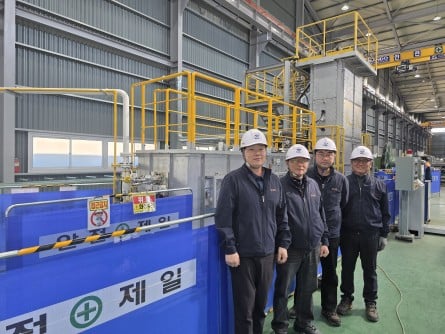
Researchers at the Korea Institute of Energy Research (KIER), led by Dr. Hookyung Lee, have developed an innovative electrification technology that transforms the traditional fossil fuel-dependent heat treatment process in the production of galvanized steel strips into a carbon-free operation. This breakthrough is expected to have significant applications across energy-intensive industries, particularly in steelmaking, as the global push for decarbonization accelerates.
The new technology aligns with South Korea’s ambitious goal to reduce greenhouse gas emissions by up to 31% from 2018 levels by 2035. The government has intensified efforts to decarbonize industrial processes, focusing on electrification as a means to achieve national climate targets. Consequently, sectors such as steel manufacturing are under increasing pressure to adopt cleaner technologies.
Galvanized steel strips are produced through a continuous galvanizing line (CGL) process, which involves immersing steel plates in a molten zinc bath for coating. A crucial step in this process is annealing—a heat treatment that enhances the ductility and formability of steel. Traditionally, this step relies on burning fossil fuels, leading to significant greenhouse gas emissions. The steel industry, including the zinc manufacturing process, contributes approximately 15% of South Korea’s total national emissions.
To combat these emissions, the research team introduced a “carbon-free annealing system” that replaces conventional burners with electric heating elements. This system was tested under conditions that closely mimic commercial production processes, yielding remarkable results. The new technology achieved a reduction of over 98% in carbon dioxide and nitrogen oxide concentrations in exhaust gases compared to traditional combustion-based systems.
The design of the new annealing system retains the essential features of existing furnaces while integrating electric heating elements positioned strategically to ensure rapid and uniform heating. By optimizing the distance between heating elements and the steel strips, the system minimizes heat loss, providing efficient energy use.
When applied to steel strips measuring 0.49 millimeters in thickness and heated to 750°C, the technology demonstrated that product quality remained consistent with that achieved through conventional methods. The emissions reductions indicate a promising shift towards sustainable practices without compromising productivity.
In addition to environmental benefits, the electric annealing furnace eliminates the need for fuel supply and exhaust systems, reducing capital investment costs and installation space by approximately 40%. When powered by renewable energy sources such as wind and solar, this system could facilitate a genuinely carbon-free heat treatment process, addressing global environmental regulations like the Carbon Border Adjustment Mechanism (CBAM).
Dr. Lee emphasized the significance of this achievement, stating, “This demonstration is the world’s first case to show that carbon-free heating can be achieved simply by replacing burners with electric heating elements.” Looking forward, the research team plans to integrate artificial intelligence into the system, allowing for optimal heating configurations based on specific production parameters.
The results of this study were published in September 2025 in the journal Applied Thermal Engineering, recognized globally in the fields of energy and thermal engineering. The research was supported by Korea’s Ministry of Trade, Industry and Energy, with practical demonstrations conducted at the facilities of Samwoo Eco Co., Ltd., in collaboration with industry partners. This advancement not only showcases technological innovation but also positions South Korea as a leader in the global movement towards sustainable industrial practices.