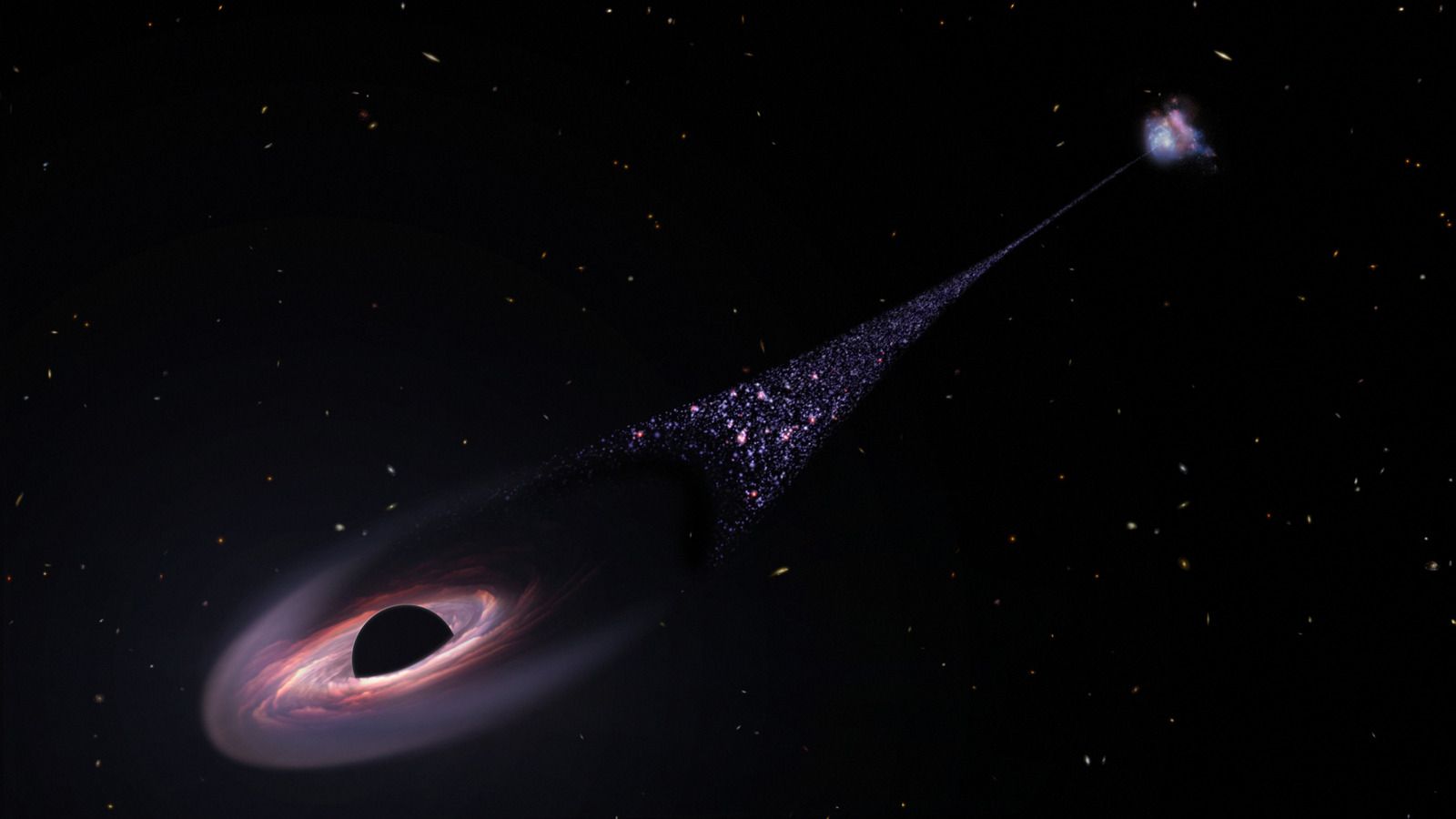
A team of scientists has confirmed the first-ever “runaway” supermassive black hole (SMBH), estimated to have a mass equivalent to 20 million suns. This extraordinary black hole is moving away from its original galaxy at a remarkable speed of 2.2 million mph, leaving a substantial trail of gas and newly formed stars in its wake. The discovery was detailed in a paper titled “JWST Confirmation of a Runaway Supermassive Black Hole via its Supersonic Bow Shock,” authored by Pieter van Dokkum from Yale University and his research team, and was uploaded to arXiv in December 2025.
The potential runaway black hole was initially identified in 2023 during an analysis of images taken by the Hubble Space Telescope. The researchers noticed a thin line connecting to the center of a galaxy in the image, which suggested the presence of a massive black hole ejected from its galaxy. Van Dokkum explained in an interview with Live Science that the line indicated a significant event, as they were “seeing a very massive black hole that was ejected from the galaxy.”
To confirm their findings, the team utilized the advanced imaging capabilities of the James Webb Space Telescope (JWST). The JWST provided crucial evidence by revealing a bow shock at the front of the black hole, confirming that it is indeed escaping its galaxy at an unprecedented pace. The existence of supermassive black holes has long fascinated scientists, as they are believed to reside at the centers of most galaxies. Yet, questions remain about how these colossal entities form and grow rapidly.
The paper published in The Astrophysical Journal Letters theorizes that the runaway black hole was propelled on its escape trajectory due to a phenomenon known as a “velocity kick.” This event could result from either gravitational-wave recoil or a three-body interaction, with the authors suggesting that gravitational-wave recoil is the more likely cause. Van Dokkum elaborated that velocity kicks can occur when two supermassive black holes come into close proximity, resulting in one being ejected due to the gravitational forces at play.
This newly identified runaway black hole may not be an isolated case. The research paper also highlights other potential candidates, including a massive black hole in the dwarf galaxy MaNGA 12772-12704, located approximately 1 kiloparsec from the galaxy’s center. This finding was first reported in a short communication published in Volume 70, Issue 21 of Science Bulletin.
As the scientific community awaits further peer review and validation of these findings, the confirmation of a runaway SMBH marks a significant milestone in our understanding of black holes and their dynamic behavior in the universe. The implications of this discovery could reshape theories surrounding the formation and evolution of these enigmatic cosmic giants.