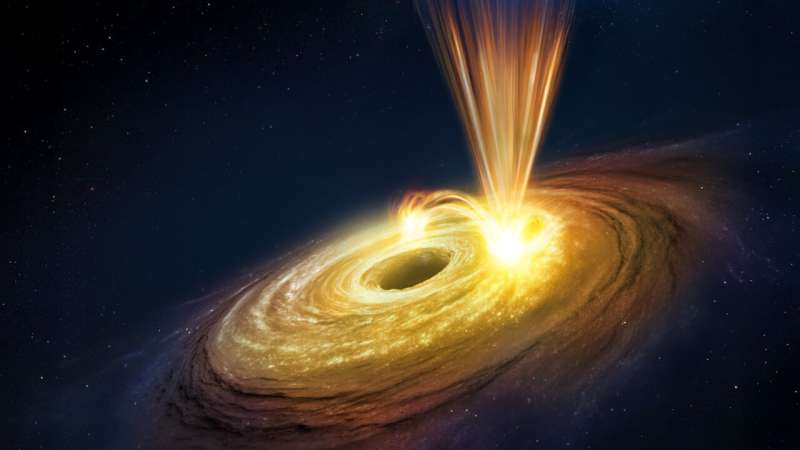
An international team of astronomers has made a groundbreaking discovery involving the supermassive black hole NGC 3783. They observed a substantial outburst of matter being ejected at speeds reaching 20% of the speed of light, a phenomenon linked to a sudden change in the black hole’s magnetic field. This research, primarily conducted with the XRISM space telescope, marks a significant advancement in understanding the dynamics surrounding black holes.
Over a continuous observation period of ten days, the researchers captured the formation and acceleration of this outburst. While similar events are typically attributed to strong radiation, this instance suggests that magnetic forces played a pivotal role, akin to solar flares on the Sun. The findings were published in the journal Astronomy & Astrophysics, highlighting the importance of international collaboration in space research.
Unprecedented Observations at NGC 3783
The study revealed that the ejected gas originated from a region approximately 50 times the size of the black hole itself. In this turbulent area, gravitational and magnetic forces interact in extreme conditions. The team, led by Liyi Gu, proposes that a process known as magnetic reconnection is responsible for the ejection. This phenomenon involves a sudden reconfiguration of magnetic fields, resulting in the release of vast amounts of energy.
“This is a unique opportunity to study the launch mechanism of ultrafast outflows,” said Gu. The data collected indicate that the acceleration of the outflow is driven by magnetic forces, similar to the coronal mass ejections observed on the Sun. These solar events involve large blobs of hot plasma being expelled into space, but the eruptions from a supermassive black hole dwarf such occurrences by a factor of ten billion.
Implications for Understanding Black Holes
This discovery offers new insights into the dual role of black holes, not only as entities that pull matter in but also as powerful sources that can eject material back into space. This process, known as feedback, is crucial for understanding galaxy formation and evolution. It influences the surrounding stars and gas, shaping the universe as we see it today.
The research also underscores the significance of collaboration among various space missions. The XRISM space telescope led the observational campaign, supported by instruments from XMM-Newton, NuSTAR, Hubble, Chandra, Swift, and NICER. This coordinated effort exemplifies the advancements that can be achieved through cooperative scientific initiatives.
The implications of this work extend beyond the confines of astrophysics. By enhancing our understanding of black hole dynamics, these findings may inform future research on cosmic phenomena and their role in the broader context of the universe. The study not only enriches our knowledge of supermassive black holes but also opens up new avenues for exploration in the field of astrophysics.