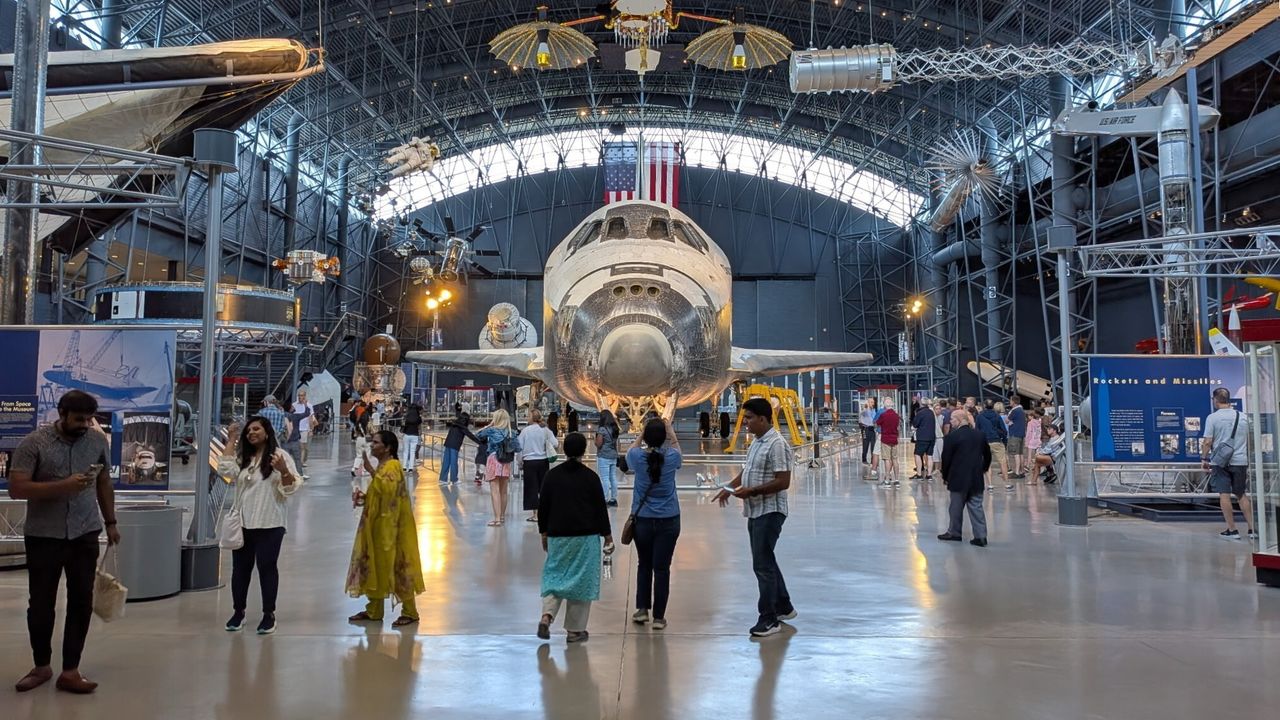
The battle over the future of the space shuttle Discovery has intensified, drawing the attention of the Department of Justice (DOJ). Texas Senators John Cornyn and Ted Cruz, along with Representative Randy Weber, are urging an investigation into the Smithsonian Institution for potential violations of the Anti-Lobbying Act. The lawmakers are advocating for the shuttle’s relocation from the Smithsonian’s Udvar-Hazy Center in Virginia to Houston, Texas, home of NASA’s Johnson Space Center.
In a letter dated October 22, 2023, addressed to Attorney General Pam Bondi and Assistant Attorney General Brett Shumate, the Texas representatives allege that the Smithsonian has misused federal funds to oppose the legislative intent of President Trump’s “One Big Beautiful Bill Act” (OBBBA). This act mandates the transfer of Discovery to Houston, although the language does not explicitly mention the shuttle. Instead, it directs the transfer of a “space vehicle” to a NASA center involved in the administration of the Commercial Crew Program.
The controversy began with the introduction of the “Bring the Space Shuttle Home Act” in April 2023, which failed in committee but was later incorporated into OBBBA. Signed into law on July 4, 2023, the bill established a deadline for NASA’s administrator to select a vehicle for relocation, with an 18-month window for the shuttle’s move to Houston. The lawmakers emphasize Houston’s significance, describing it as “the cornerstone of America’s human space exploration program.”
Despite the lawmakers’ assertions, the Smithsonian maintains that it owns Discovery outright. The institution has expressed serious concerns regarding the legalities of transferring the shuttle from its stewardship, as well as the logistics and costs associated with such a move. The Smithsonian estimates that relocating the 122-foot-long (37-meter) orbiter would require partial disassembly, with costs ranging from $120 million to $150 million. This figure far exceeds the $85 million allocated for the move under the OBBBA, which remains unappropriated.
The Smithsonian’s Position and Historical Context
Discovery’s final home was determined over a decade ago during a nationwide competition to decide the future locations for the remaining space shuttles after their retirement in 2011. Various educational institutions, museums, and space centers submitted bids. Ultimately, Atlantis was awarded to the Kennedy Space Center in Florida, Endeavour went to the California Science Center, and Discovery found its home at the Smithsonian. According to the Smithsonian, NASA transferred “all rights, title, interest and ownership” of Discovery to the museum in 2012, reinforcing its legal responsibility for the shuttle’s conservation.
Texas lawmakers have contested both the Smithsonian’s cost estimates for transporting Discovery and its claim of ownership. Their letter to the DOJ refers to “industry experts” who allegedly estimate the actual relocation costs to be significantly lower than the Smithsonian’s projections. Furthermore, they challenge the assertion that the Smithsonian operates as a federal entity, arguing that it is not bound by typical federal regulations.
The Smithsonian is recognized as a “trust instrumentality,” created by Congress to serve a public purpose, but it functions independently from the traditional federal agency structure. Although it receives two-thirds of its funding from the government, it is tasked with maintaining its national collection for the American public.
In their letter, Cornyn, Cruz, and Weber also criticize the Smithsonian’s leadership and its exhibits, which they claim reflect a “politicized agenda” that undermines its responsibilities as a federal entity. They cite concerns over the institution’s portrayal of slavery in American history and its plans for the upcoming American Women’s History Museum, which includes transgender women.
Joe Stief, founder of KeeptheShuttle.org, an independent group opposed to the relocation, described the lawmakers’ actions as an effort to silence the Smithsonian from defending its ownership rights. Stief noted that the lawmakers’ complaint mirrors an earlier appeal made to Chief Justice John Roberts, who presides over the Smithsonian’s Board of Regents, which resulted in no public response.
The Texas lawmakers’ letter asserts that the Smithsonian’s actions could constitute violations of the Anti-Lobbying Act, which prohibits the use of federal funds to influence public pressure on Congress regarding legislative matters. They request that the DOJ determine if Smithsonian personnel or funds were utilized in efforts to obstruct the law.
Despite the ongoing dispute, the Smithsonian has not publicly responded to the lawmakers’ allegations and is currently unable to comment due to the government shutdown. The resolution of this conflict may hinge on a review by the DOJ, which could clarify the application of the Anti-Lobbying Act to hybrid institutions like the Smithsonian that depend on both federal and trust funding.