The Pittsburgh Steelers are facing significant challenges on the defensive front, despite investing heavily in their roster. In 2025, the team allocated resources to uphold its historic identity as a defensive powerhouse, including using their first-round pick to select Derrick Harmon at No. 21. Yet, their defense has struggled, raising concerns about their effectiveness.
A report from Over The Cap reveals that the Steelers currently have the highest-paid defensive roster in the National Football League, spending nearly $30 million more than the next closest team, the New York Giants. Despite these investments, the results have been disappointing, particularly in high-stakes games where their defense has been exposed. Over the past two seasons, the Steelers have been eliminated in the wild-card round, conceding a staggering total of 59 points in those playoff matches.
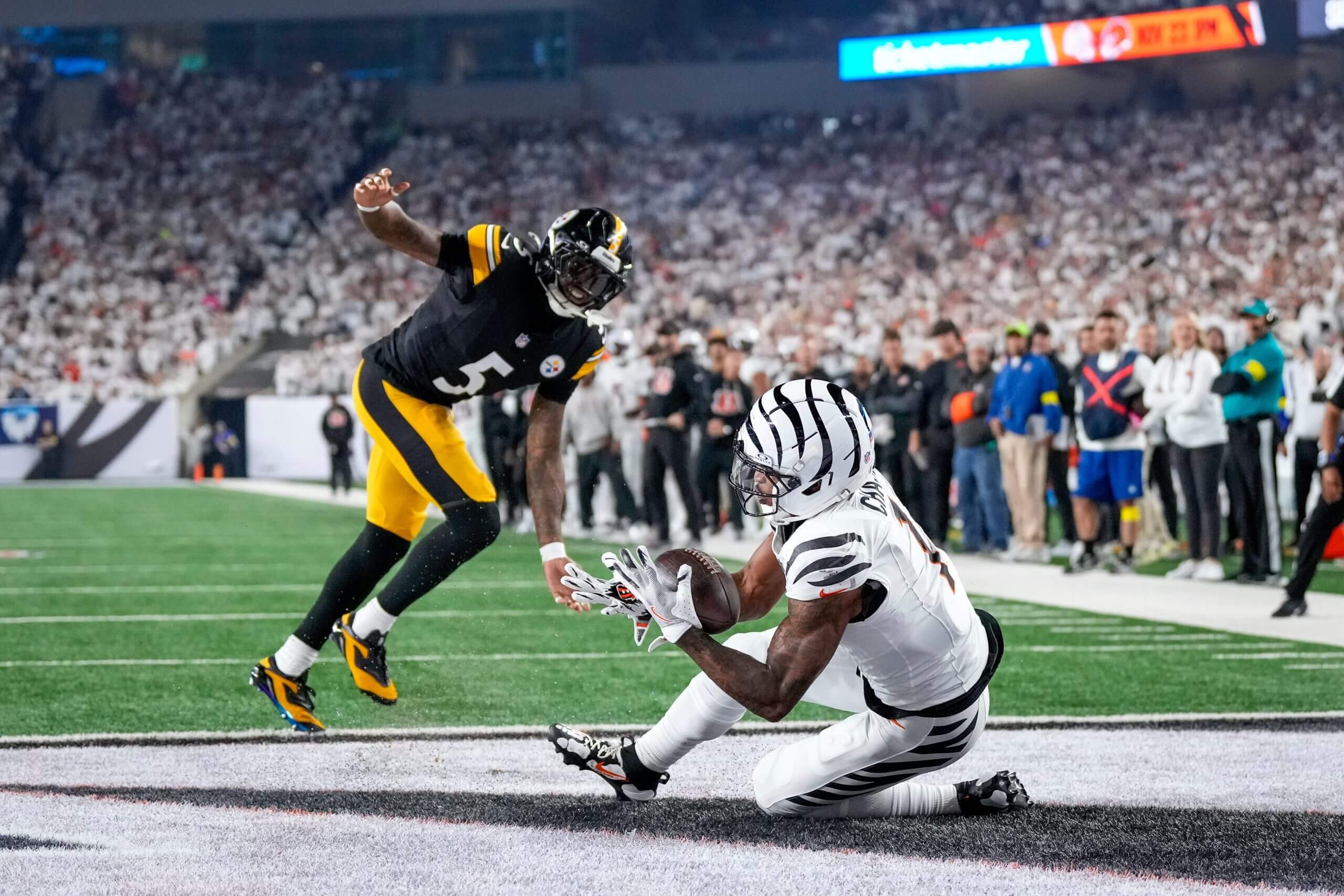
In critical moments against formidable offenses, the Steelers’ defensive strategies have appeared predictable and ineffective. This predictability has been underscored by comments from various players, including Ja’Marr Chase of the Cincinnati Bengals. After a Week 7 victory where he recorded 16 catches for 161 yards and a touchdown, Chase noted, “They did exactly what we was expecting and hoping they’d do.” His remarks highlighted the ease with which offensive coordinators have exploited the Steelers’ scheme.
In the Week 7 matchup, the Steelers employed a blitz while attempting to double-cover Chase. However, the execution was flawed. On one play, cornerback Darius Slay was tasked with covering Chase but was positioned outside, allowing Chase to run a simple slant route unimpeded. With safety Chuck Clark positioned too deep, the blitz failed to disrupt quarterback Joe Flacco, allowing him to deliver an accurate pass to Chase, who was left with ample space to gain additional yards after the catch.
The Steelers’ defensive issues have continued into their subsequent games. Against the Green Bay Packers, they struggled with basic communication and adjustments, leading to breakdowns in coverage. For instance, during a critical moment late in the fourth quarter, the Steelers left Chase uncovered following a motion play, which resulted in another significant gain. This lack of communication has become a recurring theme, with opponents successfully exploiting the Steelers’ failure to adapt to motion and formations.
The Packers capitalized on these weaknesses, notably during a touchdown play where tight end Tucker Kraft found space due to miscommunication between defensive backs. The Steelers’ inability to effectively react to offensive motions has left them vulnerable, as demonstrated by Kraft’s ability to gain 128 yards after the catch in that game alone.
Despite blitzing at the fifth-highest rate in the league—over 21.5 percent of plays—the Steelers have allowed an alarming 312 passing yards on those blitzes, averaging over 12.7 yards per play. The defensive unit’s struggles reflect an ongoing pattern under head coach Mike Tomlin, where talent occasionally masks deeper issues against elite offenses.
As the season progresses, the Steelers’ defense must address its fundamental communication and execution challenges. Without significant improvement, their high-priced investments may continue to yield disappointing returns, jeopardizing their chances in critical matchups. The road ahead requires a reevaluation of strategies and a commitment to adaptability, or they risk falling further behind in a competitive league.