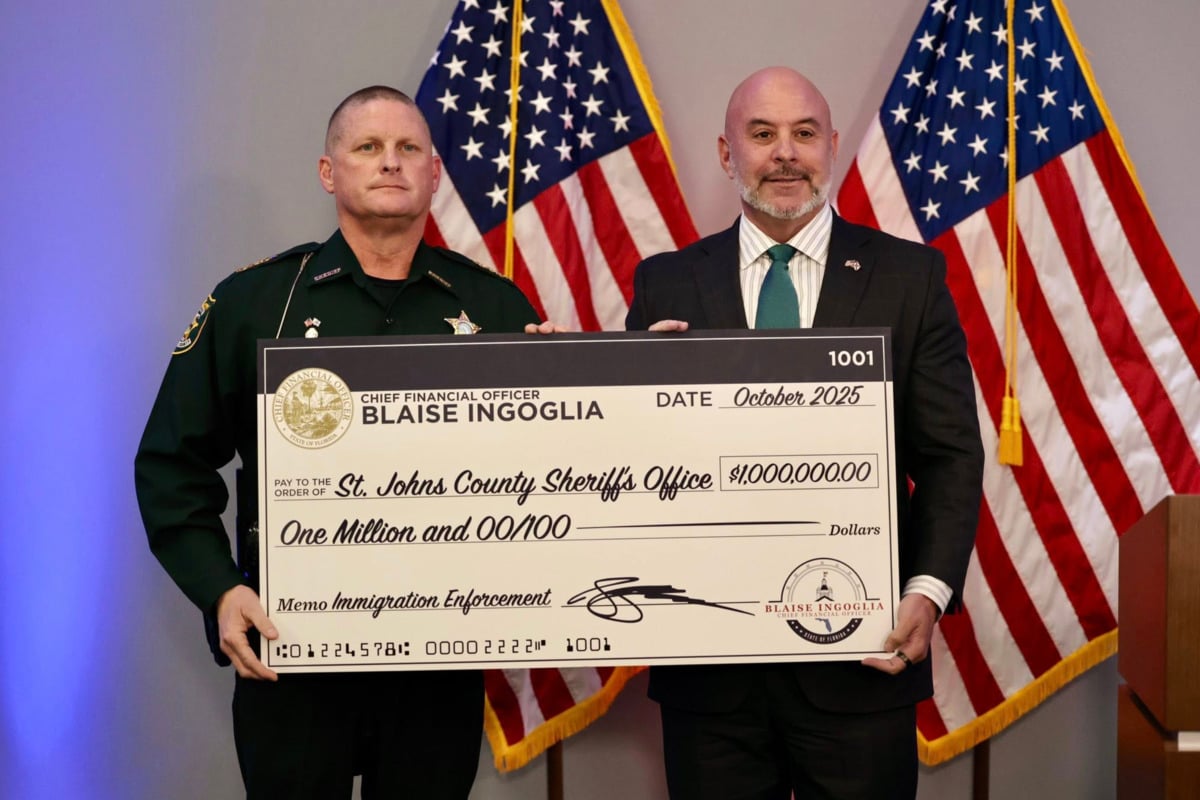
UPDATE: Florida has just allocated over $1.8 million to enhance immigration enforcement through collaboration with U.S. Immigration and Customs Enforcement (ICE). This urgent funding announcement was made by Florida Chief Financial Officer Blaise Ingoglia during a news conference in St. Augustine this week.
The financial boost is primarily aimed at sheriff’s offices in Northeast Florida, allowing local law enforcement to assist in the implementation of the 287(g) program. This program enables local agencies to enforce federal immigration laws in a significant way. The St. Johns County Sheriff’s Office received the largest share, totaling $1 million, which will be utilized for advanced technology and officer incentives.
Additionally, the Clay County Sheriff’s Office is set to receive $606,151, while smaller amounts have been allocated to sheriff’s offices in Jacksonville, Putnam County, and Bradford County. As a result, 104 officers in St. Johns County will be assigned specifically to immigration enforcement roles. This heightened enforcement effort raises pressing questions about its impact on community relations.
Authorities report that since the initiative began on January 23, 2023, the St. Johns County Sheriff’s Office has recorded 710 roadside deportations and 421 deportations of individuals initially jailed on various criminal charges. Meanwhile, the Jacksonville Sheriff’s Office has reported 545 arrests connected to deportation efforts. These statistics reflect the escalating level of immigration enforcement across participating agencies.
The implementation of the 287(g) program has generated mixed reactions. Jacksonville Sheriff T.K. Waters has openly supported the program, citing public safety as a primary concern. State leaders have also thrown their weight behind these initiatives, emphasizing the need for robust immigration enforcement in Florida.
As this story develops, the broader implications for community relations and individual rights remain critical points of discussion. Observers are keenly watching how these funding allocations will translate into action on the ground and their potential effects on the communities involved.
This is a developing story, and further updates will be provided as more information becomes available. Stay tuned for the latest on Florida’s aggressive stance on immigration enforcement.