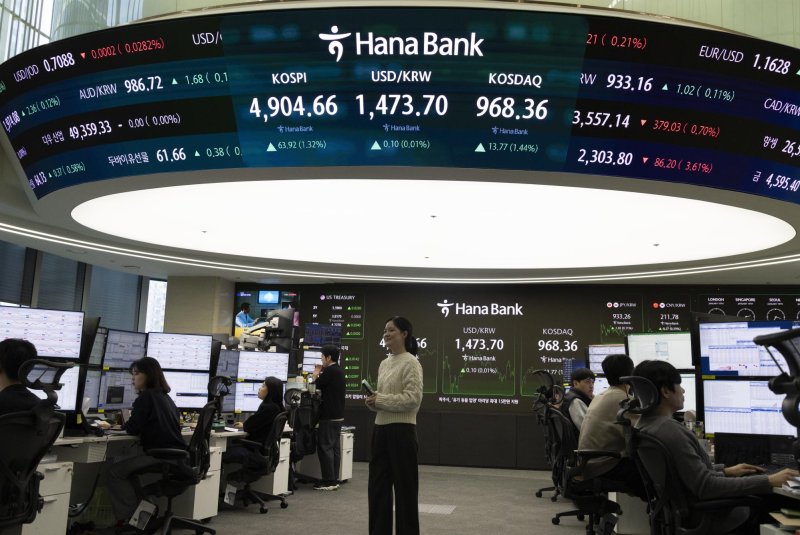
URGENT UPDATE: A significant shift in South Korea’s financial landscape is underway as investors withdraw 35.4 trillion won ($23.9 billion) from major banks, redirecting their cash into the stock market amid a surge in the KOSPI index. Latest data released on January 20, 2023, reveals that demand deposits at the five largest banks—KB Kookmin Bank, Shinhan Bank, Hana Bank, Woori Bank, and NH Nonghyup Bank—have fallen to 673.9145 trillion won ($455.6 billion), marking a 4.99% decrease since the end of last month.
The current trend is raising alarms within the financial sector as cash continues to flow away from traditional banking products. Investors are clearly capitalizing on the KOSPI’s rally, with investor deposits soaring from 77.912 trillion won ($52.7 billion) at the end of November to 91.218 trillion won ($61.7 billion) as of last Friday. This dramatic increase correlates directly with the KOSPI’s rise, which has recently approached 5,000 points.
In addition to the surge in investor deposits, cash management accounts have also seen substantial growth, climbing to 102.9779 trillion won ($69.6 billion) from 98.0722 trillion won ($66.3 billion) over the same period. Market analysts attribute these outflows to a growing preference for securities-related cash, which investors are using to purchase stocks directly.
Banks are responding to this shift by reviving deposit products that offer interest rates in the 3% range, yet they face stiff competition from newly introduced integrated investment accounts (IMAs). Launched in December, IMAs promise principal protection and target returns above 4%. On their first day, 220 billion won ($149 million) flowed into one of these products, highlighting investor interest.
A banking industry official stated that the recent introduction of 3% deposit products reflects an effort to adapt to the “money move” trend. While the decline in time deposits—currently at 938.2555 trillion won ($634.3 billion)—is noted as modest, banks are closely monitoring the situation.
As this situation unfolds, the financial community will be watching closely to see how these trends impact the broader economy and individual investors. The urgency of this financial shift is palpable, with significant implications for both banks and investors in South Korea. Stay tuned for more updates on this developing story.