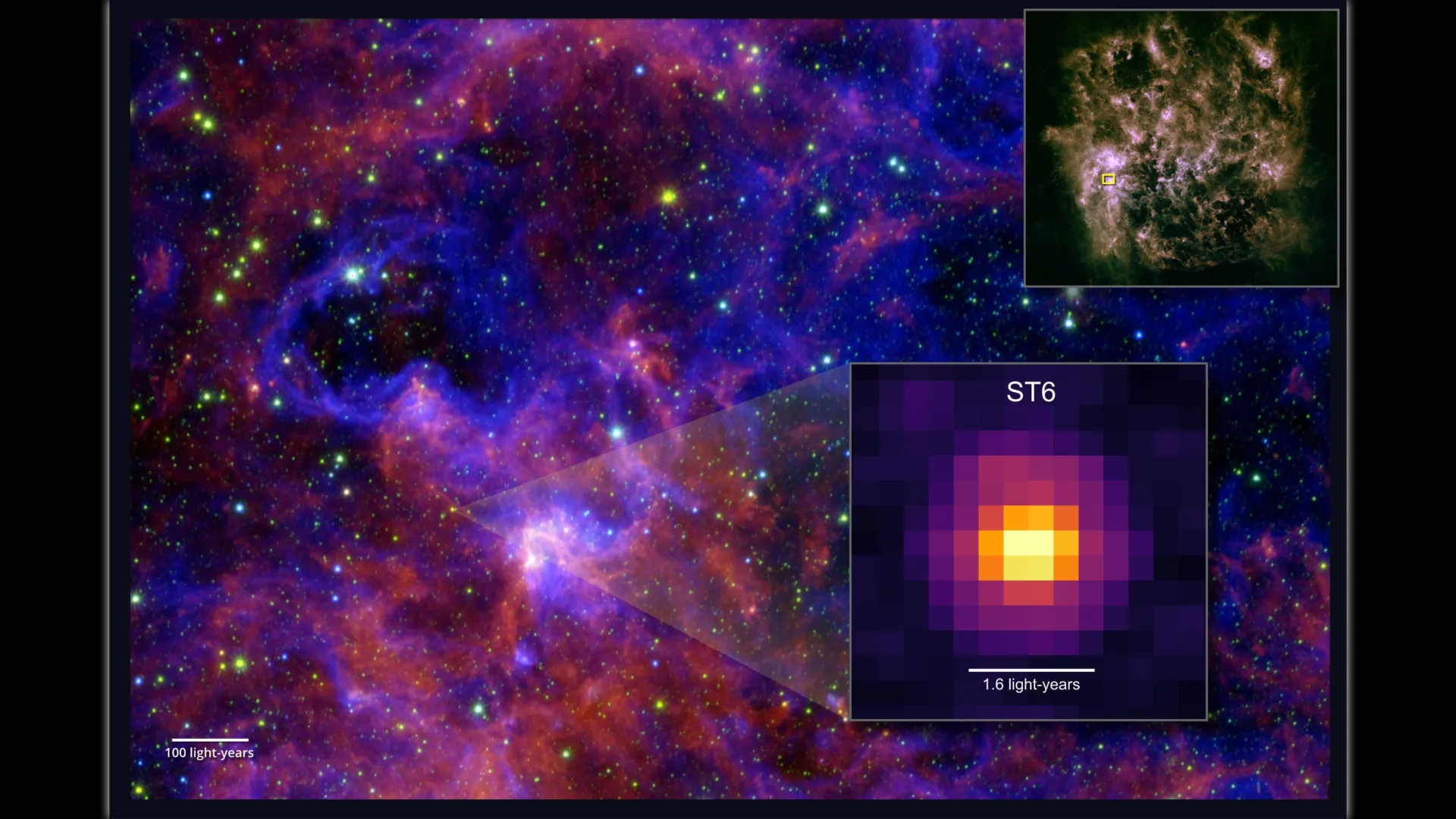
UPDATE: NASA’s James Webb Space Telescope (JWST) has made a groundbreaking discovery, uncovering complex organic molecules frozen in ice around a young star in the Large Magellanic Cloud, located approximately 160,000 light-years from Earth. This finding, announced by a team led by University of Maryland scientist Marta Sewilo, marks the first detection of acetic acid beyond the Milky Way, highlighting a potential new understanding of life’s ingredients in the universe.
This urgent discovery, published in the Astrophysical Journal Letters on October 20, 2025, reveals that the chemical precursors to life may have existed far earlier and in more diverse environments than previously imagined. The research team identified five carbon-based compounds within the ice surrounding a protostar known as ST6, suggesting that the building blocks of life could form in harsh, metal-poor conditions resembling those of the early universe.
“This finding could change how scientists understand the spread of life’s ingredients across space,” Sewilo stated. The detected molecules, including methanol, ethanol, methyl formate, and acetaldehyde, have significant implications for our understanding of cosmic chemistry.
The Large Magellanic Cloud presents an ideal laboratory for studying star formation under conditions similar to those found in the early universe. It has approximately one-third to one-half the heavy elements of our solar system and is bombarded by intense ultraviolet radiation, which creates a unique context for the formation of complex organic molecules.
“Understanding how complex organic chemistry occurs in these primitive environments opens a new window on cosmic chemistry,” Sewilo added. The JWST’s exceptional sensitivity allowed the research team to detect faint spectral features associated with these ices, paving the way for future discoveries.
Prior to this discovery, only methanol had been confirmed in ice around protostars within our galaxy. The new findings suggest that organic compounds can endure through planetary formation processes, potentially creating the right conditions for life to emerge in the cosmos.
The research team plans to extend their investigation by examining additional protostars in both the Large and Small Magellanic Clouds. “We need larger samples to confirm our results that indicate differences in complex organic molecule abundances between these two galaxies,” Sewilo reported. This could lead to vital insights into how life’s building blocks may be universally distributed across the universe.
This discovery does not prove that extraterrestrial life exists, but it significantly enhances our understanding of how organic compounds can form and persist in environments previously thought to be inhospitable. As scientists continue to explore the cosmos, the implications of this research may redefine our understanding of life’s origins and the potential for life beyond Earth.
Stay tuned for more updates on this developing story as researchers delve deeper into the mysteries of the universe.