URGENT UPDATE: A groundbreaking study has just been released that promises to transform the way geological risks are predicted in tunnel construction, with accuracy rates soaring to an impressive 96.8%. This innovative model, developed by researchers from Huazhong University of Science and Technology and Nanyang Technological University, tackles significant challenges in predicting geohazards such as collapses and landslides that often stall projects and threaten safety.
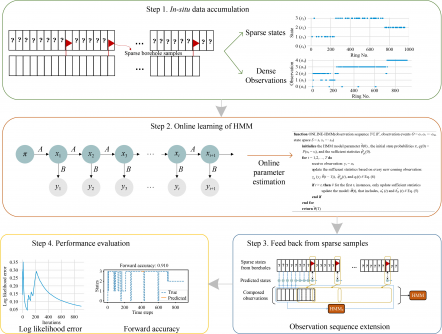
Traditional methods for assessing geological risks have long been limited, relying on either invasive borehole logging or non-invasive geophysical techniques. These older approaches struggle to deliver both the depth and accuracy needed for effective risk management. The new study introduces the online hidden Markov model (OHMM), which adapts in real-time as excavation data is collected, ensuring that predictions remain robust even in the face of uncertainty.
The OHMM utilizes an innovative observation extension mechanism, allowing it to incorporate pre-existing borehole data to enhance predictions. This is particularly critical during the initial phases of tunnel construction, where data is sparse. In a case study focusing on a challenging tunnel excavation project in Singapore, comprising 915 rings, the new model demonstrated a remarkable ability to forecast geological risks ahead of the tunnel boring machine (TBM).
As tunnel construction can span years, the continuous adaptation of OHMM to incoming data positions it as a vital tool for engineers and project managers. When tested with as few as 300 observed rings of data, the model achieved a forward prediction accuracy of 0.968, and even with 600 observed rings, it maintained strong performance at 0.902. This level of accuracy greatly surpasses that of conventional models, making OHMM a game-changer in the industry.
Given the critical importance of geological risk assessment in ensuring the safety and efficiency of tunnel projects, this research holds immense implications. The study underscores the need for modern solutions that can keep pace with the dynamic nature of construction, ultimately safeguarding workers and minimizing project delays.
As the construction industry faces increasing demands for safety and efficiency, the adoption of the OHMM could revolutionize practices worldwide. The authors of the study—Limao Zhang, Ying Wang, Xianlei Fu, Xieqing Song, and Penghui Lin—are calling for immediate implementation of their findings to enhance geological risk management.
For complete insights, the full paper titled “Geological Risk Prediction Under Uncertainty in Tunnel Excavation Using Online Learning and Hidden Markov Model” can be accessed at: https://doi.org/10.1007/s42524-024-0082-1.
Stay tuned for further updates on this vital development in engineering and construction safety. The future of tunneling is not just about digging deeper; it’s about doing so with confidence and precision.