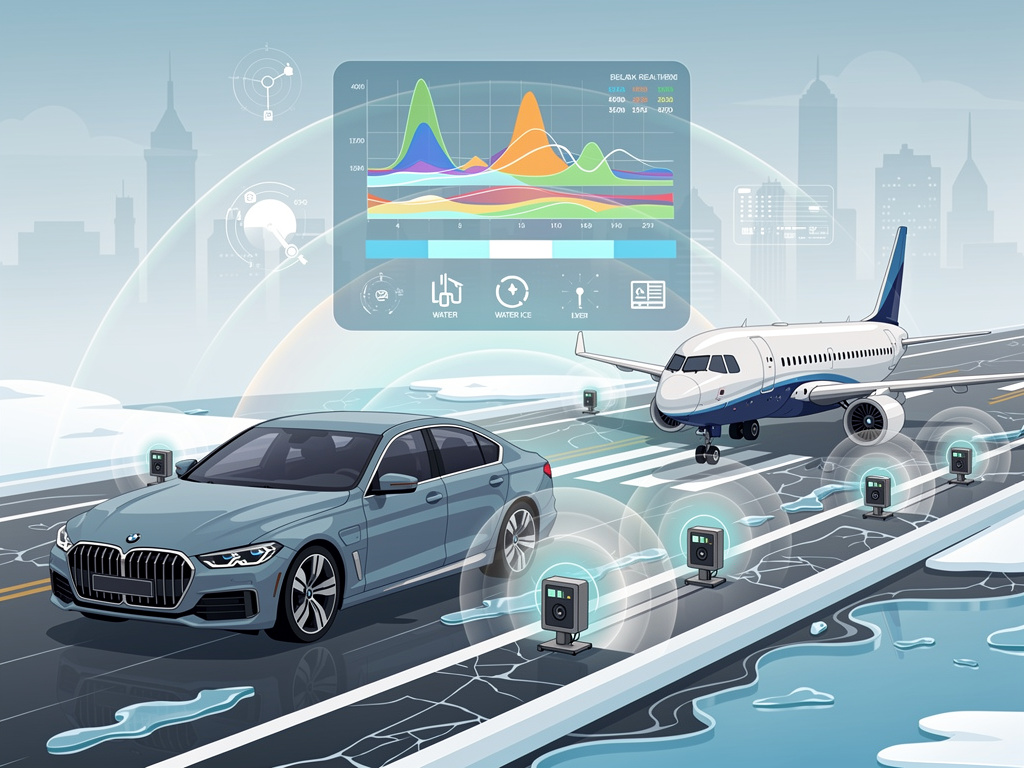
BREAKING: Revolutionary new sub-terahertz sensors are set to dramatically enhance safety for drivers and pilots, effectively eliminating the dangerous “black ice gap.” These groundbreaking sensors, spearheaded by researchers at the University of Sheffield, analyze road surface conditions in real-time, providing critical data that could save thousands of lives annually.
For decades, the automotive and aviation industries have relied on unreliable air temperature readings to assess safety, often leading to catastrophic accidents when black ice forms. This new technology moves beyond temperature guesswork, using sub-terahertz waves to identify hazardous conditions before vehicles even make contact with the ground.
This urgent development comes as the National Highway Traffic Safety Administration (NHTSA) reports that weather-related accidents account for a staggering percentage of annual crashes. Traditional sensors like LiDAR and optical cameras often fail to detect clear ice, contributing to dangerous road conditions. The Sheffield team’s innovation could be a game-changer, transforming vehicles into proactive safety machines.
The implications for autonomous vehicles (AVs) are monumental. Without the ability to detect black ice versus wet conditions, current AV systems are forced to operate in an overly cautious manner, hampering their effectiveness in winter climates. By integrating real-time friction data into their algorithms, AVs can execute micro-adjustments that surpass human capabilities. This predictive analysis will enable vehicles to adjust torque distribution and braking thresholds before traction is lost.
Furthermore, this technology has the potential to revolutionize aviation safety protocols. Pilots currently depend on manual reports for runway conditions, a process that can delay decision-making during critical phases of flight. By equipping aircraft with sub-terahertz sensors, pilots can receive instantaneous updates on runway safety, significantly reducing the risks associated with runway excursions.
The economic impact is also substantial. Airlines face hundreds of millions in losses annually due to de-icing delays, often unnecessary when thin layers of ice form. With accurate readings provided by these sensors, airlines can avoid costly de-icing procedures, improving turnaround times and reducing environmental impact.
The broader implications for the insurance industry cannot be overlooked. The introduction of friction-sensing technology may lead to a restructuring of liability models. Currently, accidents involving black ice are often categorized as “at-fault” collisions. As vehicles become equipped with these sensors, insurance companies may incentivize their use among commercial fleets, similar to the mandates for dashcam technology.
Moreover, municipalities can benefit significantly from this advancement. By embedding these sensors into smart infrastructure, local governments can optimize the deployment of road salt and other treatments, targeting only areas that are transitioning to ice. This precision approach not only saves costs but also aligns with the global push for smart city solutions.
Although the potential is immense, challenges remain. The technology must overcome hurdles related to cost and durability. Historically, terahertz sensors have been bulky and expensive, limiting their application in everyday vehicles. Researchers emphasize that miniaturization and affordability are critical for widespread adoption.
As this technology progresses, the automotive and aviation industries are poised for a transformative shift in safety standards. The urgency of these developments cannot be overstated, with lives on the line. Industry stakeholders, from automakers to insurance providers, must act swiftly to integrate this life-saving innovation.
Stay tuned for more updates on this groundbreaking technology that promises to redefine safety in winter weather. The future of driving and flying is changing NOW, and the stakes have never been higher.