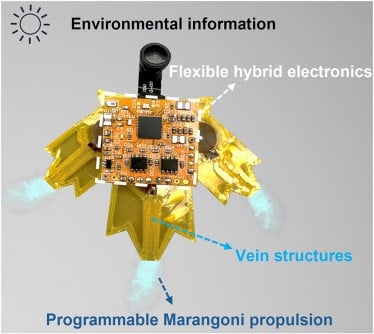
UPDATE: In a significant leap for aquatic robotics, researchers from the University of Macau and Huazhong University of Science and Technology have unveiled innovative “S-aquabots” designed for precise environmental monitoring. These groundbreaking robots, powered by a unique Marangoni motor, are set to revolutionize the way we approach ecological research and disaster response. The study, published online in eScience in May 2025, showcases the robots’ advanced capabilities in a compact form.
These centimeter-scale S-aquabots utilize ethanol-fueled propulsion to achieve silent, energy-efficient mobility. They can navigate complex environments, avoid obstacles, and even collect pollutants, making them vital for long-term outdoor monitoring. Researchers demonstrated their programmable control through a series of maneuvers, including U-turns and trajectory tracking, proving their adaptability in real-world applications.
The Marangoni effect—a principle seen in nature where beetles move quickly across water—has been effectively harnessed to propel these robots. By releasing ethanol through vein-like channels, the S-aquabots can operate on just 1.2 mL of ethanol for 226 seconds, covering distances of around 5 meters. This design boosts fuel efficiency by a remarkable 3.5 times, paving the way for more sustainable aquatic monitoring technologies.
Prof. Junwen Zhong, the study’s corresponding author, emphasized the implications of this research: “Our leaf-inspired S-aquabots demonstrate how biomimicry and advanced materials can overcome the long-standing challenges of aquatic robotics. The quiet motion and natural camouflage open possibilities for unobtrusive environmental monitoring.”
These innovative robots are equipped with mini-cameras and digital sensors, enabling real-time video transmission and extensive data collection—such as tracking light intensity and air temperature—without disturbing wildlife. Their near-silent operation, at approximately 40 dB, makes them ideal for ecological studies where stealth is crucial.
Looking ahead, there are plans to integrate sustainable energy sources, such as solar cells, to enhance the endurance of these S-aquabots. Their versatility not only supports environmental protection initiatives but also offers potential for search-and-rescue operations in hard-to-reach aquatic environments.
This breakthrough represents a critical step towards creating adaptable, eco-friendly aquatic robots capable of supporting scientific research and disaster response, bridging technological advancement with environmental stewardship. The S-aquabots are set to redefine the future of aquatic robotics, promising a more sustainable and effective approach to environmental monitoring.
Stay tuned for further updates on this developing story as researchers continue to explore the vast potential of these advanced robotic systems.