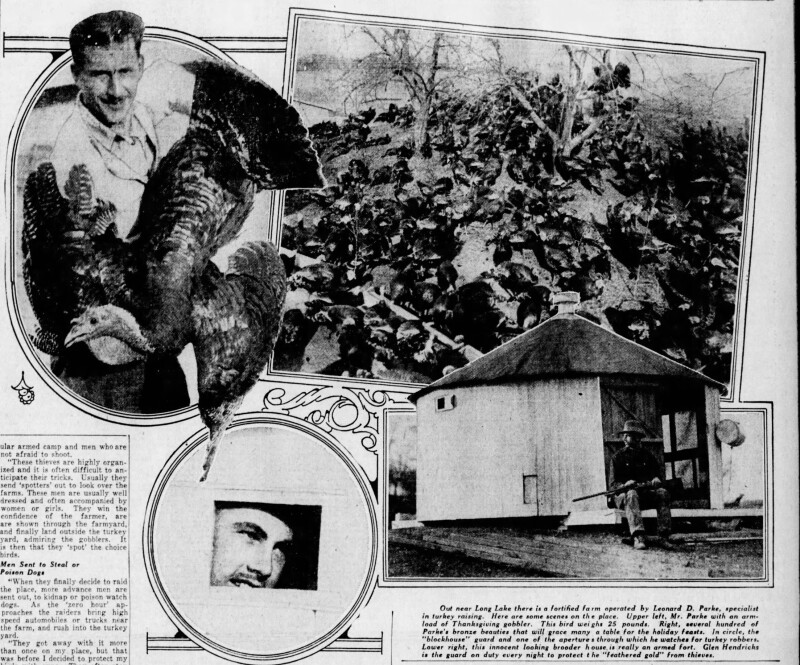
URGENT UPDATE: Thanksgiving, once a time for family feasts, has a dark history of turkey thefts that plagued rural communities for decades. Recent findings reveal that turkey bandits were a significant threat, with farmers across the Midwest facing financial ruin as they scrambled to protect their prized poultry.
In Fargo, North Dakota, authorities confirm that between the late 1800s and early 1900s, turkey rustling was rampant. The People’s Press reported in 1911 that “turkey thieves are abroad in the land,” prompting farmers to take drastic measures to safeguard their flocks. Annual raids were so frequent that they often escalated into violent confrontations, including shootouts.
The significance of these thefts cannot be understated. Turkeys were vital cash crops for family farms, and losing them could mean devastating financial losses. For instance, a 1927 heist left the Murphy family without their breeding stock, a loss that threatened their livelihood.
Shockingly, the Great Depression intensified these crimes. Law enforcement urged farmers to report every incident, as the raids became increasingly organized. One newspaper described an “organized band of scientific chicken and turkey thieves” operating in Aneta, North Dakota, leading to a growing fear among poultry owners.
Farmers resorted to extreme measures to protect their birds. Reports from 1932 detail one Minnesota farmer who lost 123 turkeys because he “neglected to wind his elaborate burglar alarm.” Another farmer transformed his property into a fortress, employing armed guards and barbed wire to deter thieves.
“Speak or I’ll shoot!” became a chilling battle cry as farmers took up arms against suspected thieves. However, in a tragic twist, one farmer mistakenly shot his own pig while trying to apprehend a suspected thief in 1923.
Legal repercussions for turkey thieves varied widely. In South Dakota, one judge handed down an eight-year prison sentence for a turkey thief, while in Minnesota, a thief narrowly escaped prison for stealing four turkeys instead of five. The Grand Forks Herald editorialized in 1929 that no local jury would convict a farmer for killing a turkey thief, highlighting the community’s disdain for these criminals.
Yet, in a surprising turn of compassion, some communities showed grace towards turkey thieves. In 1933, a sheriff in Sisseton, South Dakota, paid for stolen turkeys out of his own pocket after apprehending thieves who confessed to stealing to feed themselves.
Despite the historical challenges, the spirit of Thanksgiving endures. As families prepare for the holiday, it’s a reminder of the struggles faced by farmers in the past and the resilience of communities. Today, while turkey heists have largely faded, the legacy of those who fought to protect their harvests remains a poignant chapter in the Thanksgiving narrative.
As you gather around the table this year, take a moment to reflect on the hardships that shaped the holiday. While the threat of turkey bandits may be a thing of the past, the importance of gratitude and community support is more relevant than ever.