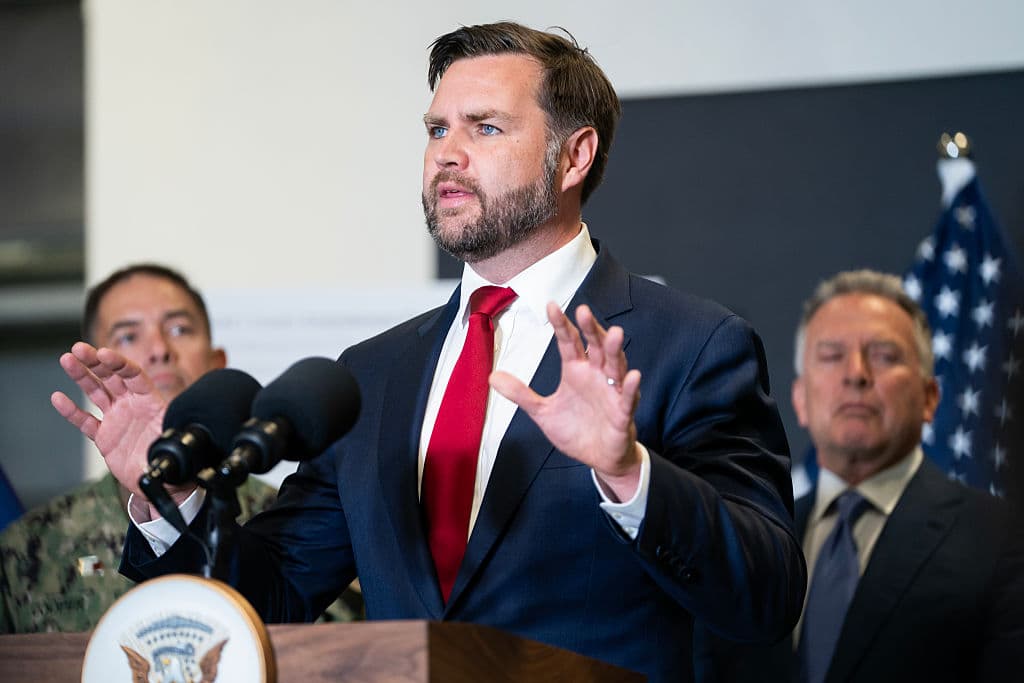
UPDATE: Tensions are escalating as Hamas swiftly regroups in Gaza, posing a significant threat to fragile peace efforts. During his visit to Israel, Vice President JD Vance expressed optimism about the 20-point Gaza plan while acknowledging growing unease among Israelis. The situation is urgent as residents fear that Hamas’s resurgence could unravel ongoing peace negotiations.
Vance addressed reporters at an American military facility in Kiryat Gat earlier today, stating, “It’s not the end, it is, in fact, exactly how this is going to have to happen. We are in a very good place.” However, many Israelis are concerned that the American vision for peace is increasingly disconnected from the realities on the ground.
The potential for new agreements with nations such as Indonesia and Saudi Arabia is on the horizon, as both Vance and Israeli Prime Minister Benjamin Netanyahu suggest. Yet, the recent actions of Hamas, coupled with support from Turkey and Qatar, have intensified fears among Israelis.
Experts warn that the American approach may not align with Israeli interests. According to Doron Matza, a professor at Achva College, the plan involves “too many power centers” and could lead to instability. “There is even a plan for a United Nations Security Council resolution that will establish a Gaza stabilizing force,” Matza noted, casting doubt on the feasibility of these proposals given the context.
The critical difference in strategy is evident. Matza compares the American approach to the Marshall Plan, which aimed to rebuild Germany after World War II, while Israel seeks a more assertive stance. “American and Israeli sensibilities are like two train tracks that progress in parallel lines,” he explained, highlighting the disconnect.
Israel’s immediate concern is the prospect of Hamas remaining the dominant power in Gaza. Recent reports indicate that Hamas has selected many of the “technocrats” who would govern Gaza under the proposed plan, raising alarms in Israeli security circles. Vance emphasized that Israel must approve these candidates before any governance can commence.
“Almost everything that happens in Gaza, Hamas has a hand in it,” stated Joe Truzman, editor of the Foundation for Defense of Democracies’ Long War Journal. He noted that even the selection of technocrats reflects Hamas’s ongoing influence in the region.
While Vance reiterated that reconstruction efforts in Gaza would only occur where Hamas is not present, the U.S. is reportedly pressuring Israel to moderate its military response to Hamas violations. The cease-fire terms are fragile, with hostages still unaccounted for a week after the agreement. Vance warned that “some of these hostages are buried under thousands of pounds of rubble,” complicating recovery efforts.
Former President Donald Trump echoed the urgency, stating on Truth Social, “If [Hamas] do not, an end to Hamas will be fast, furious & brutal!” However, Truzman pointed out that Hamas has yet to acknowledge the requirement to disarm as part of the peace process.
International enthusiasm for confronting Hamas appears low among Arab and Muslim nations considering joining a multinational force in Gaza. The complexities of re-engaging in conflict are evident, as Matza stated, “It’s not like you can flip a switch and you’re back.”
For now, maintaining the cease-fire seems to be the priority for all parties involved, even as it may play to Hamas’s advantage. The developments are unfolding rapidly, and the outcome could significantly impact the region’s stability and the future of peace in the Middle East.
Stay tuned for more updates on this developing story as the situation evolves.