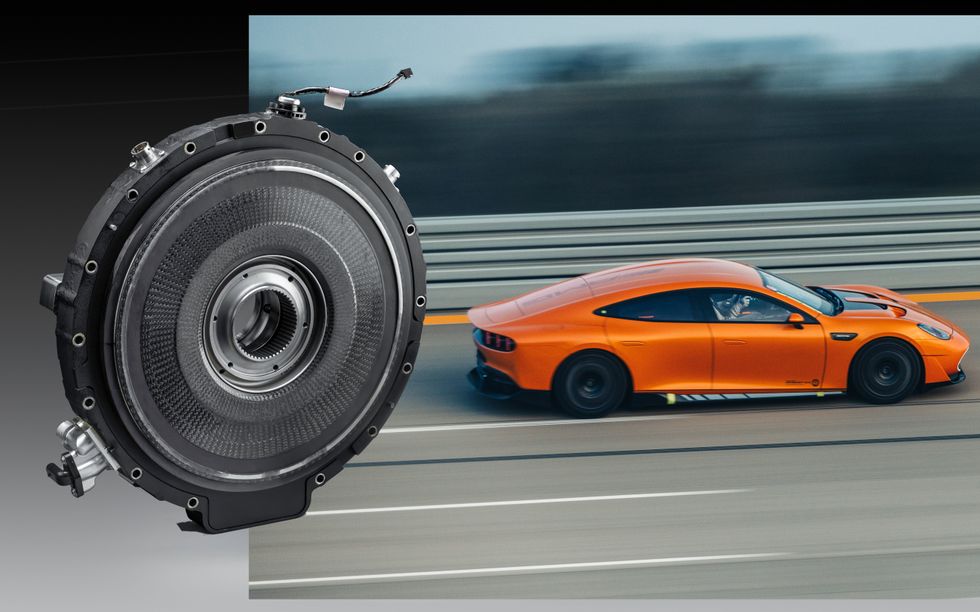
The automotive landscape is undergoing a significant transformation as axial-flux motors gain prominence in high-performance vehicles. Pioneered by the U.K.-based company YASA, these innovative electric motors are becoming a vital component for luxury hybrid supercars, marking a shift from the traditional radial-flux motors that dominate the current market.
Founded in 2009 by Tim Woolmer as a spin-off from his doctoral research at Oxford University, YASA has developed cutting-edge axial-flux motors that are now powering a host of prestigious manufacturers, including Ferrari, Lamborghini, and Koenigsegg. The latest models featuring this technology, such as the Ferrari 296 Speciale and Lamborghini Temerario, showcase remarkable performance, carving through the picturesque roads of Emilia-Romagna, Italy, with impressive speed and agility.
The Lamborghini Temerario, equipped with a gasoline V-8 engine that reaches an astonishing 10,000 rpm, incorporates three YASA motors. This configuration provides all-wheel-drive traction and a combined output of 907 hybrid horsepower (667 kilowatts), enabling the vehicle to achieve a top speed of 343 kph (213 mph). The integration of electric motors enhances acceleration and handling through torque-vectoring, allowing for seamless cornering and exceptional driving dynamics.
YASA’s axial-flux motors are not limited to supercars; they are also making waves in aviation and maritime sectors. The Rolls-Royce Spirit of Innovation, the world’s fastest electric plane, utilized three YASA motors to reach a record speed of 559.9 kph (345.4 mph). Furthermore, Jaguar set a maritime electric speed record of 142.6 kph (88.6 mph) in 2018 using YASA motors, showcasing their versatility across different forms of transport.
YASA’s motors boast a claimed power density that is three times greater than Tesla’s leading designs. In August 2023, the Mercedes-AMG GT XX prototype, powered by three YASA motors, set numerous endurance records. It maintained a speed of 186 mph (300 kph) while covering a distance equivalent to the Earth’s circumference—40,075 kilometers (24,902 miles)—in just 7.5 days, including charging stops at 850 kilowatts.
The acquisition of YASA by Daimler in 2021 has set the stage for mass production of these high-performance motors. A new facility in Berlin is being retrofitted to produce up to 100,000 YASA motors annually, targeting the high-performance segment of the market, particularly through Mercedes-AMG.
The latest YASA motor prototype generates a peak output of 750 kilowatts (1,005 horsepower) while weighing only 12.7 kilograms (27.9 pounds). This remarkable power density of 59 kilowatts per kilogram is an unofficial world record for electric motors, positioning YASA as a leader in the industry.
The unique design of YASA’s motors, which features dual rotors arranged axially, allows for greater torque generation compared to traditional radial-flux motors. This configuration not only enhances performance but also facilitates a more compact design, making it ideal for integration into hybrid systems and electric vehicles. The motors’ lightweight construction can potentially reduce the overall weight of electric vehicles by at least 200 kilograms, providing further efficiency gains.
YASA’s innovative use of a Soft Magnetic Composite (SMC) material in its motors eliminates the need for heavy iron or steel components. The SMC allows for intricate designs and reduces energy losses, enhancing overall efficiency. This material innovation has been critical in the development of YASA’s axial-flux motors, enabling the company to produce lightweight and high-performing electric motors that are paving the way for the future of transportation.
The company recently expanded its operations with a new “super factory” in Yarnton, capable of producing over 25,000 motors annually. This expansion has been supported by the British Advanced Propulsion Centre, which aims to foster advancements in zero-emission transportation to meet environmental targets.
As YASA continues to lead the charge in axial-flux motor technology, the implications for the automotive industry are profound. The transition to these high-performance motors not only enhances the capabilities of supercars but also sets the stage for more efficient and sustainable electric vehicles in the future. The ongoing collaboration between industry and academia underscores the importance of innovation in achieving the next generation of transportation solutions.