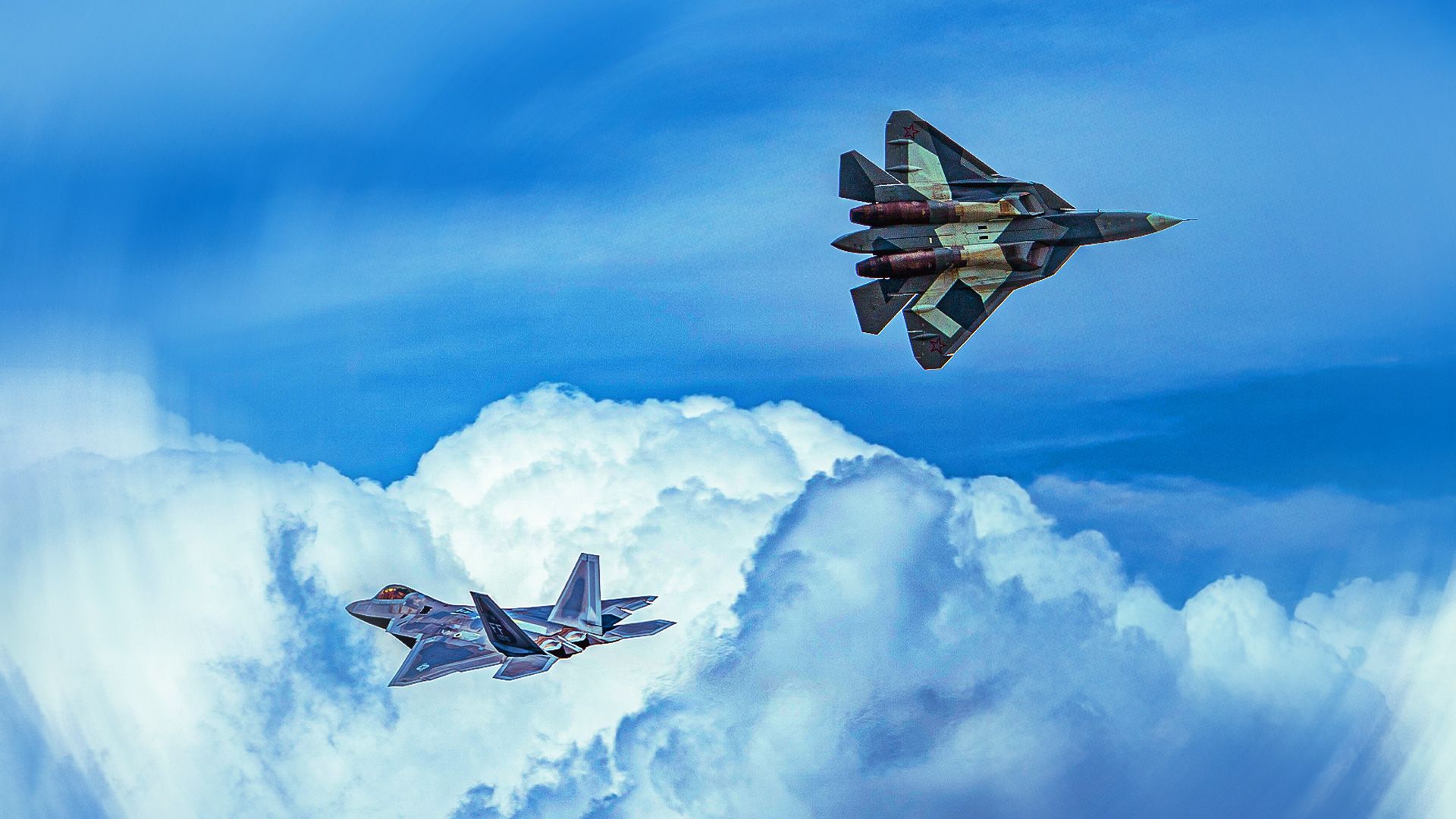
The competition between the Lockheed Martin F-22 Raptor and the Sukhoi Su-57 Felon highlights the evolving landscape of fifth-generation fighter jets as of 2025. The F-22, a stalwart of the United States Air Force (USAF), has been operational since December 15, 2005, while the Su-57, introduced to the Russian Aerospace Forces (VKS) in December 2020, represents a more recent entry into this elite category of military aviation. Both aircraft are designed for multirole operations and incorporate advanced stealth technology, positioning them as critical assets for their respective nations.
The F-22 Raptor, known for its unmatched stealth capabilities, enables the U.S. to project air dominance globally. This fighter jet has the smallest radar cross-section of any operational aircraft, making it extremely challenging for adversaries to detect. Its design incorporates radar-absorbent materials and internal weapon bays, ensuring that armaments remain concealed from enemy radar systems. The jet’s AN/APG-77 active electronically scanned array (AESA) radar provides superior targeting and situational awareness, allowing for its “first look, first shot, first kill” operational doctrine.
Specifications of the F-22 Raptor include:
– Crew: 1 pilot
– Engines: 2 × Pratt & Whitney F119-PW-100
– Maximum Speed: Mach 2-class (2,120 km/h / 1,317 mph)
– Production Run: 1996 – 2011
– Total Number Built: 195
While the F-22 is a symbol of technological excellence, its cost is significant. With a flyaway cost of approximately $143 million, the overall expense, including research and development, can reach up to $350 million per aircraft. The limited production, capped at 187 units, results from high development costs and a lack of foreign military sales, as the U.S. seeks to protect the jet’s advanced technology.
The Su-57 Felon, developed to replace the Su-27 Flanker family, represents Russia’s most advanced fighter jet. It completed its maiden flight in 2010 and has been in limited production since entering service. Despite facing production challenges, the Su-57 is designed to balance stealth, maneuverability, and multirole capability. The aircraft features an N036 Byelka AESA radar system and can accommodate a wide range of munitions, including air-to-air missiles and precision-guided bombs.
Key specifications of the Su-57 Felon include:
– Crew: 1 pilot
– Engines: 2 × Saturn AL‐41F1 or Izdeliye-30
– Maximum Speed: Mach 2-class (2,120 km/h / 1,317 mph)
– Estimated Number Built: Around 40
Despite being in full production, the Su-57’s output has been limited, partly due to Western economic sanctions and technical complications. With an estimated unit cost of $50 million, the Su-57 presents a more affordable option compared to the F-22. However, its operational impact has been minimal thus far, as Russia grapples with production hurdles.
The differences in design philosophy between the two aircraft are notable. The F-22 prioritizes stealth and first-strike capabilities, while the Su-57 emphasizes versatility and adaptability. The F-22’s radar cross-section is an impressive 0.0001 m2, compared to the Su-57’s 0.5 m2, showcasing the former’s advanced stealth features. Conversely, the Su-57’s larger payload capacity allows for diverse mission roles, reflecting its design focus.
Operational costs further highlight the economic considerations for both aircraft. The F-22’s cost per flight hour can exceed $80,000, while the Su-57 operates at around $24,000 per hour. This disparity underscores the economic challenges faced by the U.S. military, which has seen production targets for the F-22 significantly reduced.
Both the F-22 and Su-57 programs have encountered hurdles in production. The F-22’s operational experience has been primarily in ground support missions, and its production was capped at 187 units due to high costs and the decision to keep its technology classified. In contrast, the Su-57’s development has faced technical setbacks and delays, leading to a low production rate that currently hovers around 40 units.
As the landscape of aerial combat continues to evolve, both the F-22 Raptor and Su-57 Felon remain pivotal in their respective military strategies. The F-22, while superior in stealth and air-to-air capabilities, faces economic challenges that limit its production and deployment. The Su-57, despite its production issues, may offer a more versatile and cost-effective solution for the Russian military if it can overcome existing hurdles.
In conclusion, the competition between these two fifth-generation fighters illustrates the complexities of modern aerial warfare. Each aircraft has its strengths and weaknesses, shaping the air superiority strategies of the United States and Russia as they prepare for future conflicts.