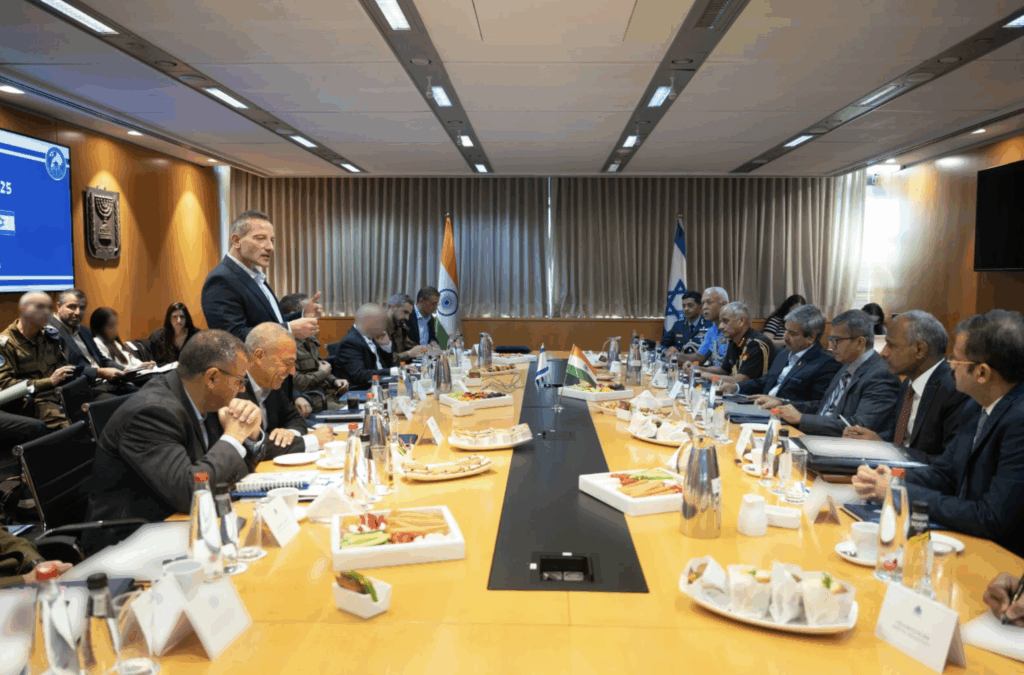
Jerusalem witnessed a significant step in international defense collaboration as India and Israel signed a new Memorandum of Understanding (MOU) on defense technology on October 24, 2023. This agreement aims to bolster defense, industrial, and technological cooperation between the two nations, reflecting their evolving strategic partnership. The announcement came during the annual meeting of the Joint Working Group (JWG) of Israel and India, highlighting the commitment to deepen ties in these crucial areas.
Amir Baram, the Director General of Israel’s Ministry of Defense, emphasized the importance of this partnership, stating that it is built on “deep mutual trust and shared security interests.” He characterized India as a “first-rate strategic partner,” indicating a strong desire to expand collaboration in defense, technology, and industry. While specific outcomes from the MOU remain unspecified, discussions during the meeting included interactions between the Indian delegation and CEOs from prominent Israeli defense firms.
The defense giants of Israel, including Rafael Advanced Defense Systems, Israel Aerospace Industries, and Elbit Systems, have a history of working with India, often through joint ventures that align with India’s “Make in India” initiative. Over the past decade, Israeli defense industries have engaged in substantial projects involving air defense and unmanned aerial systems (UAS), with contracts valued in the billions of dollars.
During the JWG meetings, Israeli industry leaders presented innovative technologies and projects, aimed at fostering deeper industrial-defense partnerships with India. The Israeli delegation comprised senior officials from multiple defense ministries, including the Political-Military Bureau and the Directorate of Defense Research and Development (DDR&D). The Indian delegation also included high-ranking representatives from the Ministry of Defence and the Armed Forces, underscoring the significance of this collaboration.
Focus on Air and Missile Defense
A notable aspect of this partnership is the potential alignment with India’s recent defense initiatives. On August 15, 2023, Indian Prime Minister Narendra Modi announced the launch of Mission Sudarshan Chakra, aimed at developing an integrated air and missile defense system for India. Given Israel’s expertise in missile defense, this area could see enhanced collaboration under the new MOU.
While Gideon Sa’ar, Israel’s Foreign Minister, was unavailable for the signing due to his travel to India, he emphasized the shared challenges both nations face, particularly regarding terrorism. In discussions with Subrahmanyam Jaishankar, India’s Minister of External Affairs, Sa’ar expressed gratitude for India’s support during the recent conflict in Gaza, particularly after the Hamas attack on October 7, 2023. He described the existing relationship as a “warm friendship” and expressed a commitment to developing a long-term strategic partnership.
In addition to bilateral cooperation, Sa’ar discussed regional initiatives such as I2U2, which includes India, Israel, the United Arab Emirates, and the United States, and the India-Middle East Economic Corridor (IMEC). He articulated a vision of promoting connectivity between South Asia, the Middle East, and Europe.
Expanding Market Reach
Israel’s proactive approach to enhancing defense ties with India is part of a broader strategy to expand its market presence in Asia. Israeli defense companies have recently showcased their capabilities at international exhibitions, such as the ADEX in Seoul from October 17-24, 2023. The participation of major Israeli firms, alongside smaller entities like SDC and Ophir Optronics, reflects a concerted effort to establish partnerships and explore new markets for defense technologies.
The new MOU between India and Israel marks a pivotal moment in their defense relationship, with expectations of substantial developments in the coming years. As both nations navigate shared security challenges, their collaboration promises to strengthen not only their bilateral ties but also their roles in regional and global stability.