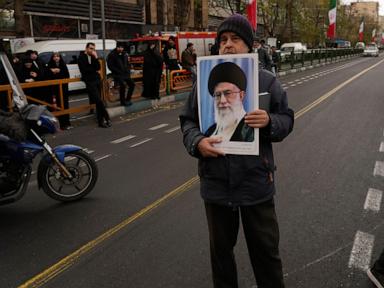
Iran’s Supreme Leader, Ayatollah Ali Khamenei, labeled U.S. President Donald Trump a “criminal” for his support of protesters in Iran, blaming the demonstrations for thousands of deaths. In a speech aired on state television, Khamenei claimed that the protests, which erupted on December 28, 2022, have resulted in “several thousand” fatalities, marking the first time an Iranian official has acknowledged such large-scale casualties from the unrest.
Khamenei accused Trump of inciting violence, stating, “In this revolt, the U.S. president made remarks in person, encouraged seditious people to go ahead and said: ‘We do support you, we do support you militarily.’” He reiterated long-standing accusations that the United States seeks to dominate Iran’s political and economic landscape. “We do consider the U.S. president a criminal, because of casualties and damages, because of accusations against the Iranian nation,” he added.
In a swift rebuttal, Trump called for an end to Khamenei’s nearly four-decade rule. In an interview with Politico, he described Khamenei as “a sick man who should run his country properly and stop killing people,” asserting that Iran is “the worst place to live anywhere in the world because of poor leadership.” He urged for new leadership in Iran, reflecting a growing frustration with the Iranian regime.
Khamenei’s remarks followed a day of mixed signals from Trump, who had previously praised Iran for allegedly canceling the execution of over 800 prisoners. The U.S. president did not provide details regarding how he verified this information. Iranian officials, however, dismissed Trump’s comments. Ali Salehi, Tehran’s Prosecutor General, stated, “Trump always makes futile and irrelevant statements. Our attitude is severe, preventive and fast,” without providing additional context.
As protests spread across Iran, which were mainly fueled by economic grievances, Trump issued statements indicating support for demonstrators and threats of action against the Iranian government if violence continued. Khamenei responded by claiming that rioters were armed with imported ammunition, although he did not specify which countries supplied these arms. He emphasized that Iran does not seek war yet vowed to pursue international offenders linked to the unrest.
The ongoing protests have resulted in a staggering death toll, with the U.S.-based Human Rights Activists News Agency reporting at least 3,095 fatalities. This number surpasses fatalities from previous protests in Iran and evokes memories of the chaos surrounding the 1979 Islamic Revolution. The agency has maintained a reliable network of contacts within Iran to verify casualty figures, although independent confirmation by external sources remains challenging.
In response to the protests, Iranian authorities have implemented a strict crackdown. Recently, the Iranian government restored limited internet access after a nationwide blackout intended to stifle the unrest. Some users reported the resumption of text messaging services and access to local websites, though international connectivity remained sporadic. Observers noted that the government may have reinstated these services as businesses were severely affected by the communication blackout.
Although protests have reportedly subsided, calls for renewed demonstrations have emerged. Reza Pahlavi, the exiled Crown Prince of Iran, urged citizens to take to the streets again, but initial reports indicated low participation. Pahlavi, whose father was overthrown in the 1979 revolution, has struggled to garner significant support within Iran, despite his backing from certain segments of the Iranian diaspora.
In the backdrop of these escalating tensions, Iranian President Masoud Pezeshkian engaged in discussions with Russian President Vladimir Putin, voicing accusations against the U.S. and Israel for meddling in Iranian affairs. The Iranian leadership continues to frame the unrest as an external conspiracy, further complicating the already tense geopolitical landscape in the region.
As the situation evolves, the international community watches closely, aware that the ramifications of these protests and the subsequent crackdown may have long-lasting implications for Iran’s internal stability and its relations with the West.