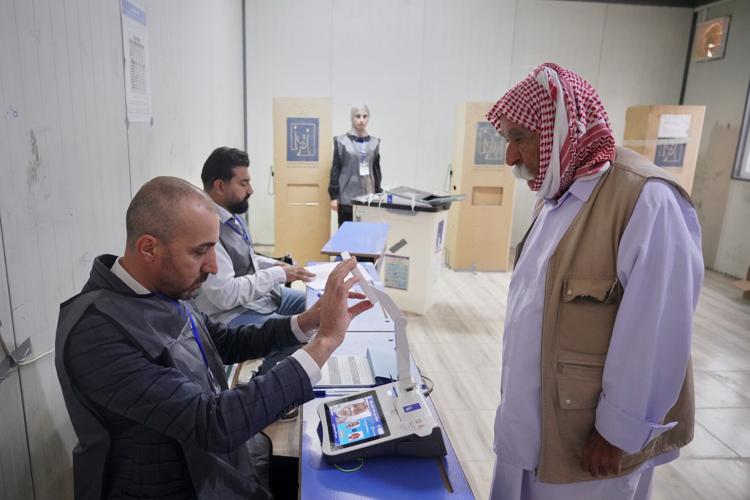
Members of Iraqi security forces and displaced individuals, including many from the Yazidi minority, participated in early voting on March 10, 2024, ahead of the upcoming parliamentary elections in Iraq. This election is critical as it could determine whether Prime Minister Mohammed Shia al-Sudani secures a second term amidst ongoing regional tensions involving Iran and Israel.
Approximately 1.3 million army and security personnel, along with around 26,000 displaced individuals, are eligible to cast their votes. With 7,744 candidates vying for positions, the elections feature a landscape dominated by sectarian-aligned parties. Election day is scheduled for March 12, 2024.
Yazidis Vote Amid Ongoing Challenges
The Yazidis, many of whom were forced from their homes over a decade ago due to attacks from the Islamic State group, voted at a camp near Dohuk in the semi-autonomous Kurdish region of northern Iraq. Despite some returning to Sinjar, the community continues to face significant obstacles, including political disputes and inadequate infrastructure for rebuilding their homes.
A polling station set up in a small school in Dohuk remained quiet until after 09:00, when voters began to arrive, some with worn identification cards and others assisting elderly relatives. Inside, numerous monitors from competing parties and candidates observed the voting process.
“Eleven years passed and the situation is the same,” said Khedhir Qassim, a displaced Yazidi from Sinjar, expressing his disappointment in the political system. “We want them to support us and rebuild our areas that are ruined due to their political dispute.”
Edris Zozani, another displaced Yazidi, indicated his support for the Kurdish Democratic Party (KDP), one of Iraq’s two main Kurdish parties. “If we have independent Yazidi candidates, they wouldn’t be able to represent us effectively,” he stated. “But if they go to parliament as part of strong lists, like the KDP, they would be in a better position to support the Yazidi community.”
Voting in Baghdad and the Role of Militias
In the Iraqi capital, both soldiers and police members participated in voting, alongside members of the Popular Mobilization Forces (PMF). This coalition, primarily composed of Iran-backed Shiite militias, was established to combat the Islamic State and was formally integrated into the Iraqi military in 2016, although it operates with considerable autonomy.
The future of the PMF is expected to be a contentious issue for the next parliament, especially given the complex relations between Baghdad and Washington regarding the presence of Iran-aligned militias in Iraq. The parliament is currently evaluating legislation that could further entrench the relationship between the military and the PMF, a move that has drawn criticism from the United States.
“I voted for the list that defends the PMF,” said one militiaman in Baghdad, who spoke on the condition of anonymity as he was not authorized to speak to journalists. He did not specify which list he referred to.
As the elections approach, the political landscape remains fraught with challenges. Many displaced individuals and minority groups like the Yazidis continue to seek representation and support amidst persistent instability and uncertainty in their regions.
The outcome of the elections could significantly influence the future of Iraq, as well as the delicate balance of power in a region marked by conflict and political strife.