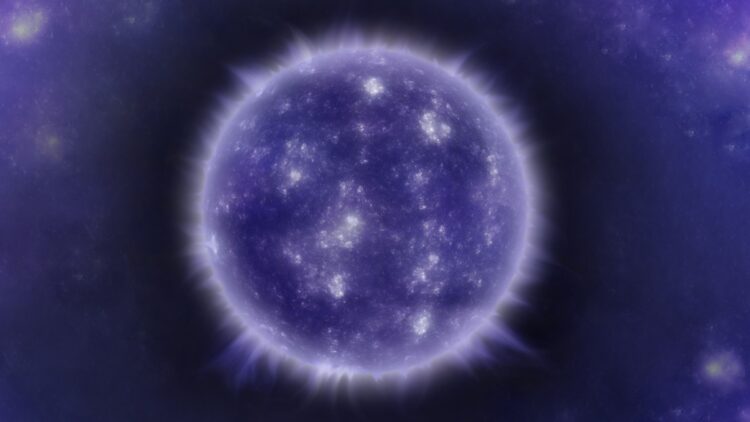
A team of researchers utilizing the James Webb Space Telescope (JWST) has potentially identified a new class of cosmic object known as supermassive dark stars. This groundbreaking discovery, if confirmed, could provide crucial insights into longstanding mysteries in physics and cosmology. The researchers detected what they describe as the “smoking gun” of a dark star, characterized by a core of dark matter particles that engage in self-annihilation.
Astrophysicist Cosmin Ilie from Colgate University in the United States noted that this marks the first instance of a possible dark star signature being detected through light absorption at a wavelength of 1,640 Angstroms. This wavelength is directly associated with dark stars, emerging from helium that has been individually ionized within their atmospheres.
Understanding Dark Stars
The term “dark star” can be misleading, as it does not imply that these objects do not emit light. Rather, dark stars are massive, fluffy clouds predominantly composed of hydrogen and helium. Unlike conventional stars such as the Sun, which generate energy through nuclear fusion, dark stars operate through processes involving dark matter particles. Ilie elaborated, stating, “Supermassive dark stars are extremely bright, gigantic, and fluffy clouds that resist gravitational collapse thanks to the minimal amounts of dark matter that self-annihilate within them.”
Researchers employed the JWST to observe four of the furthest objects recorded in the universe. Notably, one of these objects exhibited a specific feature in light absorption at the aforementioned wavelength. Although the signal-to-noise ratio for this feature is relatively low, Ilie emphasized its significance, declaring, “It is the first time we have found a possible irrefutable signal of a dark star. Which, in itself, is extraordinary.”
The Emergence of Dark Stars
The exploration of the primitive universe motivated the researchers to investigate these unknown cosmic bodies. Observations revealed what appeared to be objects within massive galaxies that had not yet fully developed, prompting the hypothesis of dark stars. These entities could possess a mass equivalent to 1 million suns and may resemble galaxies in their structure.
Among the four objects studied, one appears to be a concentrated source of light, while the remaining three exhibit a more diffuse nature, suggesting they are dark stars surrounded by nebulas of ionized hydrogen and helium.
The implications of this discovery are substantial. If validated, it could elucidate the nature of dark matter and its interactions, as well as shed light on the formation of early supermassive black holes. Although further observations are necessary to confirm the identities of these objects, the research indicates a potential shift in our understanding of physics.
This study opens the door to answering critical questions surrounding the universe’s composition and behavior. Regardless of the final determination, it appears to challenge existing frameworks in our scientific understanding.